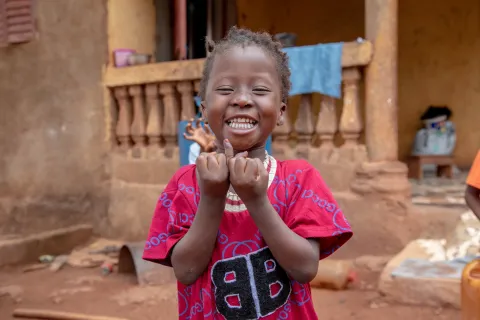
Guinean community mobilises to immunise children against polio
National days of vaccination against the polio epidemic in Guinea

- Français
- English
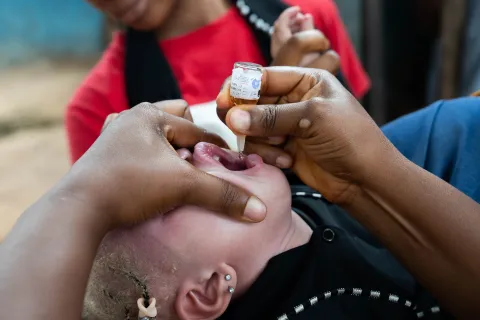
Poliomyelitis remains a serious and disabling disease, but it can be prevented by a simple measure: administering the oral polio vaccine to children, especially those under the age of five. To eradicate polio once and for all, every child must be vaccinated. Unfortunately, thousands of children remain unvaccinated, leading to resurgence of polio epidemics in several countries, including those that eradicated the virus decades ago. Although the Global Polio Eradication Initiative has achieved significant global successes since its launch in 1988, including certification of wild poliovirus eradication in Africa in August 2020, some countries in the African Region, particularly Guinea, continue to report cases of vaccine-derived poliovirus, particularly type 2.
In July 2023, Guinea detected cases of type 2 polio and organised two vaccination campaigns in September and October 2023 to address the situation. Despite these efforts, vaccination coverage surveys showed unsatisfactory results, allowing the disease to persist. To continue the fight against polio, a first round of National Immunisation Days was organised in May 2024, with the aim of vaccinating more than three million children aged 0-5 in the country's 38 health districts.
This initiative takes place in a special context, with several other epidemics such as diphtheria, whooping cough, yellow fever and measles. These days also provide a valuable opportunity to step up routine childhood immunisation and tackle these epidemics.


Antoinette Guilavogui, a vaccinator, explains: "I chose to vaccinate my baby against polio to protect him from this disease. But I can't stand by and watch while other children in my neighbourhood are not protected. My goal is for all children to be vaccinated against polio. That's why, despite the difficult weather conditions - it's very hot at the moment - I went out with my baby to vaccinate the other children, because that's how we can eradicate this disease from our country. What's more, I use my baby's presence to encourage reluctant families to accept vaccination, so that more children can be protected".

André Koulamou, in charge of immunisation at the Koulé health centre in the N'Zérékoré prefecture, points out: "Since every child in Guinea is entitled to the same protection, regardless of where they live, it is our duty to reach them and vaccinate them by any means necessary. That's why we cross rivers in dug-out canoes or use liana bridges to reach children on the other side of the river and vaccinate them. We are determined to continue making these sacrifices until all children in the rural community of Koulé are fully vaccinated."
The National Immunisation Days against circulating poliovirus type 2 (PVDV2c) have received valuable support from partners in the Global Polio Eradication Initiative, including WHO, UNICEF, Rotary International, the US Centers for Disease Control and Prevention, the Bill & Melinda Gates Foundation, Gavi, the Vaccine Alliance, the German Federal Ministry for Economic Cooperation and Development, and the King Salman Centre for Humanitarian Aid and Relief (KSrelief).