Giving every child a healthy life
Ensuring that all children practice good hygiene

AVAKPEDOME, VOLTA REGION, 7 November 2017 - Madam Mary, headmistress of Avakpedome Basic School, spoke with pride about the transformation brought on by the new hygiene practices in the school. The School Based Health Coordinator sat next to her, smiling and nodding in agreement.
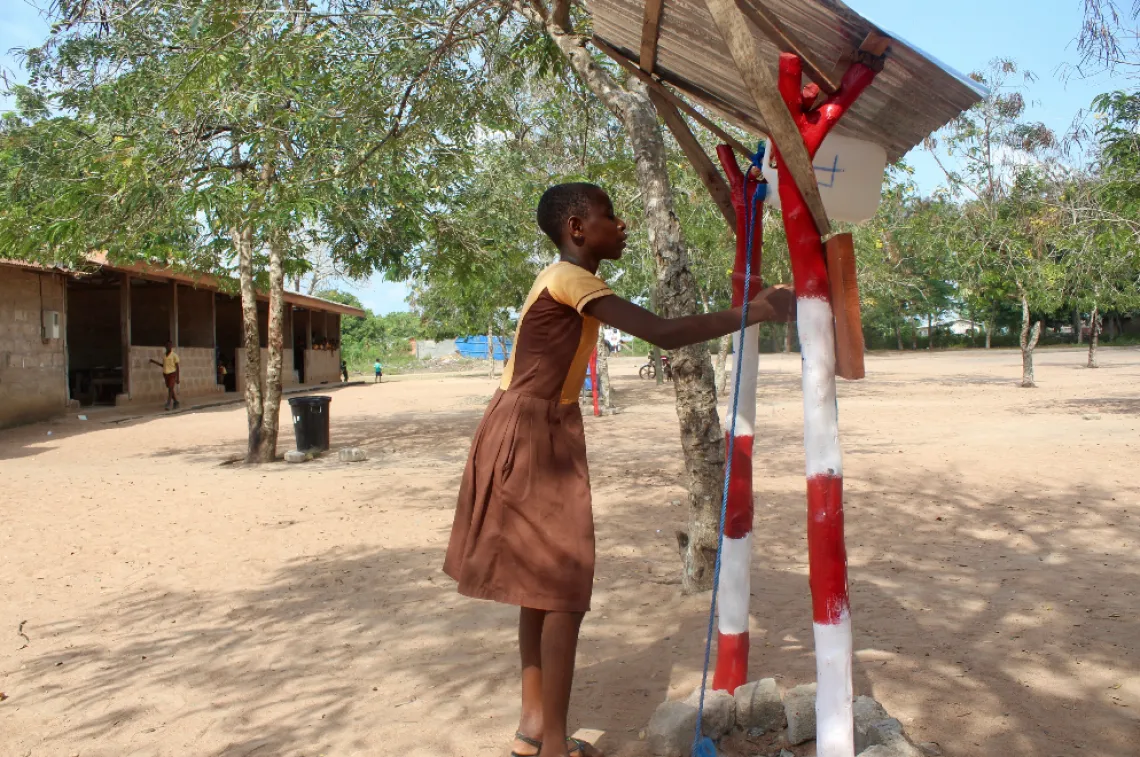
As she explained how the change occurred, a girl emerged from one of the classrooms. She moved very slowly, as though trying not to fall and made her way to one of the six tippy tap stations that were lined up in front of the school. She slowly took one step after the other until she located the one adjacent to her classroom. With her foot, she pressed on the wooden pedal to lower the gallon of water and lifted her hand to find the soap. The Health Coordinator spoke up, “Oh that’s Selassie. She was born blind but surprisingly frequents the tippy the tap more than most of her peers. This a special school. So, we teach some children living with disabilities here.”
The Health Coordinator called Selassie to come closer and asked her to introduce herself.
“My name is Selassie Demenyor, I’m in class three and I’m 13 years old.” She responded.
“How many times have you used the tippy tap today?” Madam Mary asked.
“Twice. This is the second time.”
A year ago, Madam Victoria found it difficult managing the hygiene situation in the school. 314 students excluding teachers had to share two water sources made from medium-sized plastic buckets with an attached tap. “It was challenging! To buy one bucket with a tap and fill it constantly with water was so expensive. I would spend not less a hundred and fifty Ghana Cedis (USD 38) for one. So, I could not afford more than two buckets.”
Handwashing with soap is the most cost-effective method of preventing these diseases. It reduces the effect of diarrhea by 47%.
Selassie continued, “I find it easier to wash my hands regularly in school now. At first, because we had just two buckets for hand washing, one of my friends would have to help me stand in line and wait my turn. That could take a long time. So sometimes, I would give up and decide to return to class without washing my hands hoping I could do it later or after school.”
Selassie shared how she suddenly fell sick in class and got very scared. “I suddenly started vomiting in class and felt so weak. My teacher quickly rushed me home and my mother had to take me to the hospital. It took me four days to recover and return to school.” According to the headmistress, this was a regular occurrence in school before the tippy taps were introduced.
In Ghana, 3,600 die every year from diarrheal related diseases and in 2014 over 200 people died from a cholera outbreak, most of them being children. Hand washing with soap is the most cost-effective method of preventing these diseases. It reduces the effect of diarrhea by 47%. In spite of this, the practice in developing countries like Ghana is low, rarely practiced and difficult to promote.
UNICEF with funding from the UNILEVER Global Fund have supported the Government of Ghana to promote hygiene and hand washing promoted the Tippy Tap in schools. An innovative, low-cost hands-free device made of a gallon, a string, sticks and soap. It is operated by a foot lever which reduces the chances of disease transmission as the user only touches the soap.
The intervention which was designed to induce positive behavior change has been a huge success since its introduction in all 25 districts in the Volta Region with almost every school dotted with tippy tap hand washing stations and the incidence of children contracting diarrhea and cholera reducing drastically.
Madam Victoria continued, I’m very surprised how fast the tippy tap has caught on. The children use it countless times in a day. We don’t even have to prompt them and the best part is they have introduced it to parents and family members so almost every household in the town has a tippy tap. I also don’t have to spend much to build one. The most I’d have to invest is 5 Ghana cedis (1.25 dollars).”
With her leadership, the teachers and students had built 14 tippy tap stations all around the school causing long queues to disappear and more children to excited to use the device over and over.
“I really enjoy using the tippy tap. My favorite part is that I don’t need anyone’s help to wash my hands anymore.” Selassie concludes with a smile.