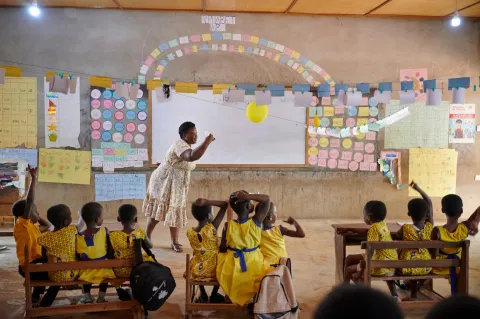
When schools, families, and communities work together, children thrive. That’s the heart of Ghana’s Family and Community Engagement (FCE) approach — a strategy that encourages teachers to connect learning in the classroom with life at home and in the community here.
Across Ghana, FCE is helping teachers and parents build stronger partnerships that support children’s well-being and foundational learning. In Otabilkrom, a small farming community in the Central Region, one dedicated teacher is showing what that looks like in practice.
A Teacher Who Refused to Give Up
Otabilkrom is a farming community located in Ghana’s Central Region with limited infrastructure. Many teachers leave after only a few weeks due to difficult conditions: there is no electricity or clean water, and the housing situation is poor.
But as a Kindergarten teacher, Aaron has taught in this school for 6 years. His commitment goes beyond the classroom walls; Aaron has seamlessly integrated himself into the community. For Aaron, the school is more than just a place for lessons; it serves as a center for connection and change.
"The school should not only be where children learn to read and write; it should also be a space where the whole community comes together to learn, share and grow,"

From Training to Action
In his early days, Aaron struggled to connect with the students' parents. Many never attended school meetings and saw education as the sole duty of the teacher.
Everything changed after he attended a two-day Family and Community workshop organised by the Ghana Education Service in collaboration with UNICEF Ghana. The training inspired him to reimagine how parents and teachers could work together.
Returning to Otabilkrom, Aaron began integrating FCE principles into everyday practice. He organised storytelling evenings and sports games to draw parents to the school, opened his classroom for parents to observe lessons, and invited local artisans and religious leaders to speak to students and share their skills. He encouraged parents’ involvement in school planning and encouraged them to create learning spaces at home using household materials.
Changing Perceptions, Building Trust
The results soon became visible. Parents who had never attended a school meeting began showing up regularly. Some borrowed storybooks to read to their children at home. Others volunteered to demonstrate traditional crafts or farming techniques in class.
Aaron took every opportunity – from community announcements to health outreach events - to discuss learning and child development.
"Once parents saw that we respected their ideas, everything changed. They stopped seeing the school as separate and started seeing it as theirs too,”
This sense of shared responsibility transformed the school into a more inclusive and welcoming place.

The Way Forward
Aaron's story shows how teachers can lead with empathy, creativity, and commitment to bring FCE to life. His experience also highlights the need for system-wide support to allow for lasting change.
He hopes the district education office will expand FCE training for teachers. Additionally, he wants traditional and religious leaders to remain actively involved in school activities.
"The classroom is only one part of the child’s life. If we ignore what happens outside of it, we have already failed."
Aaron’s words serve as an important reminder that learning is not limited to the school environment. It is a shared journey that begins at home, continues in the classroom, and is supported by the entire community.