Gathered in an empty school cafeteria at Jasikan College of Education, my colleague Akua and I asked that question to roughly two dozen trainee teachers. One, maybe two, timid hands went up.
I expected more. Naively, I thought at least a majority would have raised their hands as they are students already enrolled in a training college to become teachers. But that small gesture captured a broader story about teaching in Ghana: many who enter the profession do so not because it was their dream, but because it felt safe, affordable, and reliable
Why many Ghanaian trainee teachers didn’t start with a dream of teaching
As these students opened up, their stories were humbling and instructive. What we heard over the next hour—stories about family pressure, financial constraints, and practicality—was both a reminder and a call to action. One student had wanted to be a midwife but could not afford the training. Another had hoped to study agricultural technologies but chose teaching because it was cheaper. A third had dreamt of journalism but faced family concern over job security.
“There’s a higher demand for teachers than for nurses,” one student shared.

Teaching, for many families, represents stability: a near-certain path to employment in the Ghana Education Service. Teaching may not always begin as a calling, but be chosen out of necessity. Teaching is seen as a safe profession here in Ghana, where almost all graduates will join the Ghana Education Service and be posted to schools as teachers. While teaching salaries globally are notoriously low – a challenge faced in Ghana too – job security is not to be taken lightly.
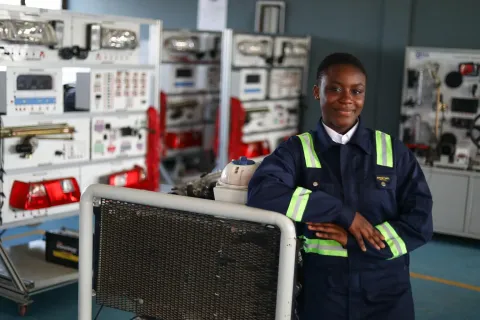
Although it may not have been their first choice of profession, the student teachers at Jasikan seemed genuinely happy to be there. They praised the “hands-on” nature of instruction at the college, with one student noting that he was inspired to come to this college of education so that he could be trained with practical tools to be used later in his own classroom. Others said they felt comfortable enrolling because of the good reviews from family friends who had gone through the teaching program here.


What motivates teachers when systems work
These concerns are not new, and they are echoed in findings from a Teacher Motivation Study conducted in partnership with STiR Education and the Ghana Education Service, with support from FCDO. The study provides a data-driven analysis of what drives and drains motivation among Ghana’s education workforce.
The good news is that Ghana is already implementing several effective initiatives. Both teachers and district officials have highlighted national programs that could improve morale and motivation, including:
- A new Bachelor of Education curriculum that modernises teacher preparation by emphasising practical and skills-based learning.
- A nationwide Continuous Professional Development (CPD) framework that connects training with teacher licensing and career advancement.
- Recognition schemes like the Ghana Teacher Prize, which celebrate outstanding educators and enhance morale within the profession.
These programs support motivational research, which shows that promoting professional growth, autonomy, competence, and purpose is effective. Teachers interviewed for the study said they are motivated by “student success,” “working with peers,” and “leadership opportunities.” These intrinsic motivators often go unnoticed. These internal drives are essential and, significantly, low-cost. We can strengthen them through policies and programs that build a professional culture based on trust, respect, and growth.

The hard limits: why motivation needs infrastructure
Even motivated teachers struggle without basic support. The study highlighted systemic barriers such as delayed salaries, limited autonomy, bureaucratic hurdles, and poor classroom infrastructure, all contributing to burnout. This issue is particularly severe in rural and underserved areas, where teachers face shortages of materials, poor internet connectivity for professional development, and transportation challenges for training. Even the most passionate educators can lose heart when systems don’t support them.


Pride, when nurtured, can lead to something great
I was reminded of this earlier this month on World Teachers’ Day, October 5th, at Ghana’s annual Ghana Teacher Prize event. It was my third year attending, and I every time I am moved by the strong sense of national pride and joy that fills the room. This event is significant: a televised ceremony attended by the Vice President and the Minister of Education, where the best teachers in the country are recognised. The Most Outstanding Teacher wins a three-bedroom house, the first runner-up gets a 4x4 pickup truck, and the second runner-up receives a car.
The excitement goes beyond the prizes. It’s in the atmosphere. When winners are announced, cheers fill the room. Teachers and colleagues jump from their seats, rush to the stage, and dance in celebration—not just for the winner, but for their school, district, and region. It is a heartwarming sight that often brings tears of joy. In those moments, teachers shine. Their pride is clear, and their profession is celebrated.
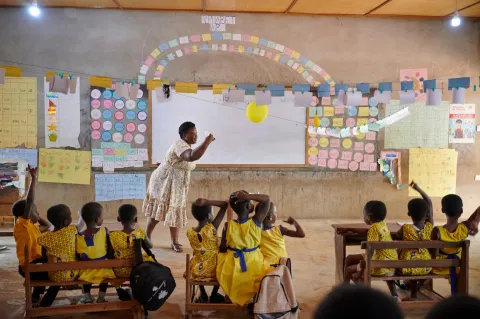
This same pride is evident in the students at Jasikan. They may have entered teaching by chance, but they are learning to see it as a calling. We can maintain this pride through better systems, supportive leadership, and continued praise. This way, Ghana can keep its teachers motivated and ready to support every learner.
As our session in Jasikan ended, Akua asked the students one last question: “How many of you think you might stay in teaching for the long haul?” This time, more hands went up.