UNICEF Executive Board discusses education innovation, child nutrition and funding trends
Second regular session of 2026

NEW YORK, United States of America, 10 September 2026 ─ The 2026 second regular session of the UNICEF Executive Board ended last Thursday. Discussions and presentations during the week ranged from funding trends to governance and oversight to child nutrition. A highlight of the week was an interactive special focus session on education innovation titled “EdTech, Artificial Intelligence and the Learning Revolution: From Promise to Proof.”
Opening the session, UNICEF Executive Board President, H.E. Mr. Rein Tammsaar, Permanent Representative of Estonia to the United Nations, acknowledged 2026 as a milestone year, with the organization approaching the end of the first year of implementation of its new Strategic Plan and set to commemorate its eightieth anniversary of service to children.
“Since 1946, UNICEF has helped to drive some of the greatest advances in human progress,” he said. “But for the first time in a generation, these hard-won gains for children can no longer be taken for granted. Let us unite with UNICEF as it calls upon all of us to reaffirm its mandate and to protect the gains made for children over multiple decades, while making an urgent case for renewed action and investment in their future.”
In her introductory remarks, Executive Director, Ms. Catherine Russell, emphasized UNICEF’s active role in UN80 reform processes, identified urgent development priorities, addressed acute humanitarian crises – including disasters in recent weeks that had devastated communities from Nepal and China to Colombia, Indonesia and the Bolivarian Republic of Venezuela – and expressed deep concern about the organization’s funding environment.
Special focus session: Innovation in education
With millions of children lacking access to quality education and foundational learning, the world faces a deepening learning crisis. Rapid advances in digital technologies, particularly artificial intelligence (AI), offer a significant opportunity to address these challenges – but only if they are used responsibly, with equity, based on evidence and in ways that protect children’s rights.
In this context, the internationally recognized success of Estonia stands as a valuable real-world example of innovation delivering results when applied to education.
The special focus session served as a powerful platform to bring together stakeholders across sectors and geographies to strengthen the UNICEF education agenda – working together to ensure that AI and educational technology are used responsibly and equitably.
Speakers emphasized that AI should support – not replace – teachers, it should be human-centered; that evidence must guide scale up; and that equity, child rights, safety, privacy and inclusion must be built into AI-enabled education from the start. A recurring message was that technology alone is not innovation, the real measure is whether it improves learning outcomes for every child.
In her opening remarks at the start of the Executive Board session, Executive Director Russell paid recognition to Ambassador Tammsaar’s leadership in helping to convene the special focus session and she highlighted the promises and risks of digital technology and AI for children.
“Children today face challenges and opportunities that the founders of UNICEF could only have imagined. Perhaps nowhere is this clearer than in the areas of digital technology and artificial intelligence. AI has extraordinary potential for children, widening access to knowledge, helping children with disabilities, supporting learning and bringing information and services to communities historically left behind,” she said. “But opportunities without safeguards can deepen inequality and cause harm. We have a responsibility to shape those systems now.”
In her keynote remarks, Deputy Minister for Economic and Development Affairs, Estonia, H.E. Ms. Mariin Ratnik, described the country’s long-standing digital education journey, which began with the Tiger Leap programme in 1996. She highlighted Estonia’s development cooperation work in several countries and outlined some of the key principles that should guide AI innovation.
Moderated by Ms. Isabelle Hau, Executive Director of the Stanford Accelerator for Learning, an interactive high-level conversation – including the Minister of Education and Technical Education, Egypt; the General Secretary, Education International; the Vice President, Google Government Affairs and Public Policy, Knowledge and Information Products; and two youth advocates – surfaced concrete insights on innovation applied to education: leveraging AI to boost learning; ensuring that emerging technologies are shaped to support education systems; promoting equitable and inclusive access to digital learning; and safeguarding children’s rights with the safe and ethical use of emerging technologies.
Questions and remarks from delegations focused on youth experience, low-connectivity contexts, language inclusion, rural access, South-South cooperation and the importance of foundational literacy and numeracy as prerequisites for critical engagement with AI.
Funding trends
On Thursday, the Board engaged with UNICEF on resource trends during the agenda item titled “Structured dialogue on financing the results of the UNICEF Strategic Plan, 2022–2025.” Conducted within the framework of United Nations system-wide funding and collaboration – and following several Board decisions – the report that was made available to the Board provided an analysis of past funding, with an eye to the present and future.
After five consecutive years of growth, in 2024 official development assistance (ODA) declined by 6 per cent in real terms, before falling by an unprecedented 23.1 per cent in 2025. This reversed a decade of growth and marked a return to funding levels last seen in 2015. Mirroring the broader ODA trend, UNICEF operated in an increasingly constrained and uncertain funding environment.
Despite this, and in contrast to conservative estimates, UNICEF did better than planned in 2025. This was largely thanks to existing multi-year funding, one-off mitigation measures and a diversified funding model, as well as stronger private sector contributions. The resilience, however, was not read as recovery: UNICEF income for 2026 is projected at $6.46 billion – a 20 per cent step-down – and UNICEF has planned the new Strategic Plan period conservatively, treating the contraction as structural rather than cyclical.
In introducing the agenda item, Kitty van der Heijden, Deputy Executive Director, Partnerships, said that although overall income had remained comparatively strong over the Strategic Plan period, the funding mix had become increasingly misaligned, with 81 per cent of income earmarked and only one dollar in five flexible: public sector core resources fell to one of the lowest levels in the organization’s history, even as over 10 million individual donors lifted private sector core resources to a record $812 million. This limits the organization’s ability to respond quickly to crises, support underfunded contexts, and invest in prevention and system strengthening.
Presenting the report, Mandeep O’Brien, Global Director, Public Partnerships and Resource Mobilization, set out four messages: 2025 marked a structural break, not a dip; UNICEF income held, but flexibility did not; the organization’s resilience rests on two engines — public and private, which complement but cannot substitute for each other; and flexible funding reaches children no other money can. She closed with the message that framed the agenda item: “Budgets can recover – but childhoods cannot.”
Ms. van der Heijden thanked public and private partners, National Committees, individual donors, corporations and foundations, as well as the Governments that had maintained or increased their core contributions to UNICEF in 2025.
Delegations broadly agreed that flexible, predictable and multi-year funding is vital for the organization’s effectiveness, although views differed on how strongly responsibility should reside with Member States versus UNICEF accountability and stewardship. Several delegations supported increasing core and thematic funding, reducing excessive earmarking and restrictions, improving donor visibility and confidence, strengthening transparency, and exploring public-private partnerships, pooled funding, innovative finance and UN80 funding reforms.
New country programmes: Child nutrition
On Wednesday, the Board considered 17 new programme documents: 16 country programme documents (CPDs) and a multi-country programme document. A selection of panellists from Government, civil society, the private sector, the United Nations and youth engaged on the theme “Country programmes driving nutrition progress,” in the context of the 17 documents.
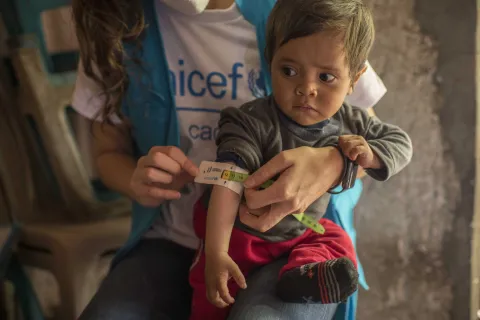
Compared to 1990, 57 million more children are free from stunting and 12 million more from wasting. Despite this remarkable progress, poor food environments and feeding practices are making it harder for families to adequately feed their children. Additionally, a new challenge is emerging: in 2025, childhood obesity surpassed undernutrition among school-age children and adolescents.
“In the Strategic Plan we have a commitment to help 500 children across the world to be well nourished. It’s a core part of our mandate,’ said George Laryea-Adjei, Director of the UNICEF Global Programme Division. “We know there’s been progress in the past 30 years. There are some 57 million fewer children affected by stunting,” he said. Some 12 million fewer children are suffering from wasting. “The task before us is huge.”
Ms. Joan Matji, Global Director of UNICEF Child Nutrition and Development, outlined the current nutrition landscape, highlighting both progress and emerging challenges. She emphasized the importance of policy reform, domestic resource mobilization, localization, youth engagement, partnerships and humanitarian leadership in scaling up nutrition programmes across different country contexts, some of which were presented in the CPDs.
Delegations from the CPD-presenting countries confirmed the alignment of the CPDs with national priorities and framed the programmes as important vehicles for advancing children’s rights, well-being and national development. Several delegations expressed appreciation for UNICEF long-standing cooperation, technical expertise and country-level presence. Many delegations identified maternal and child health, nutrition, immunization, early childhood development and the first years of life as central priorities, with several linking early investment to long-term human capital development and national prosperity.

Key decisions and wrap-up
The Board adopted five decisions that were negotiated during the session, which spanned the areas of programme and policy matters; evaluation, audit and oversight; and resource, financial and budgetary matters. The Board also approved the 17 new programme documents; the Global and Regional Programme document, 2026–2029; and the extensions of 7 ongoing country programmes; and took note of 12 extensions had been approved by the Executive Director.
In her closing remarks, Executive Director Russell said that the week’s discussions had underscored the importance of ensuring that UNICEF has the resources needed to deliver on its mandate. “I’m deeply grateful to the delegations that confirmed contributions during this session and to those who reaffirmed their commitment to prioritizing contributions to UNICEF’s core resources. And I appreciate the strong recognition from members of the Board of the importance of adequate, stable, and flexible funding. As we discussed this week, the continuing decline in core resources is deeply concerning. Your advocacy for core resources matters, and I sincerely thank you for it,” she said.
Ambassador Tammsaar ended the session putting the spotlight on partnerships to achieve tangible change for every child. “The true measure of this session will not be the decisions we have adopted, but how they translate into better outcomes for children – a responsibility that belongs to all of us.”
“Let us leave this session with a renewed sense of purpose and partnership, united in our resolve to ensure that every child has the opportunity not only to survive, but to thrive.”
________
The Executive Board will convene for its next formal session – the first regular session of 2027 – from 2 to 5 February 2027.