Executive Board hears how UNICEF is delivering in a changing humanitarian landscape
Annual session of 2026
NEW YORK, United States of America, 24 June 2026 ─ The UNICEF Executive Board concluded its annual session last Friday. The session offered an opportunity to acknowledge the results achieved in 2025 across the organization’s multiple areas of work, including the achievements, challenges and changes in humanitarian action. It also provided the chance to hear directly from some of the children and young people with whom UNICEF engages.
In his opening remarks, UNICEF Executive Board President, H.E. Mr. Rein Tammsaar, Permanent Representative of Estonia to the United Nations, referred to the timing of the session, which had come close to the start of the new UNICEF Strategic Plan, 2026–2029.
“This transition offers an opportunity to assess achievements as well as challenges, and to renew our collective commitment to ensuring that every child survives, thrives, learns and is protected,” he said.
UNICEF Executive Director, Ms. Catherine Russell, shared similar reflections. “We come together at a consequential moment for children. Across all regions, children are confronting a convergence of crises that threaten hard-won gains in survival, learning, protection and development,” she remarked.
“But this is more than a story of crises. It is also a story about choices. Choices about whether upholding the rights of children is something we do, not just something we say…and choices about whether investments in children are protected when budgets come under pressure,” she added.
Humanitarian action
In 2025, violence, food insecurity, intensifying climate shocks and public health threats continued to affect the lives of millions of children. The burden fell disproportionately on the poorest and most marginalized – including girls, displaced families and children with disabilities.
“The lives of millions of children continue to be shaped by emergencies not of their own making,” said Mr. Ted Chaiban, Deputy Executive Director for Humanitarian Action and Supply Operations. “In 2025, more than one in five children globally were living in conflict zones, facing outbreaks of diseases such as cholera or Ebola, their schools damaged or destroyed, forced to flee, many children recruited, used, abused, abducted or maimed by armed actors.”
Constrained – or worse, denied – humanitarian access, attacks on humanitarian workers, and the widespread disregard for international law undermined efforts to meet children’s growing needs. Grave violations against children remained at alarmingly high levels, following a 25 per cent increase the previous year, which marked the highest number on record.
Meanwhile, humanitarian needs remain extremely high. In 2025, an estimated 213 million children required humanitarian assistance because of protracted and intensifying crises across regions, including in Gaza, the Sudan, Yemen, Ukraine and Haiti. Two famines were declared during the year, while attacks on schools, hospitals and humanitarian workers were alarmingly frequent.
However, as needs rose, overall assistance decreased. “Funding for food, nutrition and emergency agriculture assistance fell back to levels last seen nearly a decade ago – while acute hunger has doubled, with 295 million people, half of them children, facing crisis levels of food insecurity at the beginning of the year,” highlighted Ms. Lucia Elmi, Director, Office of Emergency Programmes.
Despite these challenges, in 2025 UNICEF continued to save lives at scale. The organization responded to 414 humanitarian emergencies across 101 countries, making difficult choices to prioritize the most vulnerable. Together with its partners, UNICEF achieved life-changing results. Some of them are presented below:
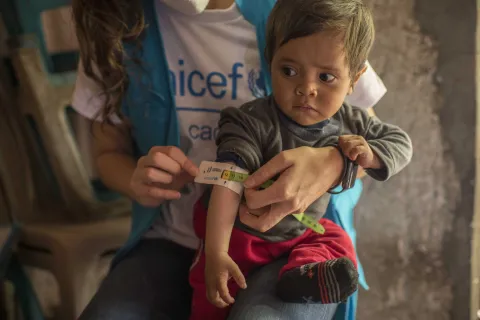
- 98.8 million children under 5 years of age benefited from early detection and treatment of wasting and other forms of malnutrition
- 9.1 million children accessed education
- 8.8 million children and families were supported with community-based mental health and psychosocial support services
- Nearly 1 million households received humanitarian cash assistance
- $1.44 billion in supplies were delivered to facilitate humanitarian action in 67 countries.
Funding shifts
Yet, “some of the results were constrained by limited funding, access restrictions and insecurity,” said Ms. Elmi. “Those gaps are not abstract. They translate directly into preventable suffering, missed opportunities and lost futures.” By the end of 2025, UNICEF had received $296 billion for the 2025 Humanitarian Action for Children appeal, only 31 per cent of the requirements.
Flexible, predictable humanitarian funding ensures that UNICEF can respond quickly and allocate resources equitably. “We remain deeply grateful to the partners providing flexible and quality funding – especially to the Global Humanitarian Thematic Fund,” said Ms. Elmi.
Localization and other approaches to humanitarian action
In the context of system-wide reforms, the UNICEF humanitarian response in 2025 continued to support localization. This means strengthening the capacities of national and local systems and actors to meet children’s needs in emergencies. In 2025, UNICEF transferred 48 per cent of its humanitarian partnership funding to local and national non-governmental organizations and 29 per cent to national Governments.
In 2025, UNICEF continued to use humanitarian diplomacy to promote adherence to international law, safeguard principled humanitarian access, raise awareness about child rights violations, including grave violations against children, and promote compliance by parties to a conflict with their international obligations. For example, to facilitate access in Gaza, in the State of Palestine, and to protect children impacted by the conflict in the Sudan.
Looking ahead, a few pointers will shape the course of UNICEF in humanitarian action. A more ambitious commitment to localization, grounded in the primary responsibility of national and local government systems as the first line of response. A new way of consolidated working through the UNICEF Centres of Excellence to ensure effective assistance in an environment of constrained funding. And continuing to scale up child protection and education interventions in emergencies, ensuring they are an integral part of life-saving assistance.

Humanitarian Review and UN reform
The Board received a final update on the organization’s Humanitarian Review. From its launch in early 2021 until the end of 2025, the Review was a crucial element of UNICEF efforts to continuously improve its humanitarian action.
By mid-2024, 43 out of the 70 recommendations had been implemented fully or were well advanced. As of the end of December 2025, the Humanitarian Review as a stand-alone process concluded. UNICEF has mainstreamed much of the remaining work into the Future Focus initiative and into ongoing system-wide reforms.
On reform in the humanitarian system more broadly – e.g., the Humanitarian Reset and the New Humanitarian Compact – UNICEF continues to actively engage so that reform efforts place children and the systems that protect them at the centre of humanitarian action. The organization remains committed to the Secretary-General's UN80 Initiative to ensure that reform leads to a stronger impact at the country level.
In their statements following the update on humanitarian action, several delegations reaffirmed their strong support for and commitment to working closely with UNICEF in humanitarian action. Several welcomed UNICEF engagement in the Humanitarian Reset and the UN80 Initiative, commending the organization for its efforts to review its operations and prioritize life-saving interventions. Delegations also paid tribute to the UNICEF staff working in challenging environments, often at great personal risk.
Common issues raised included the funding gap and the importance of ensuring predictable, adequate and flexible funding for humanitarian operations; the need for new technologies and innovation, and for a strengthened commitment to localization; concerns about the continued erosion of international humanitarian law, restrictions on humanitarian access and attacks on humanitarian workers; the centrality of protection; and the need for stronger localization, a closer humanitarian-development-peace nexus, and expanded anticipatory action.
****
Child participation
During the session, the Board heard remarks from Merlyn, a 19-year-old young man from Peru, who joined the meeting online and relayed how social protection has helped to expand opportunities for him and his family. They were beneficiaries of the cash transfer component of the Juntos programme in Peru, an evaluation of which was included on the session agenda.
Under the agenda item on the Annual report on the implementation of the UNICEF Gender Action Plan, 2022–2025, delegations listened to 17-year-old Maju from Colombia, who is a member of the UNICEF Global Girl Leaders Advisory Group. In her virtual remarks, she spoke about overcoming obstacles and about hope and called on Member States to strengthen meaningful participation mechanisms for adolescent girls, particularly those who are marginalized.
A video featuring 19-year-old Dicko from Mali highlighted her courage and determination to collaborate with the men and women in her community to help to put an end to child marriage.
Key decisions and wrap-up
By the end of the session, the Board had adopted 12 decisions: on annual reports – of the Executive Director; on ethics; risk; audit and investigations; evaluation; humanitarian action; and private fundraising and partnerships; and on updates: on protection from sexual exploitation and abuse; organizational culture and diversity; governance and oversight; the UN80 Initiative; and the repositioning of the UN development system. The Board also approved the additional one-year extensions of the country programmes for Lebanon and South Sudan following previous one-year extensions.
The Executive Director used the opportunity of the annual session to announce the winners of the UNICEF Staff Team Awards for 2025. “The leadership, creativity and service demonstrated by these colleagues reflect the very best of UNICEF” she said, while announcing the six teams from across the organization that were awarded under the categories “exceptional circumstances”, “collaboration for impact” and “innovation”.
In her closing remarks at the end of the session, Executive Director Russell said, “despite conflict, climate shocks, economic pressures and an obviously constrained financial environment, UNICEF and its partners continue to deliver for children at scale, and that’s thanks in large part to the support of all of you here.”
“At the same time, our discussions have reinforced a clear reality, which is that children’s needs are immense and they’re growing. And, as we move forward with implementation of the new Strategic Plan, we have to remain focused on accelerating progress for the most vulnerable children,” she said.
In his closing statement, Ambassador Tammsaar said: “I would say that together we made some progress over the past few days, including the adoption of 12 important decisions. We have heard highlights of the results UNICEF achieved for children in 2025. We also received updates on key areas of work for the organization, providing us with a broad overview of the challenges and risks, as well as achievements, strategic priorities and innovations.”
But he also expressed disappointment that the Board had been unable to achieve consensus on one of the draft decisions and that there had been a call for a vote. He thanked those delegations that had demonstrated flexibility and all of the parties that had worked towards a compromise.
Ambassador Tammsaar reminded the Board of its responsibility to collectively help to advance child rights. “I would ask you not to lose sight as to why we are here, and what we want to achieve, while deeply engaging into the negotiations and trying to defend national priorities,” he concluded.
****
The Executive Board’s next formal meeting will be the second regular session, which is scheduled for 1–4 September 2026.