Water: A Source of Life and Joy
A drop of water can transform lives in Tigray

“We used to walk up to six hours to fetch water, encountering numerous difficulties on the way. As it got darker, it got worse as people started arguing due to fatigue from the long queue and we never even knew how many liters we would return with. Our jerrycans can hold up to 25 liters, but often we were not able to fill it. Unfortunately, this amount of water is not even enough for our family,” explains Hadas.
Hadas Woldu (30) is a mother of two children and lives in Raya Azebo woreda (district) in Kara Hadishabo Tabia (sub-district) in the Tigray region. Her husband was injured during the conflict in Tigray, leaving her to manage everything, from household chores to caring for the children and tending to the crops, including agricultural activities such as plowing. Like many other families in the region, they rely on farming for their livelihood.
The distance to fetch water not only affected women and girls in terms of their time management but also their safety.
"I remember one day, as I was fetching water," recalls Hadas, "a group of men began throwing stones at us. We were terrified and ran for safety. Carrying heavy water on my back and my young son, Murad on my shoulder, I struggled to keep up. Unfortunately, he fell and got wounded. It was a heart-wrenching moment for me and I felt so sad. In times of darkness, such incidents used to occur."
Despite the challenges, Hadas has shown remarkable resilience. On top of domestic work and farming, she has taken on the role of chair of the water committee. Once a week, she joins the community meetings to talk about the current situation and to discuss new interventions. Her responsibilities include maintaining cleanliness at the water source and managing financial transactions.
Hadas doesn't stop there. Her ambitions extend even further!
“I have a dream”, she says with a smile. “I wish for a day when every household will have access to safe water. I envision a future where disabled individuals in our community can easily access water through pipelines, as it has become a significant concern exacerbated by the conflict.”
Thanks to the generous support from the King Salman Humanitarian Aid and Relief Centre the Saudi Esports Federation, and Gamers Without Borders, UNICEF, together with its implementing partner, Ethiopian Catholic Church Social and Development Commission, has installed a new solar water system, benefiting over 600 households (over 3,000 people).
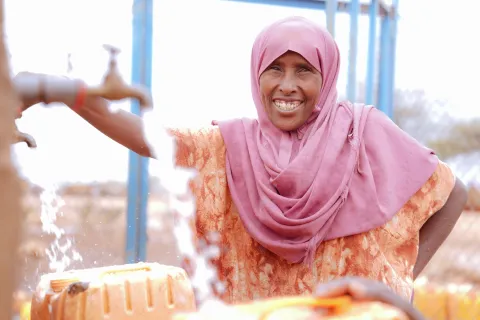
Reflecting on the transformation brought about by access to water, Hadas smiles and says, “Recalling the days of endless walking and fear, the joy I felt when water became accessible is indescribable. It freed up time for other activities and changed my life completely.”
In rural Ethiopia, particularly in the Tigray region, where access to safe water is a persistent challenge, innovative solutions like the solar water supply scheme are instrumental in improving people’s lives. Every year 70,000 benefit from such interventions, making a step towards addressing the water crisis.


Just like Hadas, Aziya Mehammed (54), a mother of eight children, shares a similar experience. She remembers when she had to wait in line for up to four hours just to fetch water. She also remembers the long journey every single day, sometimes even considering a second trip to gather enough water for her family’s needs – often made impossible because of the darkness.
“At times, we had to prioritize drinking and cooking, neglecting other essential tasks like bathing. As a result, my children and I suffered from itching skin. Seeking help, we visited a health center where we were provided with treatment,” Aziya explains.
“Having water right here means everything. It is like a lifeline for us”, says Aziya. With the new solar water system, families no longer endure the agony of walking hours in search of safe water. Now, we can prioritize caring for our children and participating in agricultural activities.

This underscores the critical importance of water which not only improves health outcomes but also reduces preventable waterborne diseases.
“Amidst the challenges brought on by COVID-19 and the conflict, the village of Raya Azebo faced a critical moment when the transformer failed, halting the water system operationality. The implementation of a new solar-powered system brings renewed hope. Siraj emphasizes its sustainability and durability that can last for over 20 years,” said Siraj Mohamed, a water supply coordinator with over two decades of experience in the district.
"Thanks to the solar water system, we've successfully delivered clean, high-quality water to our community. Installing additional water reservoirs has allowed us to extend our reach, even reaching a nearby school through pipeline connection.”
According to Siraj, the community is now highly motivated by this system and plans to contribute annually (60 ETB for low-income households (Less than 1 USD) and 120 ETB for higher-income households) to ensure the ongoing maintenance and repair of the water supply. In addition, the community is now motivated to expand the water system for irrigation purposes to cultivate more crops, vegetables, and fruits that will nurture their families and ensure food security in the area.
The ongoing drought in the northern part of Ethiopia hits hard: fields dry up, water sources shrink, and livestock die because of the failing rains. Every day without rain makes life tougher. The drought situation has affected agriculture productivity and affected the availability of water in the community. Currently, in Tigray, over 1,000,000 people live in drought-affected locations and in dire need of access to safe water.