Eritrean refugee women and their Ethiopian hosts
in the Afar region of Ethiopia

On 21 September, in Asayita Woreda, Afar Region, Ethiopia, female community leaders who missed the opportunity for education when they were young, are now ensuring their children don’t follow that same path. Through the UNICEF-introduced and UK-Aid funded Accelerated Readiness Programme, children from both refugee and host communities in Afar Region, Ethiopia are participating in the summer programme to help prepare for primary school.
Zahara Halo, 28, a mother of three from Afar Region, Ethiopia, has never been to school. She was married, had a child at 13, and spent the latter half of her childhood raising her children and performing household chores expected of Afaari women: collecting water, cooking, building huts, tending cattle, and raising children.
Rokiya Mohammed, 35, is an Afaari woman from the Afar region of Eritrea. She also has never enjoyed the benefits of education, having spent much of her life doing household chores and caring for her seven children.
Approximately 13 years ago, Rokiya fled Eritrea to Ethiopia during the war between the two countries. She arrived with other Eritreans to Asayita Woreda where she has integrated into the host Ethiopian community and has received support ever since.
Zahar and Rokiya, although from two different countries, have many things in common. Both have learned to live in harsh desert climates, both are from pastoralist cultures, and both never had the opportunity for school. However, both are determined to change that pattern for their children.
They are part of the community’s Women’s Self Help Group, where they work to change the conditions for women and children in the community. Among other group activities, such as adult literacy classes and providing loans for small business, they are the delegated community leaders who ensure their children go to school.
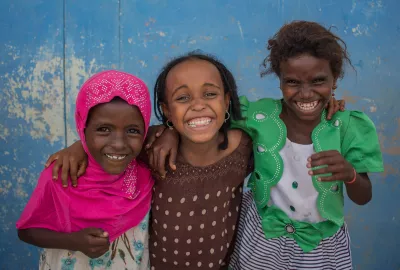
When these women heard that the new Accelerated School Readiness (ASR) programme was coming to Afar, they were determined to help. As Zahara explains:
“As the group leader (of the Women’s Group) we have difficulties in finding group members who can read and write, and we suffer a lot from this. That is why I am inspired to put my child in school. I do not want him to suffer as I have.”
Accelerated School Readiness(ASR)
ASR was designed for vulnerable children who never had early learning opportunities (like private or public pre-school) but are of age to begin primary school. It was developed through proven research on the importance of play-based activities (i.e. story-telling, art activities, literacy games) to help develop early literacy and communications skills. ASR gets children excited for school, ready for school, and keeps them in school.
In Ethiopia primary school dropout rates remain unfortunately high, with the highest rates found in Grade 1 (at 18 per cent), which is strongly linked to a lack of quality pre-primary opportunities. ASR is an innovative response to this challenge. In 2015, UNICEF introduced the initiative in rural areas of Ethiopia. Because it is relatively inexpensive (approximately US$13 per child), quick (two months over the summer), and effective, it has become a popular option for disadvantaged areas.
In 2016, ASR was offered to refugees and their host communities in an integrated and equitable approach. When they heard the news that ASR would be coming to refugees and host communities in Afar Region, the Women’s Group was ready and excited to support.
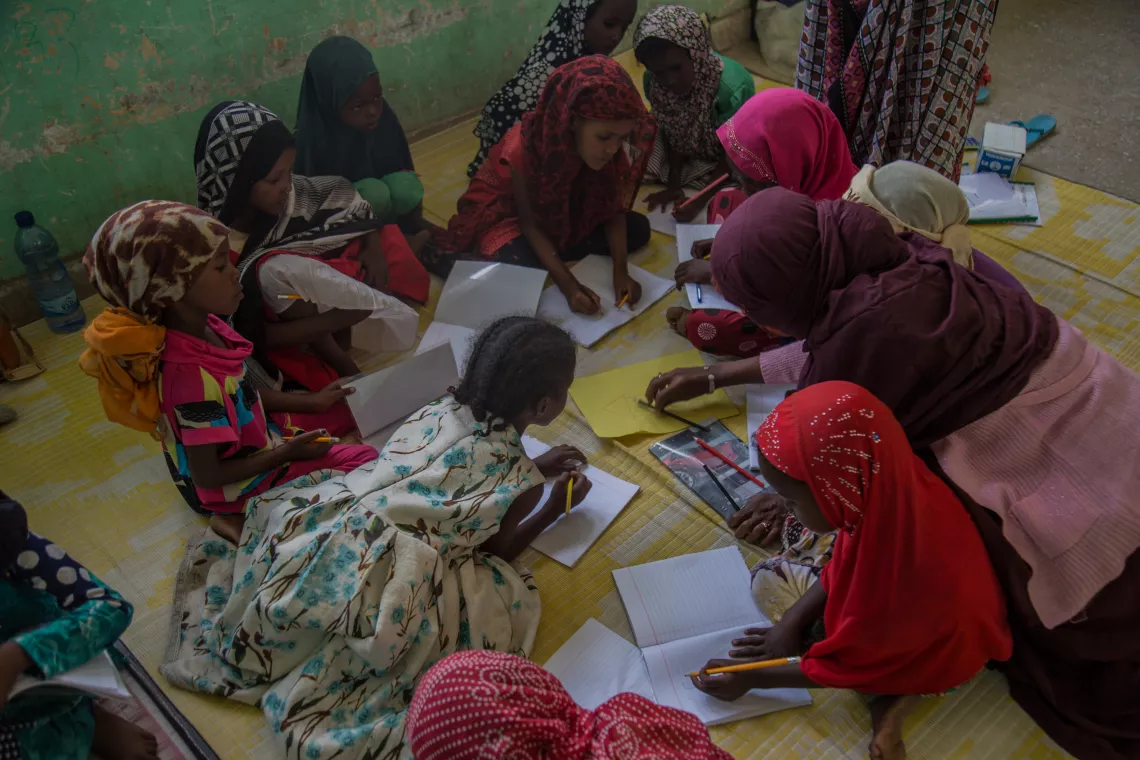
ASR is only possible through female community leaders
In Asayita Woreda, children are anywhere and everywhere – in condensed urban areas and expansive rural communities. In the vast deserts of the Afar Region where the climate is harsh and transportation services are minimal, it can be a major challenge to get children to school – a feat that is only possible by the determined female leaders of the community.
In less than one week, these women helped mobilize 258 children from urban and rural areas of Asayita Woreda, an area that spans almost 1,700 square kilometers.
Zahara explains how they were able to accomplish this: “We go from door-to-door and provide school materials for low income children … thereby giving the parents incentives to send children to school.”
Another Women’s Group member, Zahara Ali adds, “I know all of the mothers. I go knock on doors and say that you better send your children to school. I check up on each of them.”
Equal opportunities for refugees and host community children
Some Eritrean refugees, like Rokiya, have integrated into the local town, but some have decided to stay in the refugee camp just a few kilometers away. When Rokiya heard that ASR is also happening in the camp she was extremely grateful. “We are so happy our brothers and sisters also get this programme. We are grateful to see our children have equal opportunities like the host communities.”
Because of determined women like Zahara and Rokiya, positive change is possible for the next generation in Asayita Woreda. As Women’s Group member Misre Ali explains,
“We are in the darkness. We never had a chance to be educated and we don’t want this for our children. We want them to know many things.”
Since the introduction of ASR in Ethiopia, UNICEF has directly supported over 45,000 children in addition to the thousands more the Government has helped through their ASR interventions. As a result, hundreds of thousands of children have enjoyed its benefits in becoming well prepared for primary school.