Defying Expectations
One Girl's Pursuit of Education over Harmful Practices

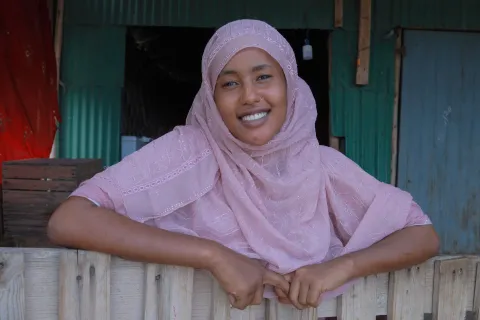
Living in the Kokosa Woreda (District) of the Oromia Region, Mekake Kebeto was just a 14-year-old when her parents told her that she was getting married. “I had no idea that they were planning this,” Mekake said. “I didn’t want to get married so young. I had seen the pain and challenges one of my classmates faced after getting married the previous year. I knew that marriage was not something I wanted at this age.” Determined to continue her education and avoid the pains of child marriage, Mekake refused her parents' wishes.
Mekake didn’t know where to seek help, but luckily, the woreda’s Bureau of Women's and Children's Affairs (BoWCA) discovered the marriage arrangement and intervened. "When we learned that she was only 14, we immediately reached out to her parents,” recalled Halima Adem, a social worker, at the Bureau. “We explained the dangers of child marriage, including the risks associated with early childbirth.”

Her parents were hesitant, so the social workers reached out to other family members and contacted Mekake's aunt, Asha Hussein. Upon learning about the marriage plans, Asha rushed to convince Mekake's parents to stop the marriage. “I suggested that she could stay with me,” said Asha. “My children have all finished university and have careers of their own, and that's what I want for her." Eventually, Mekake’s parents agreed to the arrangement.
Now, Mekake is in sixth grade, thanks to the Out-of-School Girls Programme supported by UNICEF and its implementing partners. Through this programme, UNICEF provides counselling, school supplies, and uniforms, which have enabled Mekake to continue her education.

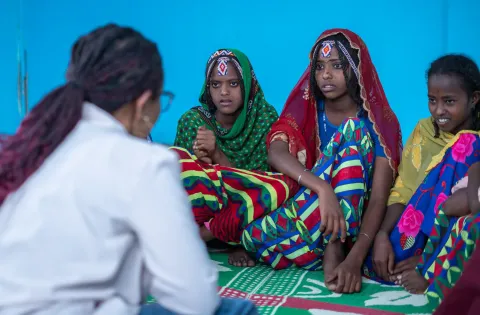
Mekake is also an active member of her school's adolescent skill training programme, where she and her peers support each other against harmful practices targeting young girls. The club provides a safe space for girls to share their experiences and advocate for their rights.
Halima Adem, BOWCA social worker, notes that Mekake's case positively impacts other girls and women in the community. "Many children come to BoWCA knowing we will help them. And women who experienced these practices at a young age are now speaking out, advising young girls not to go through the same challenges."
According to the 2016 Ethiopia Demographic and Health Survey, 48 per cent of women and girls aged 20-24 in the Oromia region were married before turning 18. To address this issue, UNICEF, in collaboration with the Ministry of Women and Social Affairs (MoWSA), and BoWCA, is working to prevent and end child marriage. UNICEF supports keeping girls at school, which in turn contributes to economic growth, improved gender equality, prevents harmful practices, and reduces violence.
UNICEF's strategies to eliminate harmful practices focus on empowering both out-of-school and in-school adolescent girls while mobilizing communities to shift attitudes and practices. By engaging parents, boys, men, religious leaders, and other community members, UNICEF aims to create a supportive and protective social environment. This involves strengthening service delivery and improving data and evidence to inform programming and policy initiatives.
The UNICEF Ethiopia End Child Marriage and FGM is funded by the European Union and the governments of Iceland, Italy, Belgium, Luxembourg, Austria, Netherlands, Norway, Spain, Canada, Sweden, and the United Kingdom. We are grateful to our donors who contribute to our joint efforts to end child marriage, FGM, and improve the lives of girls.