Community Action in Ending FGM and Child Marriage
Religious leaders, community members, and adolescents work to end harmful practices in the Somali region of Ethiopia

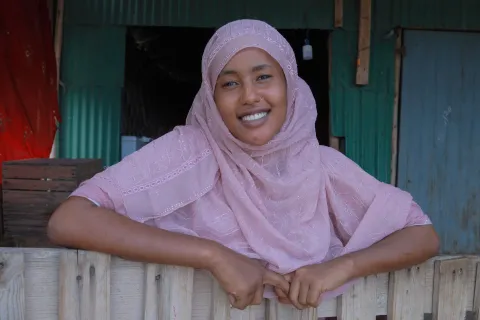
“Through our solidarity, we’ve been able to connect and make a huge difference, preventing FGM and child marriage and ensuring that girls continue their education,” said Segel Ali, a 17-year-old who was previously out of school but now in 12th grade living in Qoloji IDP camp in Somali.
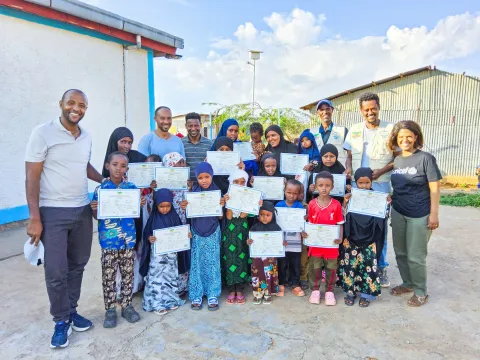
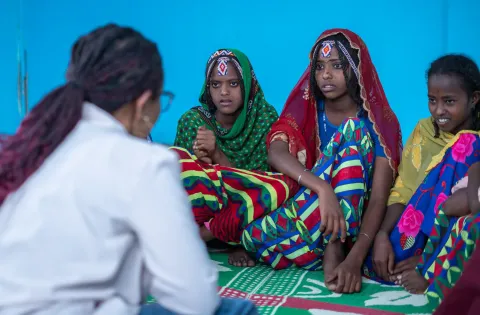
Segel facilitates a life skills training programme that consists of 20 up to 25 girls in the age category of 15-19 aimed at empowering girls. “The programme encourages us girls to support each other and collaborate on shared issues,” said Segel. “I used to feel shy discussing topics like FGM, but the training has empowered me to speak out more boldly.”
The practices of FGM and child marriage are deeply rooted in cultural and social norms in the Somali region. The region has the highest prevalence rate of FGM, 99 per cent and 95 per cent for the age groups 15-49 and 15-19 respectively (EDHS 2016). Similarly, the prevalence of child marriage is 49.4 per cent.
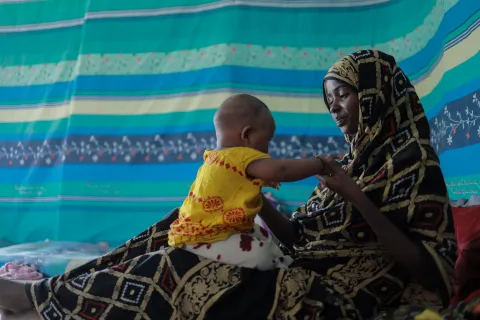
There are significant health risks associated with both FGM and child marriage, including infections and the need for surgeries due to infibulation and fistula. FGM involves removing and injuring healthy and normal female genital tissue, interfering with the natural functions of girls and women's bodies. It can lead to immediate health risks, as well as a variety of long-term complications affecting women’s physical, mental, and sexual health and well-being throughout the course of their lives.
One of the key challenges is addressing parental concerns. Life skills training has been crucial in helping girls build self-confidence and fostering open communication with their families.

“While teaching, we also tell mothers that a girl’s place is not only in the kitchen and being a wife,” says Segel. “I persuade them to send their girls to school and not to kill their morale. I aspire to become a doctor and do not want anything to get in the way of my dream.”
In terms of FGM, there are challenges with mothers regarding circumcision practices, as some continue to perform the practice in secrecy due to misinformation and fear of arrest by police. Many believe that without circumcision, their daughters won’t find suitable husbands. Additionally, for some, the practice is driven by economic reasons, as marriage is seen as a way to enhance family wealth.

“What is done is done; we can't return to the past. It's time to end these practices by working together more effectively,” said Abdilelam Abdi, a social worker and facilitator of a community conversation.
Comprised of religious leaders, the Anti harmful traditional practice (Anti-HTP) committees, adolescent boys and girls who have taken life skills training as well as community and kebele (sub-district level) leaders, the community conversation committee meets twice a week determined to end the harmful practices specifically FGM and child marriage in their communities. For committee members like Abdilelam, the formation of an empowered women's team for concern and case identification has been a crucial step.
“We are committed to reaching our communities and providing education. We go everywhere the community goes. The committee also takes every opportunity to raise awareness during social gatherings and events to teach communities about the negative consequences of these harmful practices. The committee has been meeting for the past three years, but the first two years posed challenges due to a lack of awareness, particularly in remote areas. We need the resources to reach all near and far areas to make lasting change,” said Abdilelam.

Seada Ali, 50, has been a member of the Anti-HTP committee for nearly three years.
“Currently, we are witnessing significant changes in our community. In the past, many cases went unaddressed, and women struggled to find their voices; these topics were rarely discussed openly. At times, families respond defensively, saying, ‘She is my daughter; Why do you care? Leave us alone; It’s not your concern.’ However, thanks to the life skills training, communication between parents and their children has improved. Girls are becoming more confident and learning to express themselves much better.”
Seada also said that they encounter challenges, particularly during house-to-house visits, as some mothers resist change, feeling that these practices have been part of their lives for so long. However, they are beginning to understand the need for change. Additionally, involving past circumcisers as part of change agents has proven beneficial, as it helps redirect their focus away from harmful practices.
“Regarding child marriage, I remember an incident involving a 14-year-old girl who was set to marry a much older man. We learned about it from her neighbours and decided to speak with her mother, who had already accepted money from the groom’s family. Thankfully, with the support of religious leaders and kebele officials, the marriage was canceled, and the mother was persuaded to return the money. Afterwards, the girl was enrolled in the life skills training programme. I felt so relieved when this happened, as the girl had never wanted to marry; she was being forced into it. My hope for girls is that they are not married off at a young age but instead have the opportunity to pursue their education,” said Saeda.

Omar Mehedi, (35) a religious leader from Babile is also part of the community conversation striving to make a difference in terms of teaching communities from religious perspectives.
“The community in Qoloji IDP is entirely Muslim, which facilitates our outreach and dialogue that our religion does not support these practices. We actively support the Anti-HTP Committee in helping people understand that these practices are harming our society. To this end, we receive support from the Bureau of Women and Social Affairs, strengthening our efforts to promote positive change.”
The different voices from the community highlight the transformative impact through prevention and strengthening service provision as well as a huge progress in combating harmful practices with strong advocacy, particularly involving religious leaders bolstered by training provided by the Bureau of Women and Children’s Affairs and UNICEF, there is hope to eliminate both FGM and child marriage.
“Yes, there is hope and I feel motivated when I see such positive changes in our community,” said Abdiselam. It’s about promoting positive cultural values and avoiding the harmful ones.”
As part of the community mobilization effort, the engagement of religious leaders is the key component implemented in the region. Religion as a driver plays a pivotal role in contributing to the continuation of FGM as 23.6 per cent of women age group 15-49 and 16.8 per cent of men age group 15-59 believe that FGM is required by their religion. Looking more keenly at the proportion shows that 41 per cent of Muslim women are more likely to believe that FGM is required by their religion and other women from other faiths at 28 per cent. In the Somali region, 57 per cent of women and 41 per cent of men believe that FGM is a requirement in the religion.
On behalf of the girls and women and their families and communities served by the Joint Programme, UNFPA and UNICEF would like to thank the following governments for their financial contributions: The European Union, Iceland, Italy, Luxembourg, Norway, Spain, Sweden, Canada, and the United Kingdom.