Breaking Barriers
Fatuma's Battle Against Child Marriage

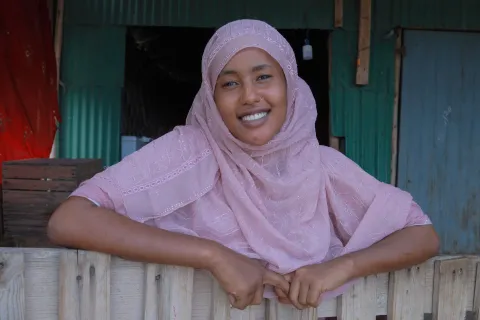
Fatuma Seid (15), finds herself shouldering the responsibilities of being the oldest child in her family, which includes taking care of two brothers and one sister. Since the loss of her father, Fatuma and her siblings have relied solely on their mother, who enrolled in the Productive Safety Net Programme (PSNP) in 2020. However, providing for their basic needs has proven to be a challenging task for her mother, who became the family's sole breadwinner.
Determined and driven, Fatuma is an 8th-grade student at Weledi Primary School in Nesim Shekila Kebele (sub-district), Dawa Chafa Woreda (district), Amhara Region. She has a burning desire to continue her education and achieve her dreams. Unfortunately, when she was 14 and in Grade 7, rumors began circulating among neighbours and fellow students about her mother's intentions to force her into an arranged marriage.
"I was immensely irritated and distressed," says Fatuma recalling the distressing time.
Like many other girls in her village, Fatuma faces the imminent risk of an arranged marriage, a decision she has no say on.

Recognizing the urgency to take a stand against this injustice, Fatuma sought support from her school's principal, firmly declaring, "I refuse to be married. I have a bright future ahead of me, and my dreams can only be realized through education."
Concerned for Fatuma's well-being, the school principal promptly reached out to Fatuma Ali, a dedicated social service worker in Nesim Shekila Kebele, and informed her about the plotted arranged marriage. Fatuma Ali wasted no time and reported the matter directly to the Woreda Anti-Harmful Traditional Practice Committee.
Extensive consultations and discussions on the detrimental impacts of child marriage followed, including firsthand experiences of married children facing complications such as fistula. The committee engaged community elders, women representatives, and the social worker. Eventually, Fatuma's mother had a heartfelt realization.
"As a widow managing the family alone, life has been incredibly difficult. I sought someone to help, and I mistakenly considered marrying off my daughter. I was subjecting my child to complex risks that would hinder her education and her future in general."
Through collaboration between the Woreda Anti-Harmful Traditional Practice Committee and the Community Care Coalition (CCC), the family's economic situation was assessed, leading to their enrollment in a comprehensive care and support program. Fatuma received school materials that helped her continue her education. Moreover, the family was directly enrolled in a dedicated care and support program supported by the Government of Sweden, which helps them to have access to essential provisions such as 25 kg of rice, 1 kg of coffee, and Birr 1,500.00 every two months.

"Thanks to my school principal, the social worker, Fatuma Ali, and the committee that convinced my mother and cancelled the arranged marriage, I am now free to pursue my education," says Fatuma with gratitude.
Nuru, an Information Management Specialist, at the Dawa Chafa Woreda Women Children and Social Affairs Office, emphasizes the inherent right to education for children like Fatuma. Through the coordinated efforts of the Anti-Harmful Traditions Practice Committee, the community care coalition, and organizations like UNICEF, child marriages are being halted, and girls are receiving unwavering support to influence their parents' decisions. Thus, concerted action to bring about social norm change interventions regarding child marriage remains of paramount importance.