A girl with a bright smile and a new home
Maise Al-shoubi, the 14-year-old Syrian student

- English
- العربية
She displays a bright smile, delicately wrapped by her white veil and speaks about her life experience as a refugee in Egypt. Maise Al-shoubi is a 14-year-old Syrian student. She was born in Syria but had to flee the country with her parents 9 years ago. Now, she calls Egypt “home”.
Maise remembers very well her family house in Syria. She used to play in the backyards and buy candy from the small shop in the corner of her street. Before the war, Syrian streets were a peaceful play haven for children. Maise even recalls building sandcastles and running around with her cousins, who lived in the same building, in Daraa, her hometown.
But Daraa also ended up being at the center of much turmoil and unrest during the Syrian conflict. Maise’s family decided to seek refuge in Egypt to protect their children from the horrors of war.
“I have been in Egypt for the past 9 years. I am practically Egyptian! I even consider Egypt as my main homeland as I didn’t live in Syria for long. Egypt is the land of all lands, my experience has been very positive especially at school” says Maise with a shy smile, reflecting on how she enjoys the lively streets of Egypt.
“I foresee myself as an Engineer in the coming ten years, as I love mathematics. It is one of my favorite subjects and I am very good at it. If I succeed, I think I will have fulfilled my dreams by then and be equipped to face the world with my education, maybe even have job in my field.”

Maise Al-shoubi is a 14-year-old Syrian student. She was born in Syria but had to flee the country with her parents 9 years ago. Now, she calls Egypt “home”.
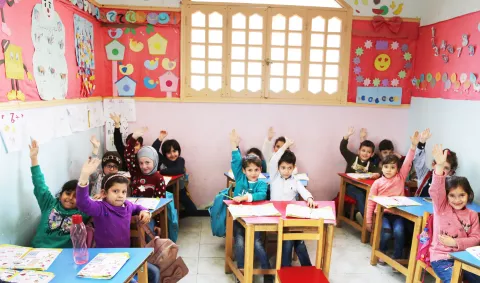
As many Syrian students in Egypt, Maise has been taking the Egyptian curriculum, studying part-time at public schools and regularly attending Syrian Learning Centers to improve her education. Walking though Maise’s classroom in her learning center, she adds: “COVID-19 has drastically changed everything over the past year. The learning pace is very fast. Although educational content is somehow accessible, comprehending the materials is more difficult. We miss the classroom setting and the human aspects of having a teacher explaining to us the lessons.”
“I have been relying on the use of internet, YouTube and educational channels, as well as on the Ministry of Education educational channels on the television to compensate for that time spent outside the classroom. Moreover, I come to the center on a rotational basis where teachers are available to support, which is not making things easier” adds Maise.
Thanks to generous contributions from Al-Adwaa, Selah AlTelmeez and Johnson & Johnson, UNICEF has so far supported 5,084 children with distant learning materials and hygiene supplies during COVID-19 to support children education during the pandemic. Furthermore, with support from BPRM and the Dutch Government, UNICEF in Egypt is launching an educational platform, “The Learning Passport”, to support refugee children with distant learning. Thanks to Norway generous contributions, UNICEF collaborated with the Ministry of Education and Technical education, 400 public schools hosting refugee children received rehabilitations which will benefit 9,825 refugee students registered in these schools.
“If I could make a wish, I would wish COVID-19 would end and we would get back to normal human communication where we can hug and greet each other without maintaining distance.”
“Accept destiny, anything life throws at you is just another opportunity, if you had to leave your country, then accept that and live your new life to the fullest,” concludes Maise.