
Youth voices strengthen Ecuador's climate change commitments
Through UNICEF, seven young people participated in the technical workshops held in five cities in Ecuador to develop the national proposals

- Español
- English
In Ecuador, young people from Quito, Guayaquil, Cuenca, Santa Cruz and Puyo joined the working groups for the country’s second Nationally Determined Contributions (NDCs). This is the name given to the commitments made by each country to address climate change and which will be submitted to the United Nations Framework Convention on Climate Change in 2025.

It is key to include the proposals and perspectives of children, adolescents, and young people in the establishment of the NDCs because they are the ones who will be affected directly by the consequences of climate change. To these ends and thanks to the support of UNICEF, Alison Guerrero, Juan Tamayo, Kevin Valencia, Fabián Quichimbo, Alejandro Luque, Nicolette Maquilón and Jordy Galarza formed part of the technical process for determining Ecuador’s NDCs, which where carried out by the Ministry of Environment, Water and Ecological Transition (MAATE), the Food and Agriculture Organization of the United Nations (FAO) and Climate Promise of the United Nations Development Programme (UNDP).
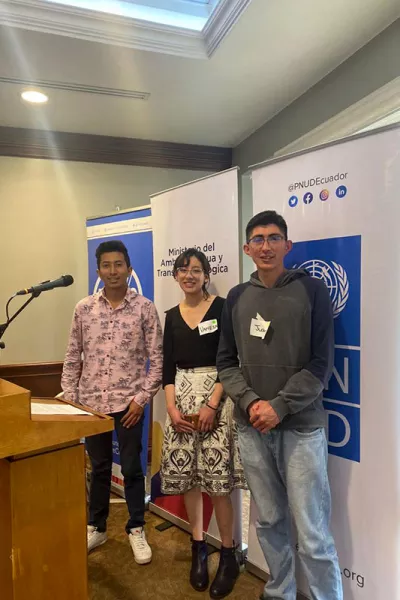
From May to August 2023, five technical workshops were held, bringing together international organizations, civil society actors, adolescents, and young activists to include their perspectives considering the cross-cutting approach of gender, interculturality, and intersectionality that is promoted in these NDCs.
UNICEF works to strengthen adolescents' and young people’s knowledge about the impacts of climate change. In 2022, it held the Youth Participation - Road to the NDCs workshop ( Participación Juvenil – Camino a las NDC, ) where 40 young people created proposals for including their areas of interest in the country's climate commitments. Among the main proposals were: environmental education, risk and disaster management, health, energy transition, sustainable agriculture, and youth participation in formal spaces of the national climate agenda.
Vanesa Guerrero, a member of the WWF Youth Community and the Simbiosis collective, contributed to the agriculture roundtable at the Quito workshop. For her, youth participation in these processes is key because it allows her to have a say "in the construction of policies that adapt to the reality of the country since there are people who are more vulnerable according to different categories such as ethnicity, gender or social class".
The working groups were divided as follows: 1) Energy and Productive and Strategic Sectors, Industrial Processes; 2) Water and Natural Heritage; 3) Waste, Human Settlements and Health; 4) Agriculture, Agriculture and Livestock Service, Land Use and Land Use Change and Forestry (LULUCF). Through these focal areas, members of civil society and organizations contributed to the fields where they are most experienced.
Fabián Quichimbo, a student at the University of Cuenca, mentioned the importance for new generations to get involved and acquire knowledge in this process because "it facilitates the transmission of knowledge so that it is accessible to everyone".
Jordy Galarza, a socio-environmental activist and member of Friday's For Future Ecuador, participated in the workshop in Puyo, in the Ecuadorian Amazon. For this young man, inclusive participation allows for a refreshing of the initiatives "that are usually given from an adult-centric point of view". He was part of the dialogues on intersectionality, gender, and climate change and contributed ideas on reducing the electronic carbon footprint, as well as the need to promote climate equity so that sustainability projects reach communities directly.

Additionally, Kevin Valencia, a member of the International Association of Agriculture and Science Students (IAAS), contributed to the Energy and Productive and Strategic Sectors, Industrial Processes working group in Quito, where he saw an opportunity to involve youth in the measurement of emissions from energy consumption, "to see how much is being emitted and how it can be reduced or mitigated”. He also emphasized the space for youth participation, because "we, as young people, want to express our ideas and that is one of the most important points here, that the contribution of our voices is seen and demonstrated".
