It´s never too late to learn
In Machala, a new cohort completed the educational support program for pregnant and parenting adolescents implemented by UNICEF in Ecuador.

- Español
- English
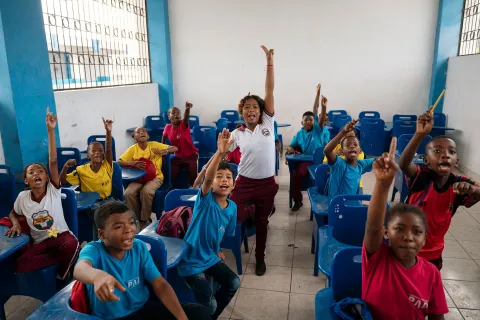
It´s midday on the last Friday of July 2023. A small celebration is taking place in the República del Ecuador High School assembly hall in Machala, where 35 young women have been receiving classes for four months. They are part of the second cohort of the Educational Inclusion Program for Pregnant and Parenting Teenagers in this port city on the Ecuadorian coast. This is a UNICEF initiative that seeks young women who have dropped out of the education system and live in highly vulnerable areas to motivate them to resume their education through a program of school support, psychosocial support, and a safe space where their babies are cared for while they study.

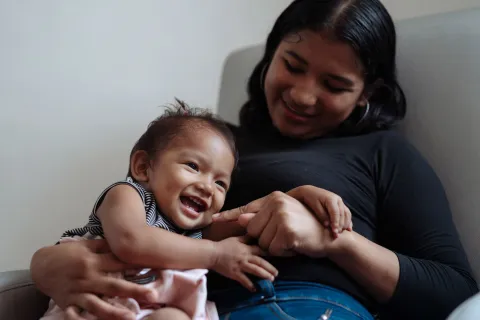
One of the young women is Kerly Cabrera, who is 17 years old and has a 4-month-old son. Her pregnancy began when she was in her second year of high school. Her delivery was not easy, she had complications and anemia, and because of that, she dropped out of school. Thanks to the support of the UNICEF program, she was able to return to school and will soon graduate.
"What I liked the most is that they were always with us, supporting and encouraging us to continue studying," says Kerly. Smiling, she talks about the path she plans to take: "I am studying accounting, and in college, I would like to study business administration.” Her dreams are linked to one of her hobbies: drawing. "I imagine myself being a graphic designer and going on many trips," she says and immediately thinks of her son, whom she hugs into her chest: "I would like to achieve everything I want for my son. Being a mom has been a wonderful experience because my life has been chaos, and now I feel good."
In Ecuador, many young women are living in a situation similar to Kerly's. In 2021 alone, 108 adolescents between 15 and 19 years of age gave birth every day. For female teenagers in Ecuador, some main reasons for dropping out of school are pregnancy, motherhood, or having to take care of younger siblings.
That happened to Carla Troncoso, 15 years old. She lives in Machala with her parents, sisters, and 9-month-old baby. She says that after her son was born, she stayed home for the first three months. The idea of continuing her studies faded away during those days caring for the baby until "teacher Lisseth came to my house and asked me if I wanted to go back to school," says Carla, who dreams of becoming a soldier.

Walking the neighborhoods and visiting the homes of adolescent girls who have dropped out of school is critical. Alisson Saldaña, Local Specialist for Development and Self-Management (DyA), the organization that implements this UNICEF program in Machala, says that through coordination with the Ministry of Education and the Ministry of Public Health, they already know who are pregnant or are mothers and have dropped out of school. They then contact them via telephone or make home visits. "We leave our things here at school and go only with the clothes on our backs because we have to go to dangerous areas. Often, there is mistrust from the families because we offer them 'heaven': to be able to go back to school and for someone to take care of their babies. But even so, despite the obstacles, we keep trying for the girls' sake."
The program enables young women to level up their knowledge so they can reintegrate into the educational system and provides them with psychosocial support. This emotional support is essential for them to cope with challenges such as combining motherhood with their studies, dealing with the aftermath of the pandemic on their families' finances, or the stress caused by the growing insecurity in the city.
"What I liked most is that they teach you how to get ahead, that you must motivate yourself to keep going. They teach you very nice things, and you have fun because they have charisma when teaching," says Nahomy Cujilema, 15 years old. She arrived at the party accompanied by her grandmother. Her grandmother and grandfather, who died during the pandemic, are essential to her motivation.
"My grandparents couldn't study. My mother couldn't either because she was 15 years old when I was born. During the pandemic, we had to go through tough times. They were merchants and were not allowed to sell their products on the street. I don't want to go through that again. I want to study and have a profession. I want to be a nurse," says Nahomy. "I want to graduate, work, help pay the debts. I despair to see my grandmother suffer," says the teenager.
COVID-19 also changed the life of Mishelle Mansaba, 19. "I am from Lago Agrio, in the province of Sucumbíos, and the school was closed during the pandemic. In the virtual classes, I didn't understand anything. It was tough for me. So I decided to stop studying," says Mishelle. The support program for pregnant and parenting adolescents helped her to resume her education.
"What I liked the most is that the teachers are nice. They put themselves in our shoes and support us. They have also given us notebooks and school supplies so we can study. My favorite subject is language and literature. I like stories, writing, and meditating because it gives me peace of mind," adds Mishelle. She is in her first year of high school and dreams of attending college. "I would like to be a lawyer to defend the people who need it most, to be fair and help single mothers and children."

As part of the UNICEF program, Elisabeth Chamorro, a teacher specialized in early education, takes care of the children in the room next to the classroom, which has been furnished with foam mats, toys, cribs, and other implements. There, the children sleep, receive early stimulation, play, and are safe while their mothers study. "Every time I came, I brought my baby, and the teacher cared for him. I was able to be close to him, to know if he needed anything," says Mishelle.
In addition to allowing the girls to study in peace, this space is important for the children’s development. One child, for example, was about 2 years old and couldn’t walk yet. Thanks to the work on his gross motor skills, he took his first steps there.
As part of the program, a link has been provided with the Ministry of Public Health services so that adolescents and children get the necessary medical check-ups. This ensures that the children are up to date with their vaccinations, receive adequate nutrition, and grow well.

"Here, my baby ate better and grew more," says Nahomy. "My daughter won't stay with anyone, but with the teacher, she got very attached. She was calm and ate everything with her," says Kristhel Seminario, 19, who dropped out of school to work in a pizzeria during the pandemic. She now attends the educational support program with her 10-month-old daughter, Valery.

The young women's words coincide: UNICEF's educational inclusion program provided them with a safe space. Here, they believed in themselves. Here, they and their children were cared for. Here, they were able to grow. Here, they found the patience, the love, the tranquility to learn. Here, they had an open door for themselves and their children. Here they found the possibility of dusting off their dreams, of planning their lives. For all these reasons and more, it is imperative to continue this initiative, providing opportunities to those who need them most.
The young women received an educational kit at the program's closing ceremony. They have taken an essential step in getting back on their education path. "Today I was able to meet the future nurses, veterinarians, lawyers, police officers," Maria Fernanda Porras, UNICEF Ecuador Education Officer, tells them. "Never get tired of continuing to learn. Don't forget where you want to go and what you want to do." The girls listen attentively while some hold their children in their arms. Together with them, invisible, in their laps, are also their dreams.
This UNICEF initiative, implemented by DyA, is being carried out in vulnerable areas of Guayaquil, Tulcán, and Machala within the framework of the Multi-Year Resilience Program for Inclusive Education (MYRP), made possible thanks to funding from the Education Cannot Wait (ECW) global fund and the Canadian Embassy.