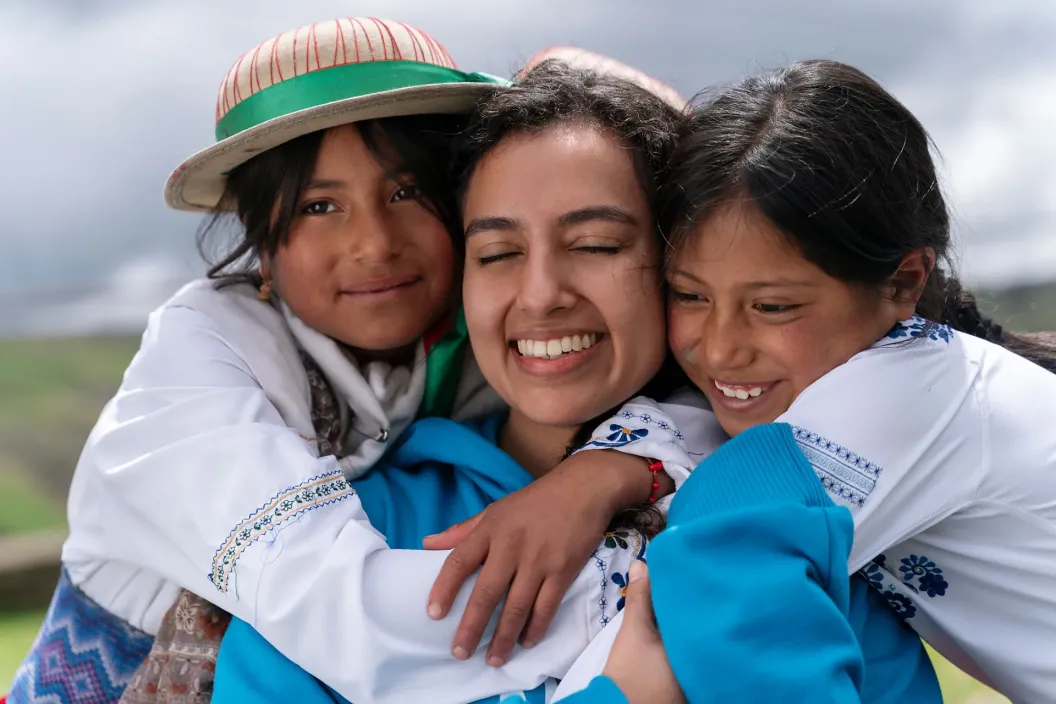
Results that transform the lives of children in Ecuador
UNICEF works with the Government, communities, partners, and families with one shared purpose: to ensure that children and adolescents grow up happy, protected, healthy, and with opportunities. Learn more about what we achieved together in 2025.
- Español
- English
From care during pregnancy to access to safe water, from violence prevention to the promotion of youth leadership, every action in 2025 had a clear goal: to protect the present and build the future. This work translates into tangible change. Mothers receive better care during pregnancy. Children gain access to health, education, and protection services. Safer, more resilient schools. Communities with access to safe water. Families strengthen their ability to care for and protect their children. Adolescents and young people raise their voices and lead to solutions.
These are the results of a year of joint effort—results that show that when children are a priority, transforming their lives is possible.
Early childhood: the importance of the beginning of life
The early years shape everything. During this stage, 90% of the brain develops, laying the foundations for cognitive, physical, and psychological development. In 2025, UNICEF Ecuador promoted actions to ensure that children have access to health care, breastfeeding, vaccination, nutrition, protection, and nurturing care. Investing in this stage is a strategic decision: for every dollar invested, between 13 and 17 dollars are returned in the medium and long term, strengthening human capital and the country’s development.
Mother and Child-Friendly Health Facilities (ESAMyN)
To strengthen care from pregnancy onward, UNICEF supported the implementation of the ESAMyN strategy in 29 health facilities across the country, benefiting more than 36,000 mothers and newborns. This strategy helped improve care during pregnancy and childbirth, promote breastfeeding, reduce mother-to-child transmission of HIV, and prevent maternal and neonatal mortality as well as malnutrition from the first days of life. These actions help ensure that children have the best possible start in life.
Early childhood development
UNICEF worked with the national government to improve care for mothers, newborns, and children. Together with the Ministry of Health, it promoted the National Policy for the Prevention of Maternal and Neonatal Mortality and contributed to the development of the National Environmental Health Policy to protect health from the earliest stages of life.
At the local level, in partnership with the Municipality of Quito, UNICEF promoted healthy habits and proper nutrition among children. Through the animated mini-series “Comeaventuras”, 2,750 children and 83 teachers learned in a simple and engaging way about the importance of consuming natural foods, maintaining an active lifestyle, and adopting healthy sleep habits to prevent overweight and obesity.
As part of the Metropolitan Early Childhood Policy, together with the Municipality of Quito and Patronato San José, UNICEF launched Wawamor, a free app that supports mothers, fathers, and caregivers in raising children aged 0 to 6. In 2025, more than 16,000 people downloaded it to access practical, reliable advice on health, nutrition, breastfeeding, learning, and well-being.
In addition, UNICEF Ecuador promoted the importance of positive parenting and healthy habits among employees of Grupo Industrial Graiman, Pasamanería PASA, Diners Club del Ecuador, and Zurich Ecuador. This initiative, which highlighted the role of the private sector in promoting children’s rights, reached more than 700 people and, indirectly, 3,934 children.
Prevention and reduction of chronic child malnutrition
In Chimborazo, UNICEF worked with national and local institutions, as well as communities, to prevent and reduce chronic child malnutrition. This intervention addressed the different causes of malnutrition by promoting health check-ups from pregnancy, breastfeeding, adequate nutrition, timely vaccination, and access to safe water and sanitation. It also encouraged nurturing and responsive caregiving practices so that children can grow properly and be well cared for from their earliest years.
“Prenatal check-ups and child visits to the doctor, along with counseling on breastfeeding, complementary feeding, and vaccination, are essential to promote children’s rights to adequate health and nutrition.”
María José Mendoza, Food Systems Officer
Comprehensive protection: preventing violence and strengthening safe environments
Every child deserves to grow up free from violence. In 2025, UNICEF Ecuador worked to protect children and adolescents through actions focused on preventing violence and ensuring access to education and comprehensive support. This work focused on creating safer environments, strengthening the capacity of institutions and communities, and promoting coordinated responses to address the different forms of violence affecting children and adolescents.
Prevention of the recruitment of children and adolescents
UNICEF Ecuador worked to prevent the recruitment of children and adolescents by organized crime groups, strengthening protection from families, communities, and institutions. In coordination with the Ecuadorian State, UNICEF focused on strengthening public services that support adolescents at risk of recruitment and generating key information to design effective responses to this issue.
Communities that protect and care for children
Through the Protective Communities program, UNICEF worked alongside adolescents, mothers, fathers, caregivers, teachers, and community leaders to strengthen environments where children can grow safer and with greater opportunities. This initiative benefited more than 4,200 children and adolescents in Esmeraldas and Lago Agrio. To prevent violence, UNICEF worked with adolescents and young people to promote the exercise of their rights, the recognition of their emotions, and skills such as communication, peaceful conflict resolution, and the ability to cope with difficult situations.
“Protecting children and adolescents is a collective effort. When families, caregivers, teachers, and communities are involved, it is possible to build protective environments that support children’s holistic development.”
José Luis Guerra, Protection Officer
School support
In Esmeraldas, 460 children aged 7 to 12 received school support in seven educational institutions located in vulnerable areas. This support is key in contexts where violence disrupts learning, as it provides close and continuous guidance so that children can continue their education. This initiative will also expand to Guayaquil in 2026.
Mental health
UNICEF implemented a Psychosocial Support Model aimed at teachers and staff from the Student Counseling Departments (DECE), in coordination with the Ministry of Education, and as part of efforts to promote students’ socio-emotional well-being. Through this initiative, more than 800 teachers and 100 DECE professionals strengthened their capacities to support emotional well-being and provide psychosocial support on a daily basis, benefiting around 69,000 students.
Climate-resilient services and access to water, sanitation, and hygiene
Climate change is already affecting the lives of millions of children around the world. In Ecuador, UNICEF promoted essential services that adapt to climate changes, supported the development of climate action policies, and improved access to water, sanitation, and hygiene—especially in rural, Indigenous, and Afro-descendant communities, where these services are more limited. Sustainable access to these services is essential to protect children’s health, prevent disease, support nutrition, and ensure adequate learning environments. UNICEF also promoted the participation of adolescents and young people in building solutions.
National Strategy for Action on Climate Empowerment
Together with the Ministry of Environment and Energy and the United Nations Institute for Training and Research (UNITAR), UNICEF presented the National Strategy for Action on Climate Empowerment (ENACE) 2026–2035, a roadmap to prepare the country for the effects of climate change. This strategy was developed through a participatory process involving more than 400 people from across the country, including children, adolescents, young people, Indigenous peoples, academia, public institutions, and civil society organizations.
Schools resilient to the impacts of climate change
UNICEF is transforming schools so that learning is not disrupted by the impacts of climate change. In 2025, it supported 15 public educational institutions—eight in Sucumbíos, three in Chimborazo, and four in Esmeraldas—by installing solar panels, rainwater harvesting systems, and school gardens. In these schools, sanitation services were also improved, and environmental education, recycling, handwashing, and menstrual hygiene management were promoted. This work benefited more than 9,500 children and adolescents and demonstrates that it can be replicated to reach more schools.
“Today more than ever, we need to build hope. In every resilient school, we find a safe space that protects those who, while not directly responsible for climate change, will be the ones who have to face its consequences in the future.”
Geovana Reinoso, Water, Sanitation and Hygiene and Climate Change Officer
Technical Guide for the Design and Construction of Safe Drinking Water Systems
In support of the national government, UNICEF collaborated in developing a practical guide for designing and building safe water systems in rural communities with fewer than 1,000 inhabitants. This guide includes recommendations to help these systems better adapt to the effects of climate change, such as droughts or heavy rainfall. This contributes to ensuring that more rural families have sustainable access to safe water and helps protect the health and well-being of children and adolescents.
Third Climate Academy and youth leadership
In 2025, 63 adolescents and young people from different provinces participated in the third edition of the Climate Academy. Through virtual sessions and an in-person experience in Santa Elena, they strengthened their knowledge and launched 46 community initiatives that benefited more than 20,600 people, including around 10,000 adolescents and more than 5,500 children.
In addition, UNICEF promoted youth leadership and climate action by creating educational materials on biodiversity, facilitating training processes that reached 17,000 adolescents and 150 teachers, and developing spaces for dialogue and exchange such as the first Ecuador–Germany Climate Dialogues. UNICEF also supported youth participation in national and international spaces, such as the Convention on Biological Diversity and LCOY 2025.
Participation of adolescents and young people in Ecuador
The participation of adolescents and young people is key to building solutions that respond to their realities and aspirations. In 2025, UNICEF Ecuador promoted spaces for their voices to be heard and taken into account, strengthening their leadership and active participation in national and international processes that influence decisions about their present and future.
Generación Más
Generación MÁS, UNICEF Ecuador’s community of adolescents and young people, is made up of 450 members aged 11 to 24 from all 24 provinces of the country. Through this community, adolescents and young people actively participate in consultation processes, proposal development, and dialogues on issues that affect their rights. As part of this community, in 2025 a network of youth organizations and leaders with more than 100 members was established.
U-Report
Through UNICEF’s U-Report tool, we gathered the opinions of adolescents and young people through six surveys on vaccination and the human papillomavirus (HPV), artificial intelligence, businesses, digital environments, care, and rights. In addition, three chatbots were launched on the use of menstrual cups, climate change, and mental health. In total, these actions received 187,274 responses. These spaces make it possible to directly understand the perceptions, concerns, and priorities of adolescents and young people, generating evidence to guide programs, campaigns, and advocacy efforts.
National and international forums
UNICEF promoted the participation of adolescents and young people in national and international spaces, where they contributed to debates and decision-making on issues that affect their generation. In 2025, three young people represented the country at global events such as the Mobile World Congress in Barcelona, the Hamburg Sustainability Conference in Germany, and the Green Entrepreneurship Academy (Mexico). In addition, one young Ecuadorian woman took part in the UNICEF Youth Foresight Fellowship and participated in the Future Forum in Dubai and the Leading Minds conference in Kenya. Ecuadorian youth also took part in the UNICEF Regional Advisory Council for Latin America and the Caribbean and the UNICEF Youth Advisory Group for Private Sector Engagement.
Additionally, ten other young people participated virtually in global UNICEF initiatives, such as the study “Beyond Being Heard” by UNICEF Innocenti and the global 16 Days of Activism campaign, bringing their voices and experiences into decision-making spaces.
Renewing the commitment to children’s rights
In 2025, Ecuador marked 35 years since ratifying the Convention on the Rights of the Child, and UNICEF published a new illustrated edition of this landmark treaty for children and adolescents. This edition, created with the participation of 10 Ecuadorian artists, seeks to inspire, raise awareness, and renew the collective commitment to children.
These results have been made possible through joint work with public institutions, international partners, embassies, United Nations agencies, civil society organizations, the private sector, and communities.
The unwavering support of our donors has also been essential. Thanks to their commitment, thousands of children and adolescents in Ecuador are now growing up healthier, happier, and with access to nutrition, safe water, education, and protection.
In 2026, we will continue working hand in hand with our partners to ensure that every child has the best start in life, grows free from violence, has access to more opportunities, and is equipped to face the challenges of climate change.