“We stayed – even through the darkest hours”
Stories of resilience and humanity come from the frontlines of a crisis that still endures. On World Humanitarian Day, we honor those who never stop showing up for others.

- English
- Українська
- Polish
In March 2022, Agnieszka Sochoń-Latuszek waited in the bitter cold at the border of Poland and Ukraine. “We were literally standing in the snow. My hands had never been so chapped in my life. But that was nothing compared to the people who had been waiting for hours – sometimes even days – just to cross the border to Poland,” she says.
Agnieszka had come to the border after the escalation of the war in Ukraine, on assignment for UNICEF. As a staff member of UNICEF’s Private Fundraising and Partnerships (PFP) Office in Geneva, she was sent to help assess the needs of families and children crossing from Ukraine.

Agnieszka and a colleague arrived in Rzeszów, a city around 100 km from the border, before moving to Medyka, where they focused on mapping the immediate needs of people fleeing the war. What stayed with her was not just the scale of the crisis, she says: it was the quiet strength of the women, who often came alone or only with their children, as their husbands and brothers had to stay behind. These women held back tears to stay strong for their children, often also caring for relatives’ children who couldn’t flee themselves.
“It was always the mothers who asked for help first– and not for themselves, but for their kids,” Agnieszka recalls. “Their selflessness and courage were humbling. UNICEF works to support children, but we don’t leave their caregivers behind.”
In response, UNICEF and partners quickly established Blue Dot safe spaces along the refugees’ journey at border crossings, train and bus stations, and collective accommodation centers. These hubs offered accurate information, psychosocial support, child protection services, and a warm, welcoming environment. Through the end of 2023, seven UNICEF-supported Blue Dots operated across Poland, with local organizations, like the Polish Scouting and Guiding Association, Krakow Region (ZHP Chorągiew Krakowska), playing a key role.

At the Blue Dot near the border, Agnieszka saw how exhausted mothers were finally able to pause for a moment, often for the first time in days. There, they could ask questions that had been building for hours: What now? Where do I go? Who can help me?
“It was important to stay beyond typical working hours – people weren’t arriving between nine and five,” says Agnieszka. “People came in the middle of the night. And we stayed.”
‘’Humanitarian crises’’, she adds, “do not operate on business hours”.

One of the most engaged volunteers in the early days was Joanna Zubel, who met evacuees at Kraków’s train station and later helped establish a Blue Dot there in April 2022.
“We worked to ensure psychological support to children and their caregivers,” Joanna explains. “We also cared for unaccompanied children, children with disabilities, children who had experienced violence, and those whose parents had limited capacities.”

The Blue Dot in Kraków operated until December 2023. “Then, Blue Dots were phasing out across Poland – and that made sense,” Joanna says. “The need was shifting from emergency acute aid to longer-term, holistic support.”
That support came in the shape of a Spilno Hubs: community centres for refugee children and families that would be a longer-term, more sustainable replacement for the Blue Dot locations. The Spilno Hub in Kraków was launched in partnership between UNICEF’s Refugee Response Office in Poland, the Polish Scouting and Guiding Association, Krakow Region (ZHP Chorągiew Krakowska).
Between 2022 and 2024 a total of six Spilno Hubs were established across Poland, all offering comprehensive and longer-term support including access to information, legal and psychological support, protection from violence, educational services, and opportunities to build local connections.
Spilno Hubs also actively engage and support the local communities, fostering integration and understanding between refugees and their Polish neighbours.
“At both centers, the Blue Dot and now at Spilno, people have always been at the heart of everything we do,” says Joanna. “We build everything around the individual’s needs. We have a psychologist, a social worker, and scheduled support, but it always starts with listening to the person.”
Many specialists working here are refugee mothers themselves. Their own experiences bring empathy and understanding, creating a unique environment where those seeking help feel truly heard and supported.

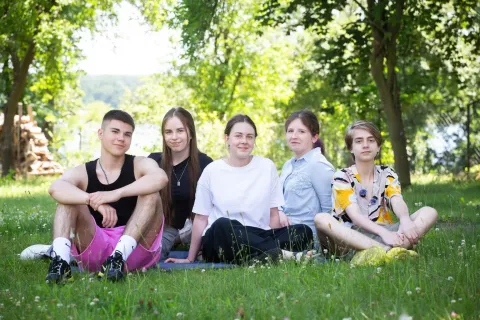
On 24 August 2025, we mark three and a half years since the escalation of the war in Ukraine. The crisis that began as an immediate emergency now has stretched into years – evolving into a protracted crisis requiring a different approach. Many of the children Joanna first met are now teenagers or young adults. They have been growing up in a new country, exploring unfamiliar conditions, with war as the backdrop to their youth.
“We’ve watched them grow, from losing their baby teeth to growing permanent ones, from changing hairstyles to dressing differently,” Joanna reflects. “I sometimes think about how different their childhoods could have been. But I also feel incredibly lucky to have been there for them. I truly hope that our presence, our listening ears, our open hearts, that all of it helped them feel a bit safer in this difficult time. That’s what mattered most for me – creating a space where they feel safe.”
For Agnieszka, a key priority of UNICEF’s refugee response in Poland is now supporting social integration: helping people feel part of their new communities and working with local and national administrations to build accessible, integrating systems.
“We must make sure everyone can feel safe, valued, and supported here,” she says.
On World Humanitarian Day, we honor the courage and compassion of humanitarians like Agnieszka and Joanna – professionals, volunteers, and community members alike.
Guided by the mission to protect life, dignity and hope, they remind us of humanity’s power, and potential for good, even in the most difficult of crises.
This work to support refugee children and their caregivers from Ukraine in Poland is made possible thanks to the generous support of the Bureau of Population, Refugees, and Migration of the U.S. Department of State (PRM), the Government of the Republic of Korea, and the Government of Japan.