“Don’t be afraid to take the first step”
Pathways to Success: how CESTY is connecting Ukrainian youth with job opportunities, and companies with promising young talent

- English
- Czech
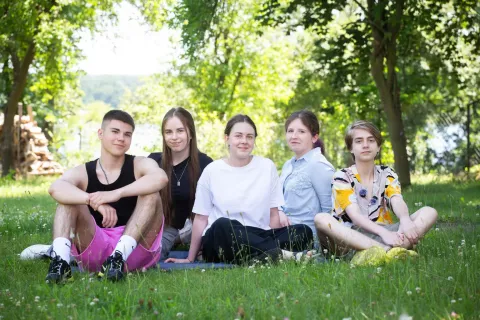
Over the past three years, more than 645,000 Ukrainians have arrived in Czechia. By the end of September 2025, nearly 400,000 remained. Almost 90,000 are young people aged 15-24.
For them, continuing their education and finding meaningful work have been central aspects of rebuilding their lives. The CESTY programme – launched by UNICEF, the Czech Government and other partners as part of the regional refugee response – was created to help.
Along with the Ministry of Labour and Social Affairs, the Ministry of Education, Youth and Sports, and the Ministry of Interior, CESTY has brought together national institutions, civil society organizations, the private sector, embassies, academia and youth to build pathways that turn uncertainty into opportunity. “Together, we are dedicated to helping young people rebuild their lives and look ahead with confidence,’’ says Yulia Oleinik, Head of the UNICEF Refugee Response Office in the Czech Republic.
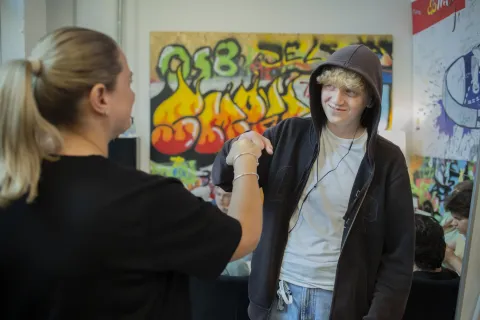
Since launch, CESTY has grown into a platform where young people discover opportunities and where employers connect with motivated candidates. Its online hub, CESTY.Space, offers both employment opportunities and training resources tailored for youth, while giving companies access to emerging talent.
“Youth aged 18-24 represent huge potential for the Czech labour market. Helping address demographic challenges, they also bring in energy and innovation. Employing them is therefore a smart and valuable investment for both sides,” says Anna Brabcová, Director of the Department of Labour Market Integration at the Ministry of Labour and Social Affairs.
Stakeholder engagement such as the Pathways to Success conference, held on 30 September 2025 in Prague, has been crucial in fostering dialogue and sharing best practices for improving young refugees’ access to quality opportunities in the Czech labour market. Organized by UNICEF and the Labour Office in cooperation with the Danish Embassy on the occasion of the Danish Presidency of the Council of the EU, the conference served as a platform of exchange for all involved parties.
How Ukrainian youth can help Czechia’s employers
The needs of Czechia’s labour market are diverse. While some roles require specialized studies or qualifications, many companies value potential and motivation over prior experience.
Meanwhile, insights from companies already working with young Ukrainians through CESTY are inspiring others to open their doors.
‘’The biggest benefit for employers engaging Ukrainian youth is the energy, enthusiasm, and drive they come with,’’ says Klára Fittnerová from EY. Other employers agree. “During a career day organized within CESTY we discovered Oleksandr, a motivated young refugee, who showed us his incredible drive. Now he’s working with us,’’ says Jana Kořínková from Metrostav.
Lukáš Ondřej from T-mobile sends a clear message: “Large companies that care about environmental, social, and governance values as well as corporate social responsibility should engage in initiatives like CESTY. As businesses, we need to be pragmatic and proactive in helping to bridge gaps in the workforce and supporting young talent, regardless of nationality, at the same time. I’m also impressed by how quickly some students master Czech and integrate into the workplace.”
“At Manpower, which has been involved with CESTY from the very beginning, we believe that every individual and every company should make a commitment to support young people, and for us, this means integrating it into our HR policies to provide meaningful employment opportunities,” reaffirms Lenka Vokáčová from Manpower.
“If you help one person, it’s like helping all of humanity,” concludes Marcela Hogenová from the Allen Overy Sherman Sterling LLP (A&O Shearman), an international law firm.
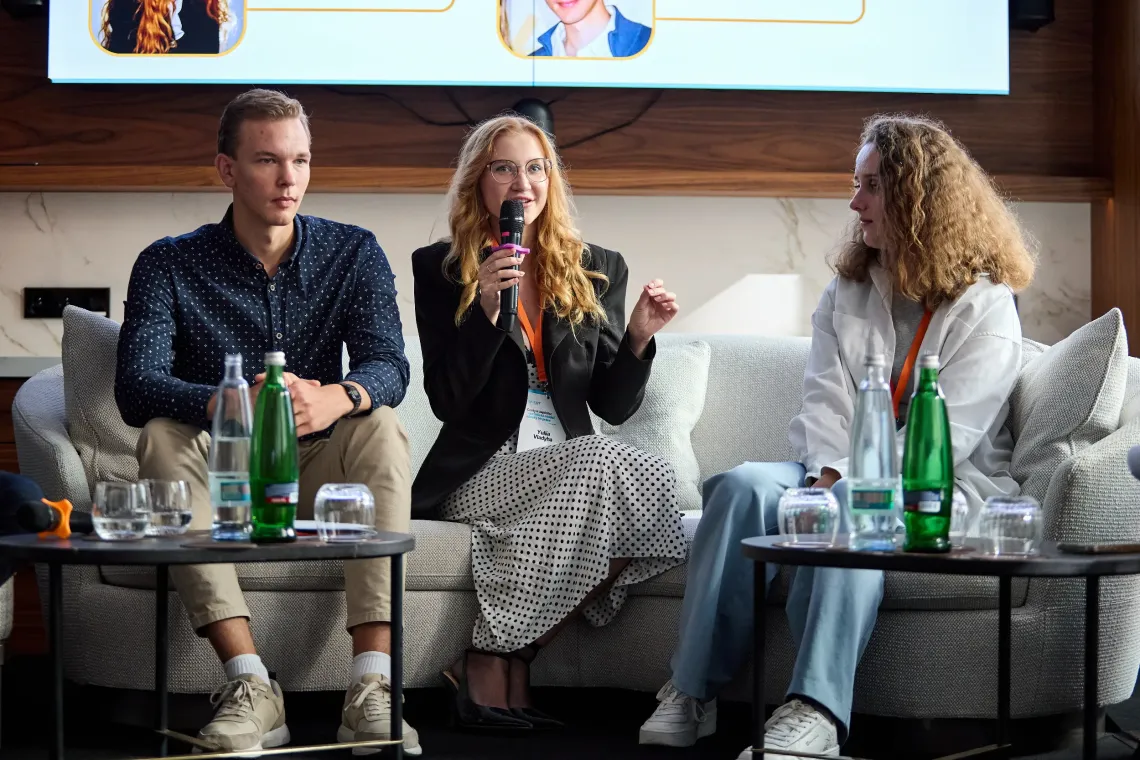
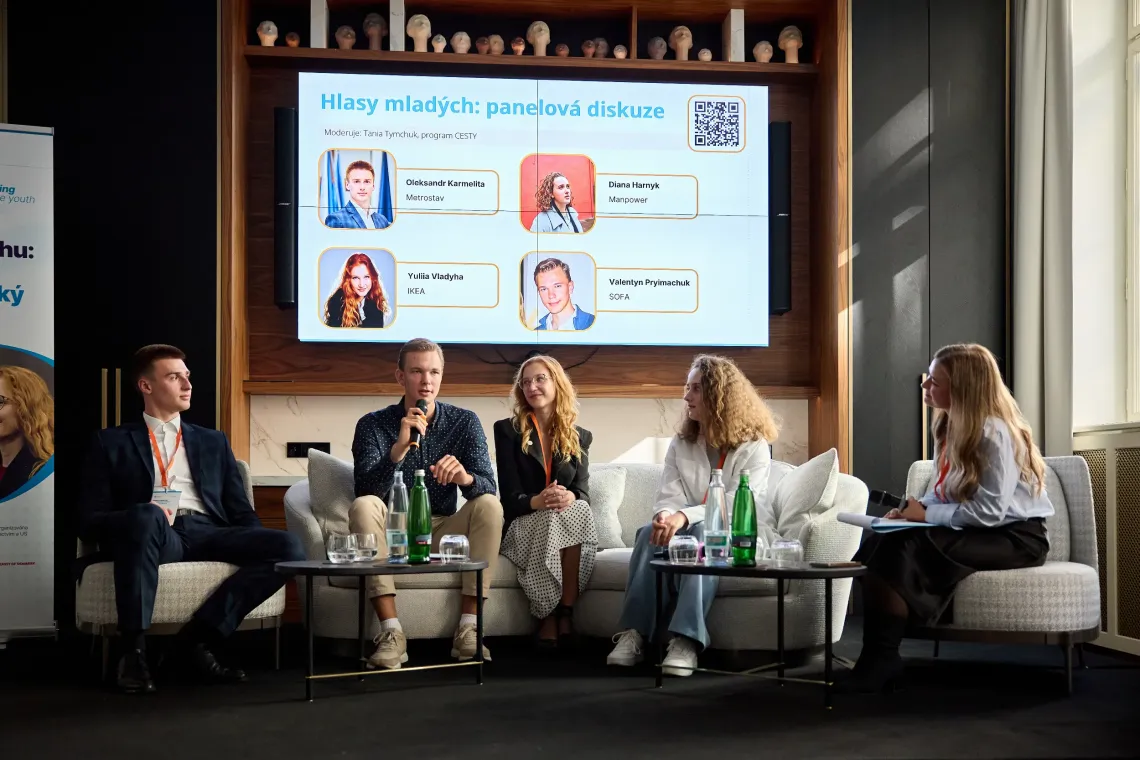
Stories from young people in Czechia
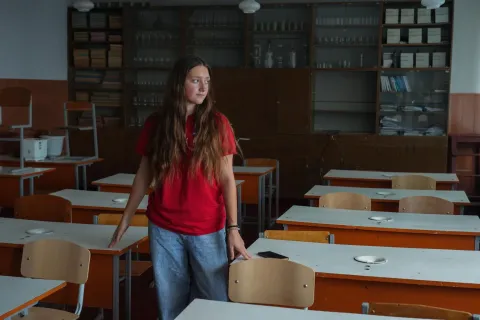
One refugee student from Ukraine now living in Czechia, 21-year-old Diana, told participants at the conference how difficult the transition was – and how much CESTY helped. Despite the language barrier, she mastered Czech in just three months thanks to the governmental programme offered, which also allowed her to pursue her international relations degree at Charles University.
However, she still struggled to find a job, sending many CVs each day. At a CESTY career day, she was connected with Manpower, where she is now gaining her first HR experience. “Even if young Ukrainians may not yet have much experience, you can be sure they are working hard to gain it. And they have so much to contribute,” she says.
Similarly, 21-year-old Valentyn arrived in Czechia when he was 17. Previously, he worked numerous jobs, from ticket office to factory work. “Many young people from Ukraine end up in low-skilled jobs – I want that to change,” he says. If he could tell his Ukrainian peers anything, he says, it would be, “Don’t be afraid to take the first step. Through CESTY, you can discover how to take that step, learn the language, build a CV, and find the motivation to follow in the right direction.”
Other refugees have similar stories.
“I felt lonely after arriving in Czechia from Ukraine in 2022 on my own, I doubted myself, had low self-esteem, and the language barrier was significant. I can see that in many young people – they struggle with their lives and also feel they have nothing to offer. For me, psychotherapy and volunteering as well as my first work experience helped. Then came the first ‘adult’ job with IKEA that gave me new skills and taught me about corporate culture. It wasn’t always easy, but I managed,” shares Yuliia, aged 22.
‘’The most difficult thing for me was being in Czechia without knowing the language. I didn’t even know how to say hello at first,’’ says 22-year-old Oleksandr, currently working in the HR’s marketing department of Metrostav, one of the biggest construction companies. ‘’In early 2025 I started working in the Regional Integration Centre for Foreigners that’s supporting refugee youth to integrate better into the Czech society by organizing various events, courses and helping in job searching. Then, I met the recruiters during one of the career days organized as part of CESTY and got the current job.’’
The impact of Ukraine’s young refugees
Whether young Ukrainians remain in Czechia or one day return to rebuild their homeland, their futures – and the futures of the communities around them – depend on sustained investment. That means not only financial resources, but also social investment: creating inclusive environments, opportunities to learn and work, and the support networks young people need to thrive.
“Refugee youth are already contributing more to the economy than they receive. Even at the Danish Embassy, most of the applicants for our open position came through CESTY – a testament to its impact,” says H.E. Soren Kelstrup, Ambassador of Denmark to Czechia. “Giving them opportunities is an investment: they will become Ukraine’s ambassadors, strengthening relations and helping build a brighter tomorrow when peace returns.” The Danish Embassy is leading by example – currently hiring a second intern from Ukraine.
David Wisner, Chargé d’Affaires of the U.S. Embassy in Czechia, further emphasizes that the CESTY programme is a powerful example of how society can respond to a crisis in ways that benefit everyone, providing both practical tools and a roadmap for inclusion. He highlights how CESTY has helped fill labour market gaps by connecting companies with Ukrainian talent, calling on participants to build on the initiative as a clear business case where humanitarian goals and economic benefits go hand in hand.
Thanks to CESTY, more than 9,900 adolescents and youth have joined non-formal education and skills development programmes, more than 14,200 have been supported to access and remain in formal education, and more than 13,500 have benefited from community-based mental health and psychosocial support and case management.
Each of these numbers tells a story of resilience – like those of Diana, Yulia, Valentyn and Oleksandr – showing that CESTY is not about survival, but growth, opportunity and societal contribution.
More than a programme, CESTY is a platform of co-creation where youth, companies, and institutions collaborate to build solutions. Their prospects – and those of their communities – depend on continued investment in education, skills, and opportunity.
Today, the Ministry of Labour and Social Affairs together with the Labour Office actively inform Ukrainian youth about available services and programmes. Labour Office specialists cooperate with youth representatives in every region to connect young people with employment and skills-building opportunities. These activities and best practices will continue.
The CESTY programme has been implemented in Czechia since 2024 with generous support from the Bureau of Population, Refugees and Migration of the U.S. Department of State, the Government of the Republic of Korea, the Swiss Confederation’s Rapid Response Fund and the European Bank for Reconstruction and Development.