Breastfeeding in Europe and Central Asia
Reducing the burden of preventable infections, cancer and chronic disease: an opportunity for the private and public sectors
Highlights
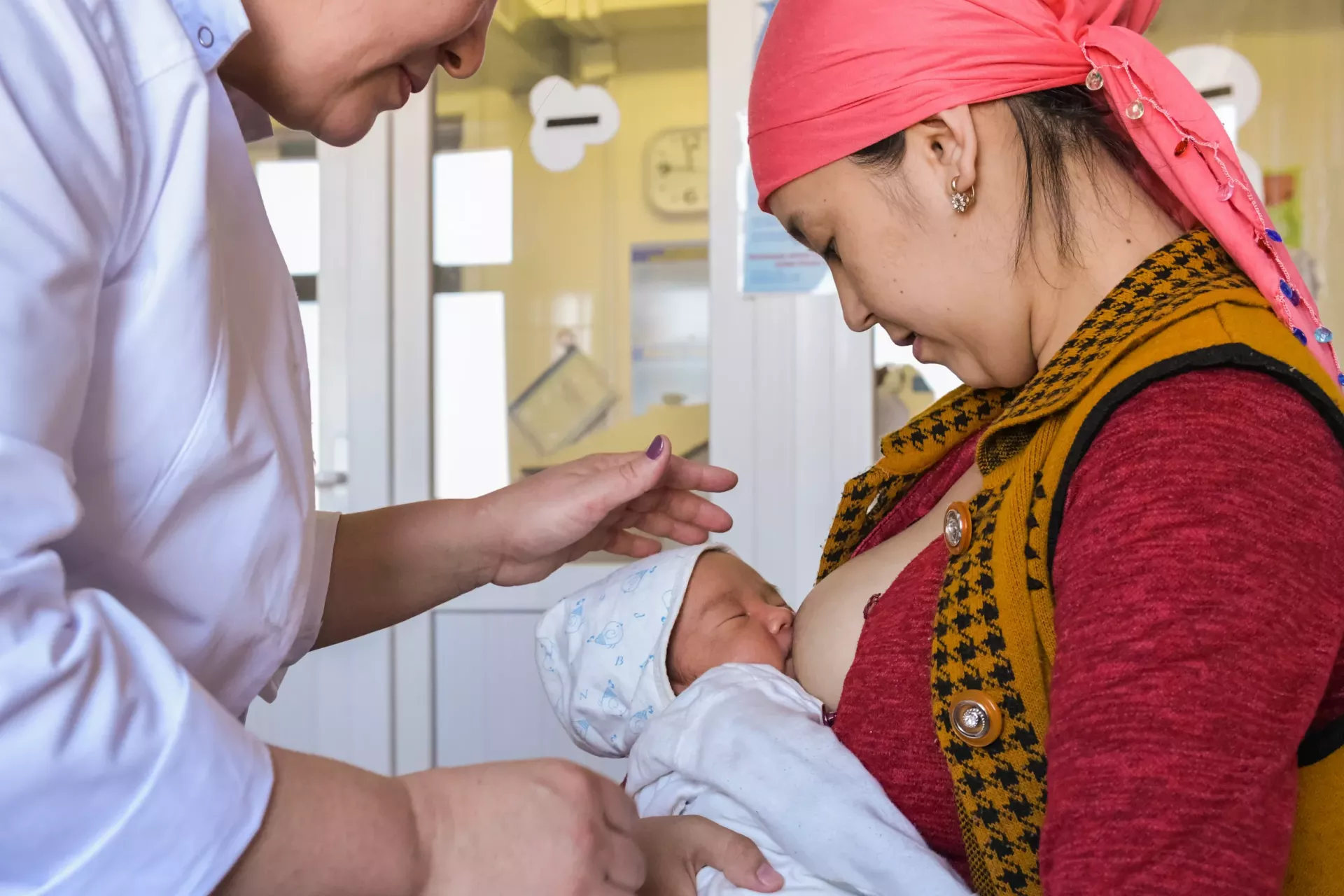
The scientific consensus is clear: breastfeeding protects the health of both children and mothers, short- and long-term. Among other benefits, breastfeeding reduces the prevalence of obesity, diabetes, and cancer.
Files available for download
If more babies were breastfed, estimates show that these health benefits alone could save the Europe and Central Asia region billions of dollars each year – as well as thousands of lives.
The health benefits aren’t the only ways in which breastfeeding can build healthier, more cost-effective societies. Breastfeeding benefits neurocognitive development in children, including in pre-term infants who can be most at risk of poorer developmental outcomes.1
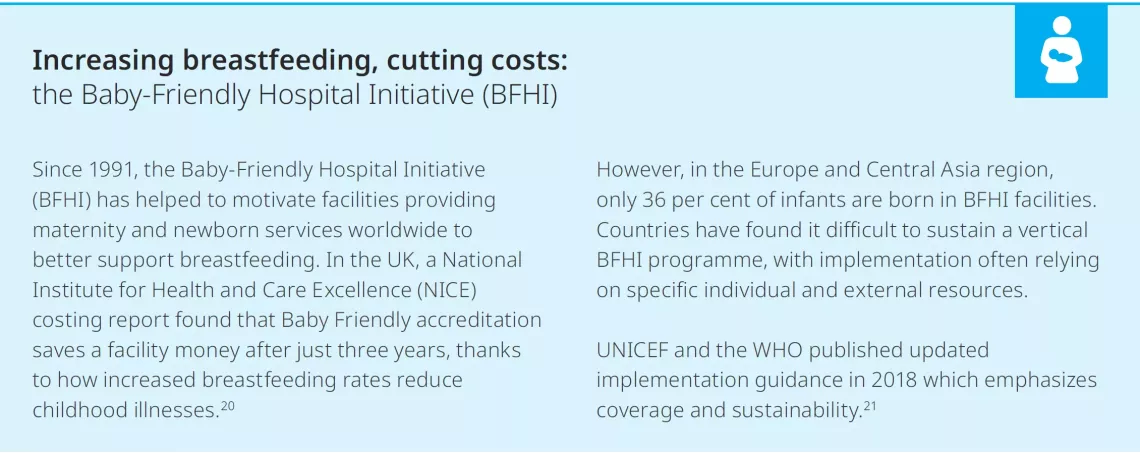
In some countries, improvements to breastfeeding support, maternity care, and the introduction of schemes such as baby-friendly hospitals have had an impact in improving breastfeeding rates.
Yet the Europe and Central Asia region persists in having some of the lowest breastfeeding rates in the world.2
This is despite the fact that some of the region’s most difficult challenges – including rising rates of obesity, diabetes and cancer – could be offset by higher breastfeeding rates.
This means that not breastfeeding has real costs – both economic, and in lives.
The costs of not increasing breastfeeding support and rates across the region are high. If breastfeeding rates in Europe and Central Asia do not increase, the region will see:
- Economic costs: an estimated US $80.3 billion lost annually to mortality, morbidity and health system expenses.
- Increased mortality: an estimated 11,829 children and women will die annually from breastfeeding-preventable deaths.3
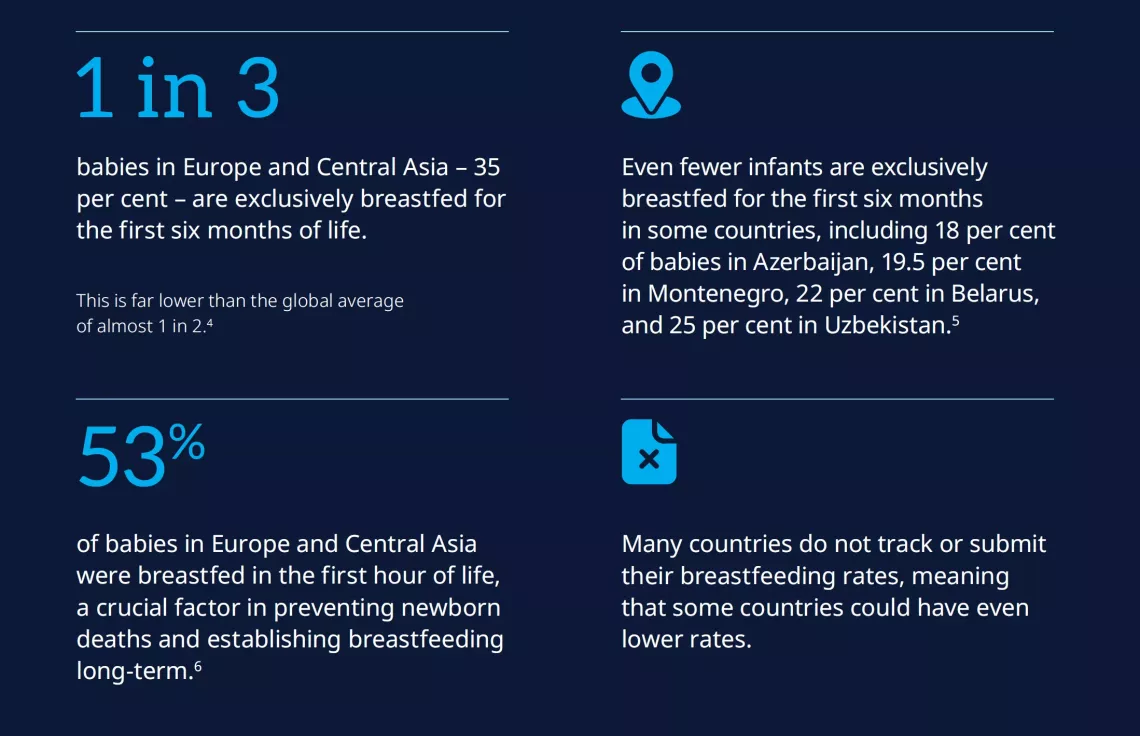
How higher breastfeeding rates could cut healthcare costs and save lives in Europe and Central Asia
More than 50 years of research on infant nutrition and lactation have found that breastfeeding offers a host of health benefits to both parents and children.
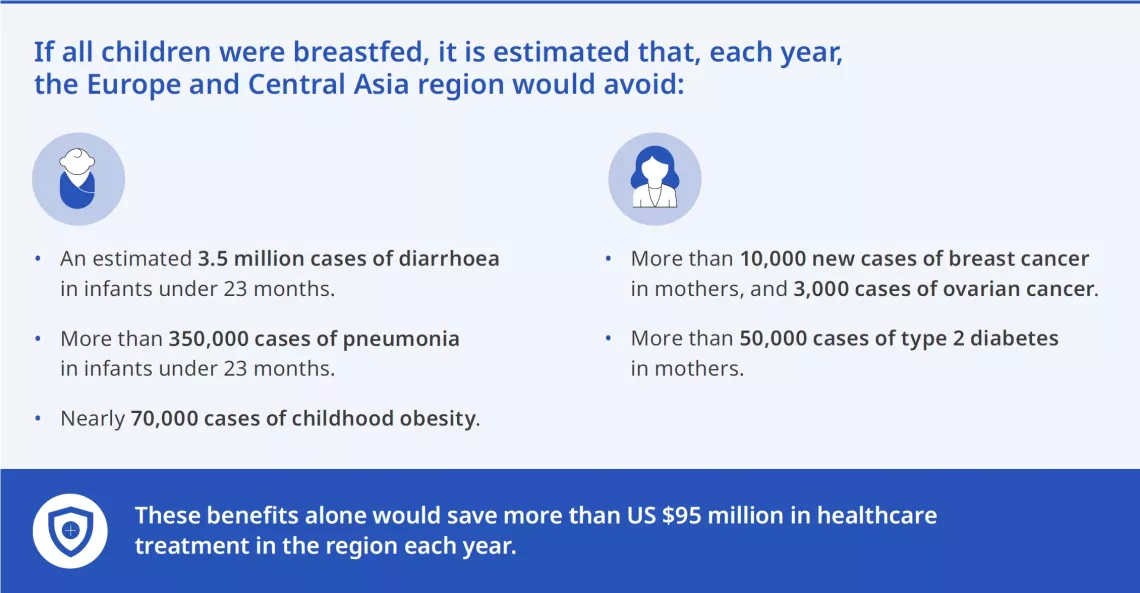
One of the most impactful is protection against gastrointestinal infections, including in upper- and middle-income countries. If all babies in the Europe and Central Asia region were breastfed, it is estimated more than 3.5 million cases of diarrhoea each year in infants under 23 months of age would be avoided.7
Breastfeeding also reduces the risk of ear infections and respiratory infections, such as pneumonia, including in high-income countries.8
One of the biggest benefits of breastfeeding could be in reducing the region’s burden of chronic disease and cancer.
More than 1 in 10 children aged seven to nine in Europe and Central Asia is living with obesity. Most countries have higher child obesity rates today than they did just five years ago.9 But breastfeeding protects against the development of child obesity: it has been estimated that nearly 70,000 cases of childhood obesity per year could be avoided by breastfeeding in Eastern Europe and Central Asia alone.10
Breastfeeding also benefits the health of the mother. Diabetes, for example, is one of the most common chronic diseases across 53 countries in Europe and Central Asia, affecting 64 million adults and causing more than 185,000 deaths per year.11 Researchers have found that mothers who breastfed for six months or more had half the risk of developing type 2 diabetes, compared to mothers who did not breastfeed at all.12
Higher breastfeeding rates also could reduce the region’s costly cancer burden. For example, for mothers who have breastfed, the risk of developing breast cancer is nearly 40 per cent lower than in mothers who have never breastfed.13 Breastfeeding also has been associated with a 24 per cent reduction in the risk of developing ovarian cancer,14 and around a 10 per cent reduction in risk of developing endometrial cancer (the most common type of uterine cancer) or thyroid cancer.15,16
Key messages
Breastfeeding - if made accessible to all - is one of the most effective way to protect both children and their mothers from preventable diseases, and protect children’s neurocognitive development.
But current policies and systems mean it is out of reach for far too many families. And with the way in which many societies and workplaces are set up, breastfeeding is not ‘free’ – and can come with an economic, social, emotional or physical cost that many families cannot afford.

In Europe and Central Asia, barriers to breastfeeding include:
- The absence of quality, effective lactation support.
- Gaps in awareness of breastfeeding’s importance, and of current guidance for how to support it, from healthcare providers, including maternity staff, paediatricians, primary healthcare providers and home visiting teams.
- Medical interventions for either mother or baby, such as a caesarean section or an infant’s stay in neonatal intensive carebreastfeeding.17
- Lack of adequate support for breastfeeding from
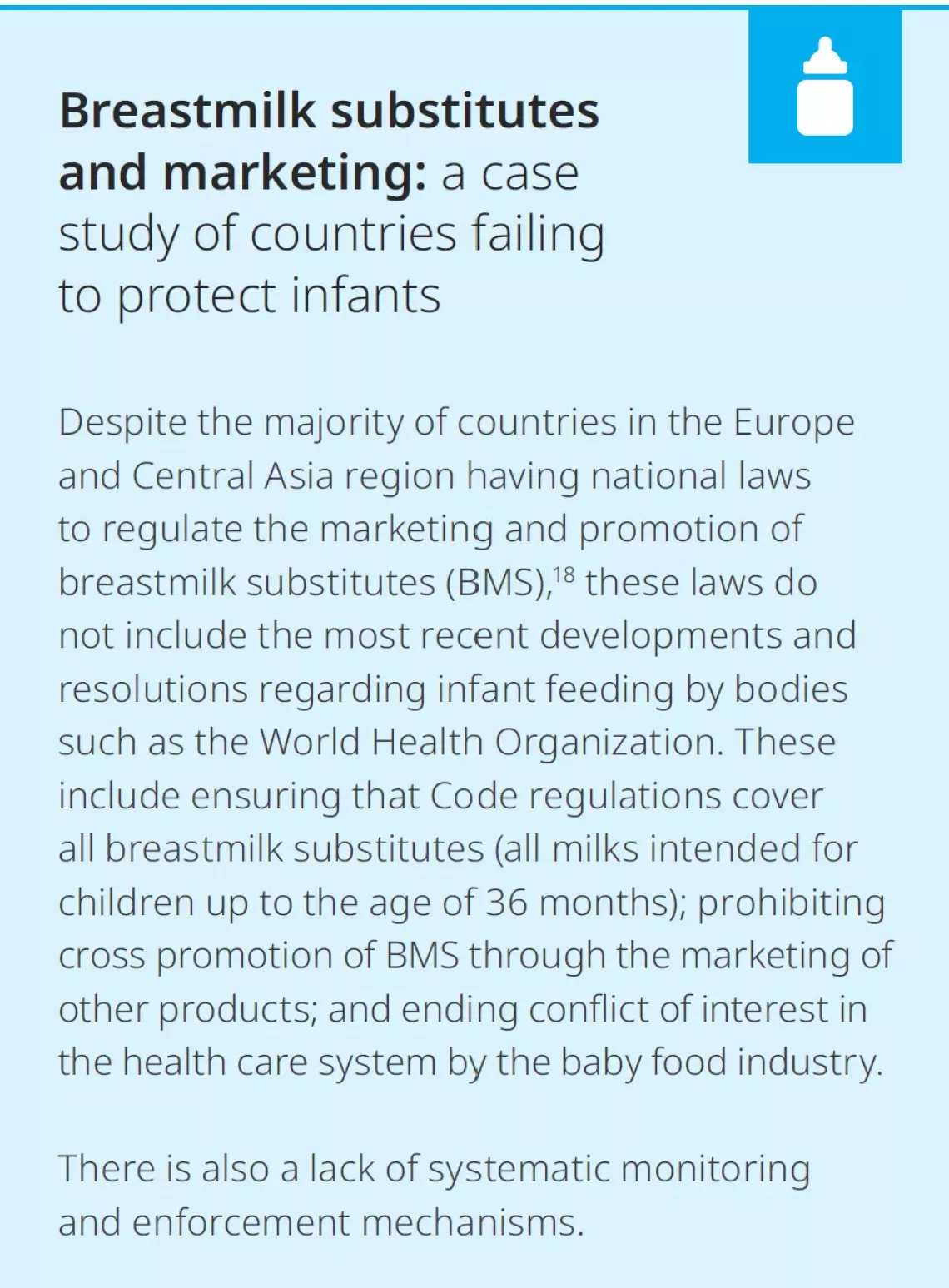
a partner, family and/or friends. - Aggressive marketing of breastmilk substitutes
(BMS) and a failure to pass or enforce regulations regarding their marketing. - A lack of sufficient maternity leave that requires many mothers to return to work before breastfeeding is fully established.
- Failure of workplaces to support lactating mothers, such as through pumping breaks and clean, safe, accessible pumping spaces.
- Lack of awareness of the legal rights of breastfeeding parents, such as the right to breastfeed in public spaces.
- Lack of community and/or cultural awareness on the importance of exclusive breastfeeding.
- Misinformation online, particularly on social media, regarding breastfeeding’s importance and best practices.
In May 2018, the World Health Assembly adopted a new resolution regarding infant and child feeding. The resolution urges Member States to:
- increase investment to protect and promote breastfeeding
- reinvigorate the Baby-Friendly Hospital Initiative
- strengthen measures to give effect to the International Code of Marketing of Breastmilk Substitutes
- promote timely and adequate complementary feeding
- end inappropriate promotion of foods for infants and young children
- and ensure appropriate child feeding during emergencies.19
A case for investment
As part of UNICEF’s commitments to improving nutrition and supporting child development worldwide, one of our goals is improving breastfeeding rates in Europe and Central Asia – which are among the lowest in the world. In particular, we:
- advocate for the full implementation and enforcement of the International Code of Marketing of Breast-milk Substitutes, and relevant World Health Assembly resolutions, including the early initiation of breastfeeding and exclusive breastfeeding until the age of six months
- support health care workers with up-to-date nutrition and lactation advice, including through primary health care and home visiting programmes
- work with organizations such as the Human Milk Bank Foundation to help families access breastfeeding support, education and donor milk
- advocate for business policies, practices and policies that support breastfeeding families, such as paid maternity leave, safe spaces to breastfeed at work, and flexible approaches for a return to the workplace
- provide and support monitoring for breastfeeding rates and barriers to address remaining gaps, such as through the Global Breastfeeding Scorecard.
UNICEF in Europe and Central Asia is seeking US $4 million in funding to support breastfeeding across the region for:
- Training healthcare providers to improve their knowledge and skills to support women and families with breastfeeding counselling and lactation management
- Strengthening national Code laws and regulations so they are significantly aligned with the International Code of Marketing of Breastmilk Substitutes and subsequent WHA Resolutions and establish monitoring and enforcement mechanisms
- Developing a pre-service curriculum for breastfeeding promotion.
Endnotes
- UNICEF UK, ‘Baby Friendly Research’, UK National
Committee for UNICEF, London, www.unicef.org.
uk/babyfriendly/news-and-research/baby-friendlyresearch, accessed 16 June 2025. - UNICEF, ‘Breastfeeding’, UNICEF New York, https://data.unicef.org/topic/nutrition/breastfeeding, accessed 16 June 2025.
- Walters, Derek D., Linh T.H. Phan and Roger Mathisen, ‘The Cost of Not Breastfeeding: Global results from a new tool’, Health Policy and Planning, vol. 34, no. 6, 2019, pp. 407–417, https://doi.org/10.1093/heapol/czz050, accessed 16 June 2025.
- UNICEF, ‘Breastfeeding’, UNICEF New York, https://data.unicef.org/topic/nutrition/breastfeeding, accessed 16 June 2025.
- Ibid.
- Ibid.
- Walters et al., ‘Cost of Not Breastfeeding’, accessed
16 June 2025. - Rollins, Nigel, C. et al., ’Why Invest, and What It Will
Take to Improve Breastfeeding Practices?’, The Lancet, www.thelancet.com/journals/lancet/article/PIIS0140-
6736(15)01044-2/abstract, accessed 16 June 2025. - World Health Organization, Brief Review of Results from Round 6 of COSI (2022–2024), Geneva, 2024, who.int/europe/publications/m/item/brief-review-of-resultsfrom-round-6-of-cosi-2022-2024, accessed 16 June 2025.
- Walters et al., ’Cost of Not Breastfeeding’, accessed
16 June 2025. - World Health Organization, ‘Diabetes Fact Sheet’,
Geneva, who.int/europe/news-room/fact-sheets/item/
diabetes, accessed 16 June 2025. - Gunderson, Erica P., et al., ‘Lactation Duration and
Progression to Diabetes in Women across the
Childbearing Years: The 30-Year CARDIA Study’, JAMA Internal Medicine, vol. 178, no. 3, 2018, pp. 328–337, doi.org/10.1001/jamainternmed.2017.7978, accessed 16 June 2025. - Zhou, Yan, et al., ‘Association between Breastfeeding
and Breast Cancer Risk: Evidence from a Meta-analysis’, Breastfeeding Medicine, vol. 10, no. 3, 2015, pp. 175–182, doi.org/10.1089/bfm.2014.0141, accessed 16 June 2025. - Babic, Ana, et al., ‘Association between Breastfeeding and Ovarian Cancer Risk’, JAMA Oncology, vol. 6, no. 6, 2020, e200421, doi.org/10.1001/jamaoncol.2020.0421, accessed 16 June 2025.
- Jordan, Susan J., et al., ‘Breastfeeding and Endometrial Cancer Risk: An Analysis from the Epidemiology of Endometrial Cancer Consortium’, Obstetrics & Gynecology, vol. 129, no. 6, 2017, pp. 1059–1067, doi.org/10.1097/AOG.0000000000002057, accessed 16 June 2025.
- Nielsen, Samantha M., et al., ‘The Breast–Thyroid Cancer Link: A Systematic Review and Meta-analysis’, Cancer Epidemiology, Biomarkers & Prevention, vol. 25, no. 2, 2016, pp. 231–238, doi.org/10.1158/1055-9965.EPI-15-0833, accessed 16 June 2025.
- National Institute for Health and Care Excellence (NICE), Postnatal Care: Breastfeeding Facilitators and Barriers, NICE guideline NG194, National Guideline Alliance, Royal College of Obstetricians and Gynaecologists, London, 2021.
- World Health Organization, UNICEF and IBFAN, National Implementation of the International Code, Status Report 2024, Geneva, 2024, iris.who.int/bitstream/handle/10665/376854/9789240094482-eng.pdf?sequence=1, accessed 16 June 2025.
- World Health Organization, Sixty-seventh World Health Assembly, Summary of Provisional Decisions and Decisions Adopted by the Health Assembly (WHA71-REC1), Geneva, 2018, <apps.who.int/gb/ebwha/pdf_files/WHA71-REC1/
A71_2018_REC1-en.pdf>, accessed 16 June 2025. - National Institute for Health and Care Excellence (NICE), Guideline CG37, London, 2006 (updated 2015), nice.org.uk/guidance/cg37, accessed 16 June 2025.
- UNICEF, Decade of Action on Infant and Young Child Feeding in Europe and Central Asia, UNICEF Regional Office for Europe and Central Asia, unicef.org/eca/media/17061/file/Decate%20of%20Action%20on%20Infant%20and%20Young%20Child%20Feeding%20in%20Europe%20and%20Central%20Asia.pdf, accessed16 June 2025