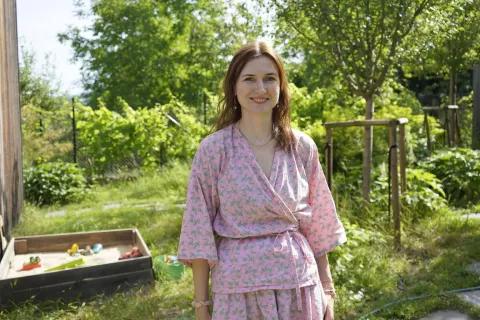
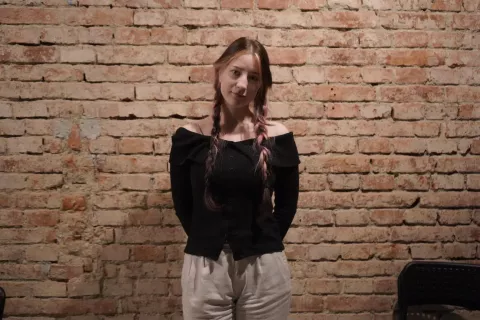
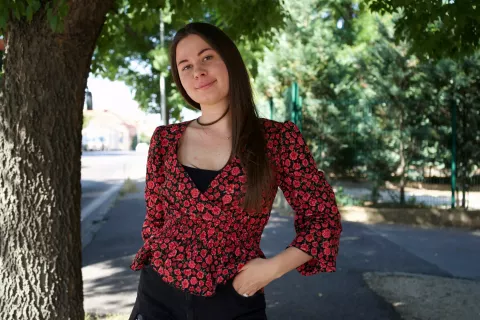
Soap bubbles float in a room of the Scouts’ House in Banská Štiavnica, Slovakia, which hosts one of the 80 community centres coordinated by UNICEF and the League for Mental Health. Below the bubbles, Masha wiggles as they touch her skin, while Kira is sound asleep. Above them kneels Zdenka; social worker and culprit for the bubbles’ presence.
Both Masha and Kira are Ukrainian, and they arrived in Slovakia in March 2022, soon after the escalation of war in their home country. They both have severe motor and neurological disabilities: their moment is limited, and they cannot speak. They live in almost constant pain. Kira is also blind.
As of August 2023, over 120,000 Ukrainians – mostly women and children – applied for Temporary Protection in Slovakia. Among refugee children, children with disabilities often face additional barriers in accessing support and being included in host communities.

Kira was tired of apple pudding
Maria, Kira’s mother, recalls the days before she had to leave Ukraine. "I did not believe them," she says of her friends' warnings. "I realized they were right only when I heard the sound of the first bombs."
With Kira's disability, their journey to safety was complicated. Many people, however, helped them along the way. “I remember, before crossing into Poland, a group of volunteers gave us some apple pudding for Kira,” she says. While the family was grateful, “Kira got so tired of eating pudding,” she laughs.
Svitlana, Masha’s mother, says the family stayed in Ukraine for two weeks before moving, waiting to see how the situation evolved. Masha’s disability made it difficult to hide from the air raids. Concerned for their safety, they fled to Slovakia. "We did not want to go too far from Ukraine," Svitlana explains. “We also wanted to be somewhere we could easily understand the language and adapt.”

Snow, bubbles and songs
Both families found hope in a UNICEF-supported community centre for mental health and psychosocial support. There, Zdenka, their social worker, has dedicated herself to creating a nurturing environment for Masha and Kira. Through sensory and senso-motoric stimulation – using bubbles, for instance – Zdenka helps them develop and relax, forging connections with their families and supporting them along the way.
Masha's mother, Svitlana, notes how Zdenka's efforts helped her daughter: "Masha is smart, even sneaky. She does not talk but she loves singing... She likes her small circle of people." Getting support was difficult when they arrived in Slovakia because Masha did not like the specialists that were assigned to her. Everything changed when she met Zdenka.

For Kira, the centre offered more than therapy; it extended a lifeline to Maria and her family. "Through the centre, I found a lot of support, including for my own mental health," Maria says, her gratitude is clear.
The connections established through the centre introduced them to essential medical care, including dentists, pediatricians and providers of orthopedic trolleys and wheelchairs. Masha will soon undergo an operation aimed at reducing her pain and increasing her mobility. Both families also receive humanitarian cash assistance for parents of children with disabilities set up by UNICEF and the Government of Slovakia.

I would do the same
Amidst their physical limitations, Masha and Kira find joy in simple pleasures – from singing songs to the sensation of touching cold materials like metal or snow. Due to their disabilities, touch is how both girls explore the world.
“Although Kira can’t smile nor speak, whenever we come out of the centre, I can sense she is happy,” says Maria.
“If I didn’t have Kira and had free time, I would do what the social workers of the centre do,” Maria continues. “So many Ukrainians need support, especially the ones that came here alone,” she concludes.
This work to support refugee children and families in Slovakia has been made possible with generous contributions from the people of Australia through UNICEF Australia as well as from the Bureau of Population, Refugees, and Migration of the US Government.