Growing up protected, generation after generation
In the Democratic Republic of the Congo, vaccines support every stage of life, driven by a collective commitment

- Français
- English
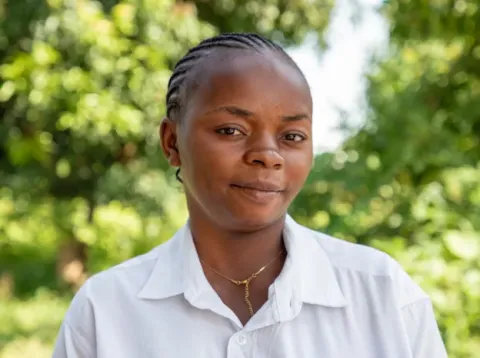
Odette gently rocks her three-month-old son Elvis in a UNICEF-supported health centre in the Democratic Republic of the Congo (DRC). Between two classes at the school where she teaches, she has taken the time to bring him for his vaccination appointment.
“The vaccines he receives protect him against several diseases, including measles, polio, meningitis and tuberculosis,” she explains. “I do everything I can to make sure my children are vaccinated, because it’s essential for their health.”
For Odette, vaccination is something that has always felt obvious.
“We were vaccinated as children too. If we are healthy today, it’s thanks to that.”


Like Elvis, more than 4.6 million infants were reached with routine immunisation, according to data from the Expanded Programme on Immunisation supported by UNICEF.
“Vaccines protect both children and their families,” Odette adds.
In Tanganyika province, five-year-old Pierot also received vital protection against polio during a vaccination campaign. Behind every vaccinated child is a collective effort, driven by committed women and men working at the heart of communities.


For more than ten years, Madeleine has been one of those trusted faces in the community of Kalungu. During campaigns, she goes from household to household, vaccine carrier on her shoulder, administering a few drops of oral polio vaccine.
“Every drop counts to protect our children,” she says.
Thanks to the mobilisation of thousands of community health workers and vaccinators, more than 27 million children under five were vaccinated against polio in 2025. In some provinces, the target group was expanded to include children up to 14 years old, allowing nearly 2 million additional children to be protected.


Behind these efforts is an entire system working quietly in the background: a reliable supply chain, strong cold chain equipment, and close coordination between health authorities and their partners.
These investments not only ensure that children are vaccinated, but also enable a rapid response to outbreaks.
When mpox threatened families in Goma, Furaha Kanyere chose to get vaccinated to protect herself and her loved ones.

“I didn’t hesitate,” she says. “It’s a way to protect myself, but also my children.”
Nearly 1.5 million people at risk were vaccinated against mpox in 2025. In other contexts, such as the Ebola outbreak in Kasaï, thousands of people were also vaccinated.
Didier Bokele, 47, is one of them.
“Getting vaccinated means protecting yourself, your family and your community. I encourage everyone to do the same.”

Vaccination does not stop in early childhood. It protects people at every stage of life. In 2025, as the DRC faced its worst cholera outbreaks in decades, more than 10 million people were vaccinated as part of the response.
The year also marked a major step forward with the introduction of the measles-rubella vaccine, protecting more than 16 million children.
These achievements are the result of a collective effort, from national authorities to communities, with the support of technical and financial partners.


In Kinshasa, the fourth National Forum on Vaccination marked renewed momentum, with the launch of the Mashako Plan to strengthen routine immunisation and a reinforced commitment to reach zero-dose children and tackle preventable diseases.
At the same time, young people continue to carry this message forward. Through UNICEF-supported initiatives, voices like Consolation Hata’s are helping call for greater investment in child vaccination.
Beyond the numbers, vaccination tells a simple story: one of generations protecting one another. From Odette to Elvis, from Madeleine to the children she vaccinates, from Didier to his community, one message is passed on: vaccines work, for every child and for every generation.
UNICEF thanks the Government of the DRC, the World Health Organization (WHO), the Bureau of African Affairs of the United States Department of State, the Gates Foundation, the Government of Canada, Rotary, Gavi, the Vaccine Alliance, the Centers for Disease Control and Prevention (CDC), as well as the European Commission–European Investment Bank (EIB) and the King Salman Humanitarian Aid and Relief Centre (KSrelief).