Every child counts, every drop protects
In eastern DRC, women and men mobilize to end polio

- Français
- English
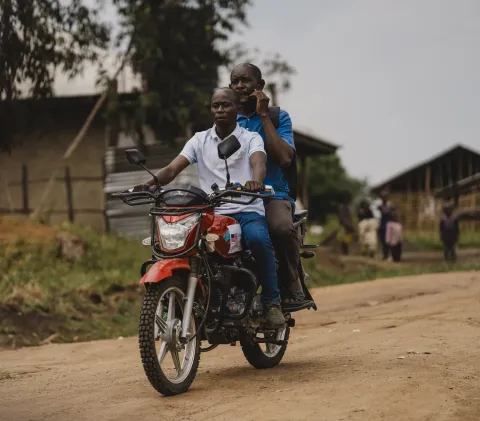
In the hills of North Kivu and South Kivu, the fight against poliomyelitis is part of everyday life. Every drop of vaccine carries the dedication of a passionate advocate, a reassuring voice, and a shared hope: to see a generation of children grow up free from the disease.
The polio vaccine is given in just a few drops, yet each dose can require hours of walking, patient conversations and, sometimes, immense courage.
Supported by UNICEF, vaccination teams travel to reach families, even in the most remote villages, to protect children from a virus that still threatens their future.
At Ihusi, in South Kivu province, health worker Matthieu Munganga knows nearly every family by name. His grey cooler never leaves his side during vaccination campaigns.

“When I vaccinate a child, I feel like I’m protecting the whole village,” he says with a smile, walking from house to house. “It’s not only about giving a vaccine: it’s about listening, reassuring, and showing that every life matters.”
In a context marked by displacement and misinformation, Matthieu’s work is an act of trust. He brings much more than drops of vaccine: simple words, reassuring messages, and a promise of protection for children.
Sitting in the shade outside her house, Faida Bahavu watches her three children – Astride, Gladis, and six-month-old Exaucé – after they received their oral polio vaccine.


“When the vaccinators arrive, I’m always ready,” she says proudly. “I know how important it is for my children. A well-vaccinated child doesn’t get sick easily.”
Her confidence inspires others. Around her, other mothers follow her example, ensuring their children are protected too.
In Butembo, North Kivu, Zawadi Kasereka moves carefully with the help of a crutch. Polio has left traces on his body, but it has also shaped his determination.
“I was born at a time when there were many myths about vaccination,” he recalls. “My parents used to hide me when vaccinators came, and that decision changed my life forever.”

Today, Zawadi dedicates his energy to making sure no other child faces the same fate. Campaign after campaign, he walks through neighborhoods, reassures families, and helps protect children.
“Many parents now agree to have their children vaccinated. Mothers know the importance of the vaccine and even come looking for us to make sure their children aren’t left out,” he explains confidently.
About 50 kilometers away, in Beni, Cécile Kyakimwa walks the streets with a smile and a vaccine cooler. A mother of six, she has long been a leader in her community, driven by a deep sense of solidarity.

“What motivated me was the desire to help,” she says simply. As president of a community coordination cell, she manages more than 100 community workers, 40 of whom mobilize during every vaccination campaign.
To sustain their efforts, the group produces palm oil and soap and operates a community savings system to fund their activities independently.
“Polio is still present in the region, and thanks to these efforts, we are helping to protect the next generation.”
In an area affected by displacement, significant identification work is carried out before each campaign to ensure that no child is missed.
Patience Godu found refuge with her nine children in front of a building in the city of Beni, where she lives with about 15 other families.


“Even with all these challenges, my children received their vaccines, including my youngest, who is 11 months old,” she says. “For me, a vaccine is like an umbrella in the rain: it helps children better resist disease.”
Beside her, little Princesse smiles after her vaccination. “I want to go to school,” she says. “With a skirt, a shirt, and a bottle that Mama will buy for me.”
The polio vaccine acts like an umbrella in a storm – or the arms of a mother during a cry – a quiet but essential protection.

“I want Jayden to grow up healthy, and vaccination is key to making that happen,” says Syntique after vaccinating her 9-month-old son in Goma.
In 2025, more than 28 million children were vaccinated across the Democratic Republic of the Congo, thanks to the joint efforts of the Government of DRC, the World Health Organization (WHO), USAID, the Gates Foundation, the Government of Canada, Rotary, Gavi, the Vaccine Alliance, the Centers for Disease Control and Prevention (CDC), the European Commission – European Investment Bank (EIB), and the King Salman Humanitarian Aid and Relief Centre (KSrelief).