A ray of hope in Lebanon
Whilst ongoing conflict disrupts education across the country, UNICEF’s Learning Passport is working with partners to drive learning continuity.

The escalating conflict in Lebanon is having a devastating impact on girls and boys across the country. Since the escalation began, hundreds of children have been killed and even more injured.
“That’s a classroom of children every day since the beginning of the war – killed or injured in Lebanon,” said UNICEF Deputy Executive Director Ted Chaiban after his visit to Lebanon in March. “In a shelter in Beirut, I met 15-year-old Fatima who had escaped with her family from the South to the same school they took refuge in 18 months ago. She told me that the night before I met her she had laid awake listening to the bombing hitting the southern suburb of Beirut worried about her family, her friends, her future. All she wants is to be able to go home and get back to school.”
But Fatima’s hope of a return to the classroom is on hold – a dream disrupted by the latest outbreak of conflict.
Though some schools have gradually managed to reopen for in-person learning, hundreds are still in use as collective shelters, bear severe structural damage from airstrikes, or are located in areas that continue to be directly affected by the conflict. Approximately 165,000 children are learning remotely as their schools were either converted to shelters or closed due to their location in a war zone area. For these girls and boys digital learning is not merely a supplement — it is a lifeline — and for many Lebanese children, the only thread of educational continuity that remains.
This also exacerbates ongoing learning losses as Lebanon was already facing a deep education crisis. An estimated 1.1 million students enrolled in formal education have experienced disruptions to learning since 2019, with around 400,000 children remaining out of school all together.






A digital lifeline
To address these challenges, UNICEF has been working closely with the Ministry of Education and Higher Education to expand remote learning through the national digital learning platform known as Madristi (the localized Learning Passport platform).
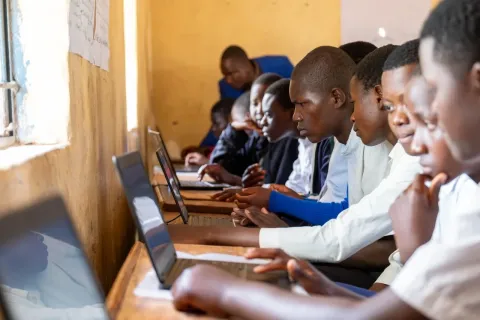
With support from UNICEF’s Learning Passport – in collaboration with Microsoft and the United Nations International Computing Centre (UNICC) – an estimated 400,000 students enrolled within the public education system and 50,000 teachers are now able to access Madristi.
The Learning Passport is UNICEF’s global digital learning programme in 51 countries, which provides localized, curriculum‑aligned education for children and young people. The adaptable and portable digital learning platform enables children and young people to continue learning anywhere, at any time, including in crisis-affected settings. Through offline functionality and multiple delivery approaches, the programme is able to meet learners wherever they are. By the end of 2025, the Learning Passport had 12.5 million registered users, comprising both learners and educators.
Madristi currently hosts over 540 courses aligned to the national curriculum, this includes over 9,000 lessons for all grades and subjects that can help keep learning alive for students. Government officials, UNICEF and partners are working closely together to meet the moment and to ensure learners have continuous and reliable access to the platform. This includes a drive to engage and prepare teachers – sharing teacher credentials via SMS and WhatsApp, creating Microsoft Teams classrooms to connect them with learners and establishing call centres to provide efficient troubleshooting support with technical issues arising.
Blended learning solutions to reach every student
To ensure continuity of learning for all children affected by the crisis, ensuring no child is left behind, a set of complementary learning modalities has been deployed, combining online and low-tech solutions.
Madristi has been ‘zero-rated’ thanks to support from the Ministry of Telecommunications. This enables students to access the platform without incurring data charges, helping ensure access is equitable and inclusive.
Additionally, low-tech solutions are also being implemented to help reach more children and communities. This includes a ‘call and learn tutoring hotline’ that provides remote and free-of-charge academic support through qualified teachers. The service operates through both direct student outreach via WhatsApp and referrals from MEHE through UNICEF.
The distribution of printed learning materials ensures no child is left behind, regardless of access to connectivity and devices, supporting both self-paced and guided learning at home, in shelters or community spaces. Distribution includes children in war zones and hard to reach areas that lack connectivity and are therefore unable to participate in online learning, complemented by low-tech tutoring support through the hotline.




The story so far
The Madristi story highlights the value of taking human-centred, equity-driven approaches to digital learning as we go beyond digital as usual to transform the delivery of digital education in the 21st century.
Initially piloted during the 2023–2024 school year in 14 public schools, Madristi demonstrated strong teacher buy-in and high student engagement, particularly in Grades 6 and 7 across math, science and languages. Implementation research found that teachers valued the curriculum-aligned content and students loved the videos and other interactive exercises.
Despite operational challenges, the pilot confirmed that digital learning is most impactful when supported by training, mentoring, aligned content, and developed with equity in mind.
Building on this foundation, Madristi was rapidly scaled in response to the escalation of conflict in the first quarter of the 2024–2025 school year. In coordination with Government partners and the Center for Educational Research and Development (CERD), UNICEF supported a national capacity-building effort, including webinars on the use of Microsoft Teams, virtual classrooms, flipped learning, safe learning in emergencies, and platform navigation, reaching and supporting around 10,000 teachers.
Madristi is a cornerstone of Lebanon’s national learning recovery and system strengthening efforts. To expand access, Madristi offline servers will be deployed in around 200 public schools with no or low internet bandwidth, enabling access to interactive, curriculum-aligned digital content without the need for connectivity.
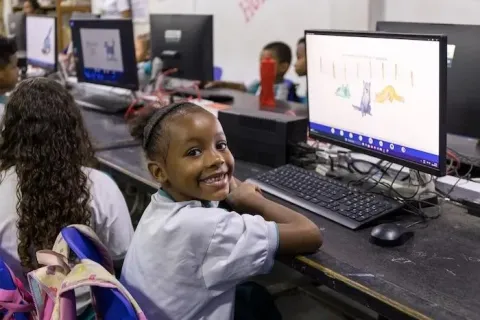
As part of its digital transformation programme for Lebanon, UNICEF in coordination with the MEHE also equipped 544 public schools with a solid connectivity network and digital equipment. Together with Madristi this will enable the integration of blended learning during in-person teaching and learning, providing public schools students with enhanced digital skills and engaging learning opportunities. This is a critical step toward bridging the significant digital divide at the national level.
Education for every child
While remote learning offers the hope of continuous learning, sustained and immediate support is needed. UNICEF joined UN appeals to call for an immediate cessation of hostilities; safe, rapid and unimpeded humanitarian access; and urgent financial support in Lebanon and across the region.
UNICEF’s Learning Passport and other initiatives are providing girls like Fatima with the lifesaving hope of an education. Whether they are learning online, in school or in a remote village, join us in ensuring every child, everywhere, is guaranteed their right to a quality education.