EdTech for Good Framework 2.0 strengthens how digital and AI enabled tools for learning and teaching
UNICEF launches updated framework at AI for Good Global Summit with a growing community of endorsing partners

Education technology (EdTech) and artificial intelligence (AI) are reshaping classrooms and learning environments around the world. These fast-evolving technologies are impacting decision-making at every level – from the classroom to the boardroom – and teachers, government policymakers and technology leaders need trusted, evidence-based ways to identify, implement and build solutions that are safe, inclusive and impactful – with children’s learning, rights and well-being at the centre.
As artificial intelligence transforms how children learn – often faster than governments can assess its risks and benefits – the world lacks a common, independent standard for judging which tools genuinely serve children.
Over the years, billions have been lost to misaligned investments, and there is no one-size-fits-all approach, especially in contexts with limited connectivity, resources and capacity.
“The EdTech for Good Framework is a global public good and a declaration that public systems can, and must, shape how AI and digital tools enter and are used in learning spaces,” said Catherine Russell, UNICEF Executive Director. “As the global custodian of child rights, UNICEF is uniting partners to lead this transformation and shape how innovation serves education to help fulfill every child’s fundamental right to learn while keeping them safe.”
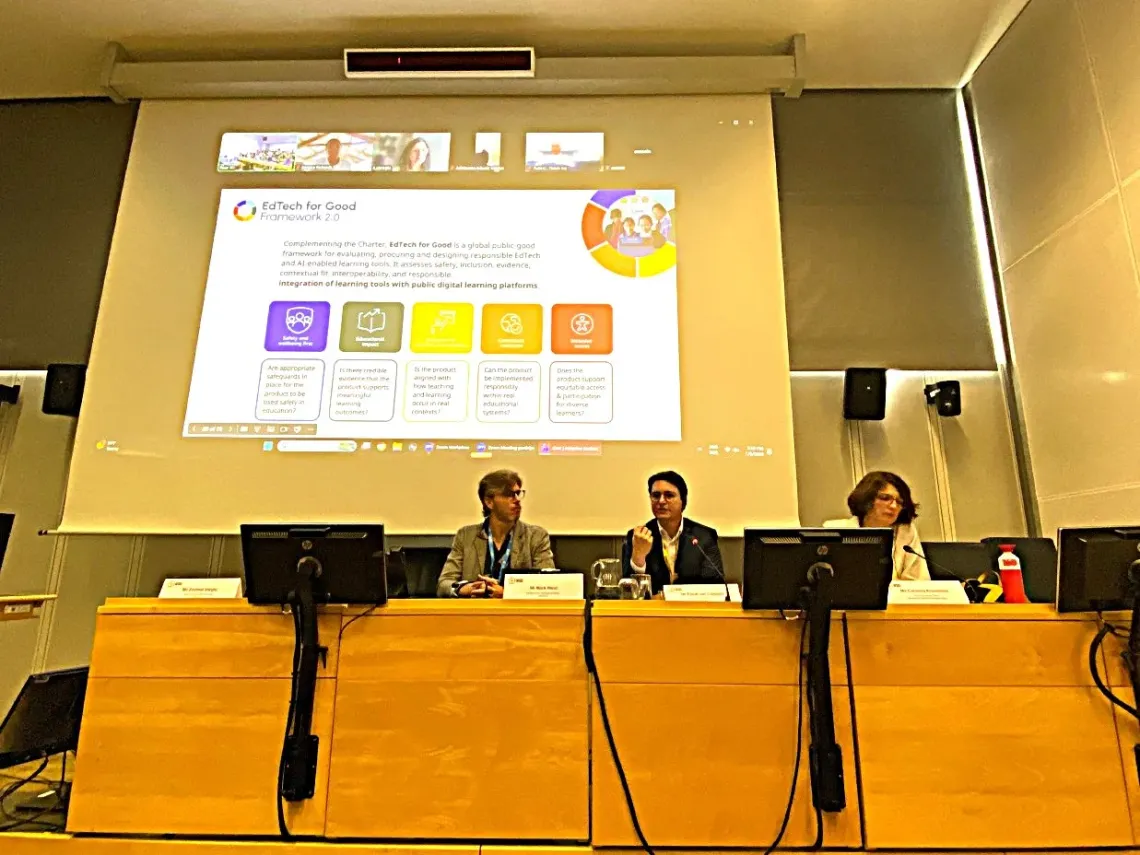
Since its first version, the EdTech for Good Framework has guided the evaluation of over 1,000 solutions and informed framework builders, governments and investors globally. At the AI for Good Global Summit today in Geneva, UNICEF launched the EdTech for Good Framework Version 2.0 – a refined version with a stronger focus on transparency, context, proportionality and responsibility. Version 2.0 significantly strengthens the Framework’s ability to evaluate emerging AI tools – placing children and evidence at the centre of the decisions that will shape how AI enters classrooms worldwide.
Version 2.0 of the EdTech for Good Framework was informed by an extensive review process including approximately 900 individual feedback items from over 60 countries representing 141 reviewing organizations contributed by EdTech providers, policymakers, researchers, practitioners and international organizations.
A growing community of endorsers and adopters
The launch also marks a significant moment of partnership convergence. New endorsing organizations of the framework – Foreign, Commonwealth and Development Office (FCDO); Global Partnership for Education; Gates Foundation; EdTech Hub; Fab AI; Digital Promise; Helsinki Education Hub; EdTech Impact; ISTE ASCD; CITE Ukraine; EduEvidence; and GoldStar Education Diagnostics – join UNICEF and its strategic partners, the Ministry for Foreign Affairs of Finland, the Asian Development Bank and Arm, in a shared commitment to greater transparency, accountability and impact.
By endorsing the Framework, organizations are committing to promoting its values and principles, leveraging the Framework in assessments, and contributing to collective efforts to strengthen transparent, evidence-based and child-centred EdTech ecosystems. The breadth of committed partners is not incidental. It is the Framework's greatest strength. No single company, government or agency can set the terms for how AI and technology enter education alone. The Framework works because UNICEF convenes all of them – governments, industry, funders and educators – around one independent, child-centred standard.
Creating common baselines for evaluation
At its heart, the Framework offers a pathway for partners and organizations to work together and establish a solid basis to evaluate EdTech solutions globally. It also works to ensure the responsible and impactful deployment of AI and technology solutions worldwide, as governments, teachers, the private sector and other partners adapt education systems to ensure students have the skills and tools they need to thrive in the 21st century. The Framework is built to serve teachers, not burden them – and to hold every tool to the one test that matters: whether it is good for children and their learning.
As a global public good, the Framework establishes a common basis for evaluating EdTech and AI solutions across different technologies, regions and levels of maturity. Version 2.0 improves the ability to evaluate emerging AI tools and informs a transparency standard for EdTech providers worldwide. It is fully open source, so governments and evaluating organizations can adapt it to their specific needs.
Forerunners already using and adapting the Framework include the Learning Cabinet, the Council of Europe and WinWin Center of EdTech Excellence of Ukraine.
Beyond digital as usual
The Framework is a cornerstone of UNICEF’s new Digital Education Strategy, which focuses on teacher empowerment, foundational learning, skills and competencies, systems strengthening and thought leadership.
By 2030, global spending on education technology is expected to reach US$620 billion. Whether that investment narrows learning gaps or widens them will depend on the standards that guide it. With the EdTech for Good Framework 2.0, UNICEF and its partners are working to ensure those standards are set in the open, grounded in evidence, and anchored in the one measure that matters: what is good for children. The coalition of supporters continues to grow – UNICEF welcomes new endorsers committed to transparency, accountability and impact, and additional partners and Framework updates will be announced later in 2026.
The EdTech for Good Framework has been endorsed by: