“We will make it”: committing to inclusive education in Cuba
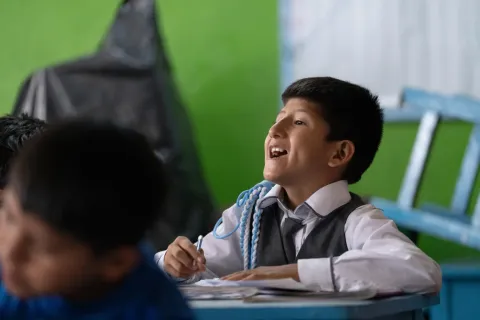
Cristian has intellectual disability and he goes to an elementary school in Moa, Holguín. He and his mom feel that’s where he learns everything he needs for growing up. It is part of quality inclusive education supported by UNICEF Cuba
- Español
- English
Pero qué estoy haciendo aquí
Amando a este país como a mí mismo
No, no hay heroísmo
Vine a darle un beso al mundo
Y nada más.
When Cristian Alejandro Morell Sarrión sings Valientes, the song written by the Cuban band Buena Fe as an homage to the work done by Cuban medical personnel fighting COVID-19, not one person can be found who doesn’t get goose bumps.
He keeps a low voice so as to remain on key, and he pronounces slowly, so that no word slips before its time. That’s his favorite song, and he learned it by heart along with his classmates. He finishes and people applaud. Then, his mom and his teacher feel a rewarding sensation. They know the effort Cristian makes in order to learn, and how they accompany him along each step of the way.
At moments like these, Marelis Sarrión Caboverde thinks about her life and Cristian’s, which has been like an obstacle course where the finish line occasionally seems to be very far away. However, she has decided that they will always be driven by the expression “we will make it!”
And she has made a mantra of that phrase since the day she went into premature labor, at 33 weeks of pregnancy. She also held on to that idea when specialists from Moa’s Orientation and Diagnostic Center (CDO) spoke to her about the child’s intellectual disability, and offered to enroll him in special education.
In Cuba, 33,000 children with disabilities attend special education schools.
Both times, Marelis had to grow. First, she put all her strength into her child’s birth and now she’s the mother of a strong boy. Then, she chose to send her son to the “Amistad Cuba-Holanda” Elementary School, in spite of recommendations by those closest to her to enroll him in special education.

The decision to keep him in the school he joined after kindergarten has always had the support of his teacher, who recognizes the benefit of inclusive education for children like Christian.
And it sure has been beneficial. It’s enough to hear him sing or watch him draw or raise his hand to answer in class or interact during school recess to confirm it.

According to national statistics, 11,842 children with disabilities attend regular schools in Cuba as part of a process of inclusive education. Nearly half of them have some type of intellectual disability. UNICEF Cuba supports this initiative with the generation of abilities in teachers and the creation of accessible resources for quality education.
Inclusive education implies offering opportunities for meaningful learning to students within the general education system and allowing children with or without disabilities to attend the same age-appropriate lessons, with personalized support if necessary.
The first sign of learning barriers shown by Cristian was a slower progress in comparison with the educational parameters set for the school year.
After studying his diagnosis, the teacher planned a series of activities and prepared means for learning support to motivate him to attain the academic goals. Until today, he is a child who makes gains in his achievements, skills and relationships, both at school and in the community.

To those who still show resistance to including children with intellectual disabilities in their classrooms, Grisela Valles París, Cristian’s teacher, says they should take on the responsibility of educating, in all senses and in everyday practice. For her, there is no greater satisfaction than changing defeat into support and company from the classrooms and in the families themselves.
UNICEF Cuba, together with the Central Institute of Pedagogical Science (ICCP), supports the online multi-platform Together for Inclusion, which carries out educational and emotional support sessions, through weekly meetings via WhatsApp and Telegram, for families and teachers who care for children with intellectual disabilities
That’s exactly what Marelis’s rebirth with Cristian Alejandro has been like: in the family, at school, with help and patience, changing rejection and frustration into a constant flow of “You can do it”, “You’re doing great” and “We will make it”.