Harmony is in nature
Through drawings, readings and simulations, the children of a rural school in the Santiago de Cuba municipality of Guamá learn how to act in the event of a hurricane or earthquake

- Español
- English
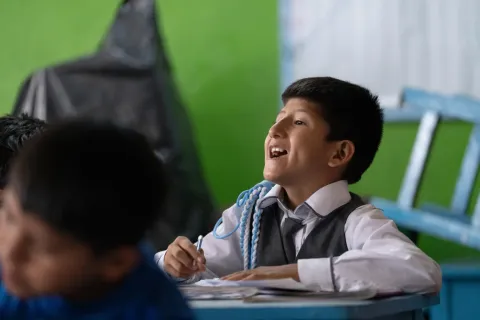
The fifth grade class looked on attentively as the local Red Cross representative spoke to them about the importance of remaining calm during the application of first aid. One of the students raised his hand. He wanted to ask something that he could not express because, suddenly, the insistent ringing of the bell was heard. They were not ringing to signal the beginning of school recess. That was the sound of the rustic alarm indicating to the students of the Lidio Rivaflechas elementary school, in the Santiago de Cuba municipality of Guamá, that something very serious was happening: they had to protect themselves from an earthquake.
There was no panic or despair. The reaction was instantaneous. The children crawled under the tables, their hands clasped over their heads in a fetal position. After a reasonable time, the teacher indicated that the danger had passed. When Lietys managed to sit up, she noticed that one of her classmates was complaining of pain in his right arm. She quickly took a handkerchief from her backpack and made a sling for him. Other children helped some of the injured and, together with their teachers, carried them on improvised stretchers to the nearest medical post, which had been provisionally set up.
Fortunately, there was no earthquake, or at least not on that occasion. It was one of the many drills carried out at the institution, as part of the circle of interest called “The school and preventive measures in the face of disasters”.
The two faces of Guamá
Guamá is the longest municipality in Cuba and the one with the largest number of tributaries in the country, with 22 rivers and 32 streams. But that is just a textbook geographical outline. Guamá is a municipality that goes to extremes, if we talk about natural events: from intense droughts to flooding due to rains.
Its rivers are only rivers half of the year; from January to June, during the “hard dry” season, they are long and wide rocky trails. It is easier to walk along its routes, full of stones punished by the sun, than on the local roads.
In addition, Guamá has 175 kilometers of coastline and nine popular councils near the sea. One of them is Chivirico, a kind of municipal capital surrounded by mountains of medium height.
North of Chivirico is the community of Las Calabazas, where the Lidio Rivaflechas elementary school is located. It is a small school with a light fiber cement roof. More than a hundred children come to its classrooms every day from different areas surrounding the community.

But Guamá is different when the rainy season arrives, as in these days of June. As has been said, the extremes. When the rains really come down, everything gets worse. The paths of dry stones are again widened rivers that when the precipitations intensify, flood everything: roads, bridges, hamlets.
“Here the river gets guapo. It goes down there and doesn’t believe in anything,” says a local. In the local lingo, guapo means hard, difficult. And that’s how the river gets every time it leaves its course and floods roads and villages. But it’s not only the floods that are a concern, but also the fires when the drought rages, or the hurricanes that have left their mark on the communities crops and houses.
UNICEF Cuba accompanies the Ministry of Education in capacity building for more than 800 teachers in schools in communities exposed to multi-risks in the municipalities of Segundo Frente, Songo-La Maya and Guamá, in the eastern province of Santiago de Cuba.
Remaining calm and acting intelligently
When Hurricane Sandy hit Santiago de Cuba in 2012, Érika Camila Rodríguez Aguilera was not yet born. She learned about its impact on Santiago’s territory thanks to teacher Saday Mojena Perera, who has explained to her the types of disasters and their characteristics, the different phases established by the Cuban Civil Defense when a tropical cyclone is imminent, and what measures to take.
At eleven years old, Erika Camila knows that in the town of Las Calabazas, where her school Lidio Rivaflechas is located, natural disasters are likely to occur and that it is necessary to act intelligently and remain informed. She says this naturally, because this is not memorized knowledge; it has been incorporated into her day-to-day life. The project coordinated by the Ministry of Education (MINED), with the support of UNICEF Cuba, has allowed her to learn what to do in the event of hurricanes, floods and even a major earthquake.
“We have to take care of ourselves, protect ourselves under the table and not be near the windows. I have taught my family that during a hurricane we can’t go outside the house," says the fifth grader.
This is confirmed by little Keyla Ramírez, a first grader, who warns that the river could become very big and dangerous. “If it grows, we can’t get through. We have to wait for it to go away,” she says, with the liveliness of her six years of age.
“When it grows, there are children who have to stay at a classmate’s house to wait for it to calm down,” adds Daniel Cardenal, a fourth grader, and in his words we notice the alliances that are established in the community to support each other in the face of these events.
With the contribution of the European Union, UNICEF Cuba supports around 4,315 children and adolescents, including 175 with disabilities, to acquire skills and participate in actions for disaster multi-risk reduction and adolescent empowerment in the face of the negative effects of climate change.

The multi-risk map of the Lidio Rivaflechas elementary school, prepared by the students themselves, reflects the risks that exist in the Las Calabazas area: heavy rains, river overflows, floods, droughts and forest fires.
Teacher Saday knows this because in order to create it, they explored the same roads that students and teachers travel every day, to identify the dangers to which they could be exposed. That is why she never tires of looking for creative ways for students to be aware of these hazards and be able to act correctly, should they have to face any of them.
As proof of her enthusiasm for communicating these topics, he shows a dozen drawings hanging from a string stretched outside in the school garden. It is a multicolored exhibition featuring a river out of its course and a forest engulfed in flames.

“The exhibition is the result of the ‘Natural Disasters’ drawing contest,” explains the teacher. “The children chose which one they wanted to represent. This is one of the activities developed in the circle of interest, where we also promote reading, especially with the books of the Multi-risk Map and the Climate Glossary for young people, donated by UNICEF”.
The Ministry of Education articulates socioemotional support actions for children and adolescents before, during and after natural disasters. For this purpose, it implements didactic and recreational activities with the support of recreation kits and the Riskland and Seismic Hike games, which UNICEF Cuba has set up in about 15 schools in the municipality of Guamá.

The students at the small Las Calabazas school know that they must be prepared. In the circle of interest they have been shown the different ways to act before an imminent disaster and they have instilled in them love and coexistence with nature as the basis of all environmental education and prevention, as summarized by little Jennifer Batista and Yinelis de la Caridad Matos: “taking care of the beaches, planting trees and cleaning the garbage from the rivers, because harmony is in nature”.