
The day Afra and Leslie’s faces shone with beauty
During a field mission to remote north-eastern CAR, UNICEF staff met two children with cleft lips. Thanks to a partnership with Bangui’s paediatric hospital, UNICEF arranged for both children to undergo corrective surgery.

- English
- Français
Prencia Yabenda’s face beams with joy as she watches her three-year-old daughter, Leslie, sitting in the courtyard of their home. It is as though seeing her daughter’s transformed appearance has restored something she had longed for.
“Yes, my baby is so cute. But ever since she was born, every time I looked at her and saw that [cleft] lip, I felt disheartened. Now I am overjoyed. It is as if a miracle has happened.”
The young mother speaks with conviction, her joy evident in every word.
Leslie is Prencia’s firstborn child. They live in one of the neighbourhoods of Birao, a remote town in the northeast of the Central African Republic, more than 1,000 kilometres from the capital, Bangui.
A few weeks ago, Prencia was surprised when a vehicle bearing the UNICEF logo stopped at the entrance to her compound. The team explained that she and her daughter were being invited to travel to Bangui, where Leslie would undergo surgery at the pediatric hospital. Their transportation and accommodation would be provided free of charge, including full board.
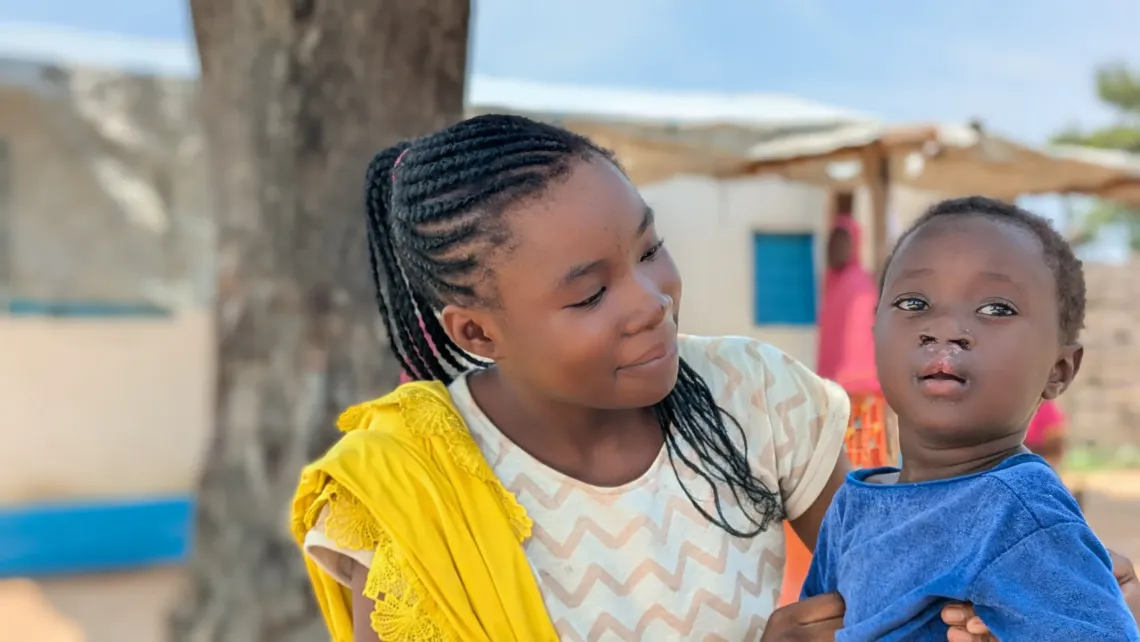
This story began during a visit involving several agencies and donors. On that occasion, the visitors met a Sudanese girl, Afra, at a ‘Child-Friendly Space’ run by UNICEF in partnership with the NGO Triangle in Korsi — a neighbourhood home to some 25,000 Sudanese refugees. They immediately noticed a little girl who was neither laughing nor singing as loudly as the other children. It was then that the US Chargé d’Affaires asked UNICEF to step in to help her.
Eight-year-old Nashra had been born with a cleft lip, a congenital condition in which the tissue forming the upper lip does not fully join during development, leaving a gap or opening.
A cleft lip is not usually life-threatening, but if left untreated, it can cause problems as children grow up. They may struggle to pronounce certain words, need extra care for the teeth and gums around the gap, and be more prone to recurrent ear infections. This last issue was something Nashra had already encountered.
After several calls to Bangui, the capital, UNICEF made the necessary arrangements for Afra and her mother, Noura Abakar, to be flown to Bangui as soon as possible so that the little girl could undergo surgery there. A programme funded by donors and supported by the US-based NGO Smile Train enables the Bangui Paediatric Complex to have trained specialists on hand and to carry out this type of operation free of charge. Beyond providing care, the hospital carries out crucial active outreach work to identify and treat other children in need. To provide accommodation for the family, UNICEF contacted a hostel run by the Catholic Church.

As they considered how to organize the journey, one of the monitors at the Child Friendly Space spoke up: “I know another child in Birao who has the same problem. She doesn’t live far from here.”
And so, in the end, UNICEF arranged for both children to travel to Bangui, accompanied by their mothers.
Medical statistics show that cleft lip occurs in approximately one to two out of every 1,000 births worldwide. Yet where a child is born can determine whether they will have access to the treatment they need. Medical professionals generally recommend that cleft lip repair be performed when a baby is between three and six months old. In more developed countries, this procedure is often readily available. But in places like Birao, where medical facilities are extremely limited, a child born with this condition may never have the opportunity to undergo surgery simply because surgeons with the expertise to perform it are not available. And getting to Bangui by road can take days, sometimes even weeks, along badly degraded roads where insecurity is rife.
The two children and their mothers stayed in Bangui for two weeks, until they were discharged and, accompanied by a UNICEF staff member, returned to Birao on a humanitarian flight.
As they were escorted back to their respective homes, scores of children poured out to welcome them, their faces beaming with joy. They stared in disbelief at what seemed to be the children’s new, brighter faces. Everyone wanted to see them, touch them, and have a photo taken with them.

UNICEF supports the Central African Republic’s broader health system, working closely with the Ministry of Health and Population to develop programmes that strengthen public health. These include maternal and child health initiatives, vaccination campaigns, nutrition programmes, and other interventions aimed at building a resilient health system capable of providing access to basic healthcare for all children, particularly the most vulnerable.
All that remains now is for Leslie and Afra to go to Birao hospital to have their stitches removed. From now on, they look forward to a happier, healthier life.
Given the success of these interventions, the medical team is now expecting more cases to be referred to them. To build on this momentum and scale up this initiative, UNICEF intends to step up its support by facilitating the referral of further children to the hospital, thereby ensuring that no child suffering from this condition is left behind.

