Salak Tendéo’s new borehole is a women’s affair
A small village in one of the driest areas of Cameroon, received a borehole that has changed the life of its inhabitants, especially the women.

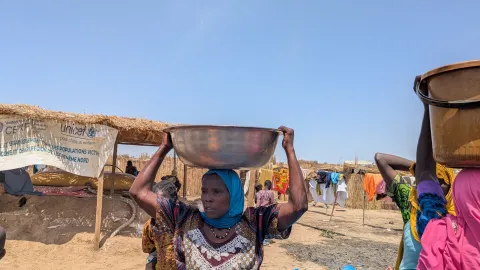
Women are in charge of fetching water for the family. Before the new borehole was installed, they had to walk more than a kilometre to fill their containers and return heavily loaded with water. And the water was often unfit for consumption, resulting in recurrent waterborne diseases. This borehole is part of a major project funded by JICA, Japan's international cooperation agency, with support from UNICEF, the project's implementing partner. Now women only need to go as far as the village borehole to collect clear and potable water. In a good-natured atmosphere, they place their containers in single file in front of the borehole. Each woman is often assisted by a neighbour to activate the pedal that will lift the precious liquid up from the depths. With grace and strength at the same time, the movement will be repeated many times, like an elegant water ballet.

Dieba, a happy beneficiary
Dieba, a -45year-old village resident, is one of the women beneficiaries who have seen their lives changing. Having an accessible borehole means she no longer has to walk for kilometers once or twice a day to fetch untreated water, as she did before. In addition, since the borehole was dug she has noticed, both in her family and at the village level, that “there is almost no diarrheal disease, whereas before it was really common”.
Now, Dieba performs the daily task of fetching water with enthusiasm, meeting her friends and neighbors during the hours of access, from 6am to 10am and from 3pm to 6pm. She explains happily that “This has never happened in the neighbourhood, a borehole that brings everyone together. We fetch water together, wash our clothes together. Even sheep, goats and cows can drink healthy water now!”
And sure enough, we see women present water buckets to a herd of cows who have also come to drink.
This has never happened in the neighbourhood, a borehole that brings everyone together. We fetch water together, wash our clothes together. Even sheep, goats and cows can drink healthy water now!

A joint management committee
A community management committee has been set up to ensure the proper use, maintenance and good management of the borehole, assisted by individual contributions of CFA500 per year (less than $1).
The inhabitants were assisted by the Association of Animators and Managers in Community Development (AAMCD), of which Oumarou is a member. He explains that the committee’s support must extend over a whole year so that its functioning can be evaluated, and the necessary adjustments made. Oumarou has more than two decades of experience, and he insists that women play a role in these committees.

He believes that the committees that work best are those where the financial affairs are managed by women This point of view is echoed by Toukou, a member of the Salak Tendéo management committee. Their committee is made up of 12 members, including 3 women. This may not sound like much, he notes, but it is actually very encouraging in this region, where “wives are still very much at home. It's tradition."
"But we have three women. One is assistant treasurer and the two others" are counsellors. They intervene in case of difficulties, especially at the level of contributions. They are the ones who manage. It must be admitted that men are less good at managing money. But women know how to keep and manage money.”