Minawao: Supporting Adolescent Girls’ Health Through Micronutrients
In Minawao, anaemia is declining among refugee adolescent girls thanks to iron and folic acid supplements provided by UNICEF with financial support from the Government of Germany/BMZ through KfW.
- English
- Français
In the muddy alleys of the Minawao refugee camp in northern Cameroon, thousands of adolescent girls silently bear the burdens of exile, precarious living conditions, and health issues. One of the invisible challenges they face daily is anaemia, which has become a significant threat, weakening their bodies and compromising their health, development, and overall well-being. Anaemia among adolescent girls in the camp is often caused by a diet lacking in iron.
For several years, UNICEF, with financial support from partners such as the Government of Germany/BMZ through KfW, has been working to raise awareness and distribute iron and folic acid tablets. In 2024, 192,079 adolescent girls across the country received these vital supplements, including 6,200 girls in the Minawao camp. Many of these girls had dropped out of school, but now have renewed hope for their futures.


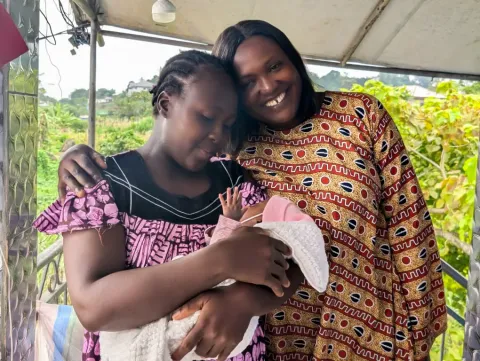
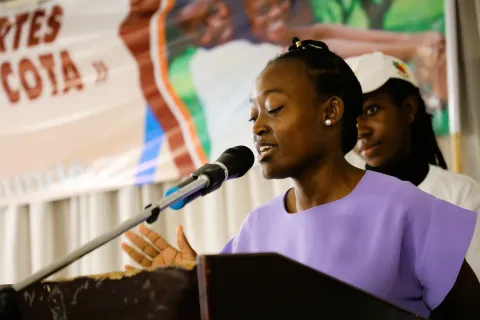
Twice a week, ASGARA's multi-skilled community health workers, supported by UNICEF, engage with adolescent girls aged 10 to 19 years. This afternoon, Agnes Laeli and her colleague, Samuel Bitrus, led an interactive session conducted in the Hausa language. The discussion focused on the importance of iron and folic acid, the prevention of early pregnancy, family planning, and menstrual hygiene. At the end of the session, the adolescent girls received their weekly supplements of iron and folic acid.


"I used to experience regular dizziness and a loss of appetite, especially during my periods. However, since I started taking iron and folic acid tablets, I feel full of energy and in great shape. I recently visited the hospital for a consultation, and the doctor confirmed that I no longer have anaemia. I encourage UNICEF and ASGARA to continue distributing iron and folic acid tablets to prevent a return to the previous situation where many teenage girls suffered from anaemia," says Saratou Shawulu, a teenage girl from the region.
"Before iron and folic acid supplementation, it was difficult to find blood donors in the community because of the high rate of anaemia. With iron and folic acid supplementation, there are more and more blood donors."

For Adolescent girls who missed the distribution during the weekly meetings, Samuel Bitrus and other community health workers distribute the tablets door-to-door. They also take the opportunity to treat the girls for intestinal worms.


"Iron and folic acid supplementation is good for our community. Before, there was enough food, but there were also many cases of anaemia. Today, despite the reduction in food rations, we are seeing a decrease in cases of anaemia among teenage girls. I am very happy to see that our work is bearing fruit. Before iron and folic acid supplementation, I could donate blood three times a week. Since last year, this is no longer the case," says Samuel Bitrus.
He has been working as a community health worker in the Minawao refugee camp for 10 years.


The Minawao health district has reported a decline in anaemia cases, attributed to the implementation of weekly iron and folic acid supplementation in the camp. Currently, 6,300 adolescent girls aged 10 to 19 are enrolled in the programme, supported by a network of 40 community health workers who serve the Minawao camp. In the years 2023, 2024, and 2025, the recorded cases of anaemia in the camp were 170, 164, and 116, respectively. In the extreme northern region of Cameroon, UNICEF and its partner the Government of Germany/BMZ through KfW aim to distribute weekly iron and folic acid tablets to 67,860 adolescent girls by the end of 2025.