In Maga III, when playtime ends, the real challenges resurface
At Maga III Government Primary School, more than 1,800 pupils are learning in precarious conditions. Thanks to UNICEF’s Japan Project, new inclusive sanitation facilities are restoring health and dignity to the children.

- English
- Français
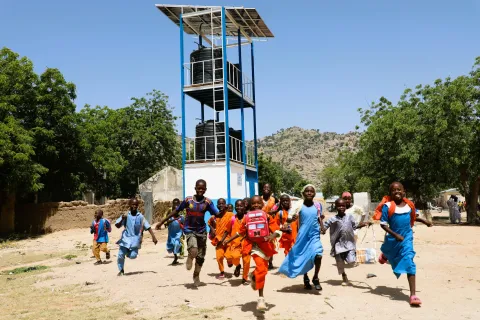
Under the bright sunshine of Maga, the children’s laughter echoes through the playground of Maga III State School. More than 1,800 pupils, including 778 girls, share this space where dreams, friendships and the hope for a better future are nurtured every day.
Then, suddenly, a whistle blows, signalling the end of the lunch break. Playtime comes to an end and the children head back to their classrooms, but behind this ordinary scene lies a reality that is far less visible.
Due to a lack of adequate sanitation facilities, many pupils are still forced to relieve themselves in the open.

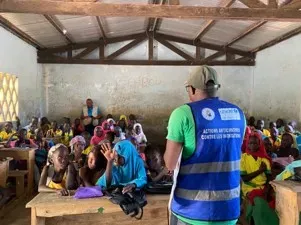
This situation exposes them to an increased risk of illness, jeopardises their well-being and affects their ability to learn. For the girls, who make up a particularly large proportion of the pupil body at this school, this reality also presents an additional obstacle to a peaceful and dignified education. The challenges do not end there. In this school, which is attended by over a thousand children, only a few permanent classrooms (four) are available. The rest of the pupils attend lessons in makeshift shelters covered with straw.

Amidst the dry winds of Maga, the stifling heat of the heatwave and the inclement weather of the rainy season, learning can sometimes feel like a real struggle. Despite these difficult conditions, the children continue to show a remarkable thirst for learning, whilst the school’s nine teachers are redoubling their efforts to maintain the quality of teaching. For Oumar Saissidi Sanda, the school’s headteacher, the needs remain immense.

“The challenges are great, and they are even greater for our children. We are facing a lack of infrastructure that directly affects their health and learning. When pupils have to learn in sheds without adequate sanitary facilities, their dignity and their success are put to the test.”
Behind the figures lie more than a thousand children who simply long to grow up, learn and dream in a safe and supportive environment. They are not asking for much: a school where health, dignity and inclusion are not privileges, but rights.

It is with this in mind that the UNICEF–Government of Japan partnership is providing a practical and hopeful response.
At Maga III, every brick laid tells a story of resilience. Every classroom built is a victory against preventable diseases, a step towards a more inclusive school and an investment in the future. But there are still needs to be met. As well as latrines, the school needs safe and suitable classrooms so that every child can learn sheltered from the scorching sun, the wind and the rain.
In Maga III, UNICEF’s work, supported by the Government of Japan, goes far beyond the construction of latrines. It helps to create a healthier, safer and more inclusive environment, providing more than a thousand children with the conditions they need to learn, grow and fulfil their potential.