Ending period poverty in emergencies: dignity and a brighter future for adolescent girls
How UNICEF and partners are helping girls manage menstruation with dignity and stay in school in crisis-affected communities

For many adolescent girls, a normal school day can change in an instant. An unexpected period or a stain transforms an eager student’s focus into a single worry: finding a way to go home without being noticed. In crisis-affected communities, where families are already dealing with displacement, poverty, and disrupted access to basic services, managing menstruation can become another challenge that keeps girls away from the classroom.
While menstruation is a natural biological process, it remains surrounded by silence, stigma, misinformation and shame. The challenge is heightened when girls cannot afford sanitary products or do not have access to safe and private water, sanitation and hygiene facilities. UNICEF highlights that the lack of menstrual hygiene products can restrict girls’ participation in school and other activities, while emergencies can make these barriers even more acute.
Across the crisis-affected North West and South West regions of Cameroon, UNICEF and partners are working to ensure that menstruation does not become another barrier to education. Through menstrual health education, dignity boxes and reusable sanitary pads, girls in schools and Temporary Learning Spaces are receiving practical support to manage their periods safely and with dignity.
When a period gets in the way of learning
For a girl already living through crisis, missing school because of sanitary supplies might seem secondary compared to broader security or environmental challenges. However, repeated absences can gradually affect her learning, self-confidence and participation in school.
The issue goes beyond product availability in many communities. Girls often lack accurate information about menstruation, feel ashamed to ask for help, or fear being teased by their peers. In schools without emergency menstrual hygiene materials, a girl who experiences an unexpected period may have little choice but to return home.
This is why menstrual health support is about more than providing a pad. It is about creating an environment where girls can learn without fear, understand their bodies and feel supported when they need help.
A solution made in the community

At a local production centre supported by UNICEF and its partner Royalty World, the response to period poverty relies on fabric, thread, sewing machines and the skills of women from the community.
The centre produces reusable sanitary pads and distributes them to girls in crisis-affected communities. This approach provides a practical menstrual health solution while also creating opportunities for women, including single mothers, to develop skills and help support adolescent girls.

Blandine was among the first single mothers to join the initiative. Today, she works at the production centre where reusable sanitary pads are made for girls in schools, Temporary Learning Spaces and communities.
“We devote our time every day to this process because we want to help adolescent girls access affordable and, sometimes, free menstrual materials. Here, we produce washable pads that UNICEF uses to support girls in schools, Temporary Learning Spaces and communities.”
For Blandine, every pad represents more than a piece of fabric. It is a practical response to a challenge she sees affecting girls around her.
From local fabric to a reusable solution

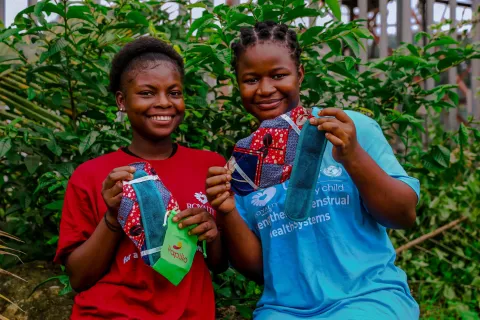
Pauline Ndive is part of the team helping to produce the reusable pads and educating girls on how to use them. Made from locally sourced fabric (Ankara), these reusable pads feature multiple layers. The pads are designed to absorb menstrual flow while remaining secure and comfortable when worn with underwear.
“The pad has different layers, and each one has a purpose. There is a soft layer that touches the skin, an absorbent layer in the middle and a protective layer underneath. The wings have snaps that help keep the pad in place. After use, it can be washed, dried properly and reused, which makes it a practical option for girls and families who may not be able to buy disposable pads every month.”
Utilising a local approach helps bring menstrual hygiene support closer to the communities that need it while reducing dependence on products that may be difficult or expensive to access in hard-to-reach or remote areas.
Reusable pads are recognised by UNICEF as one of the menstrual hygiene options that can be used in humanitarian settings. They require proper washing, drying, clean water, soap and appropriate storage to ensure safe use.
A dignity box when a girl needs it most

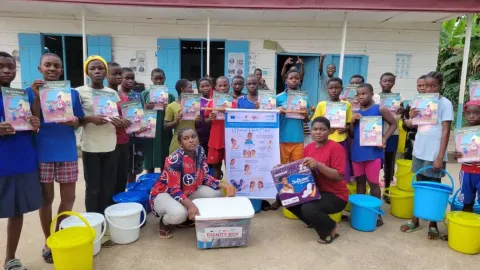
UNICEF-supported schools and Temporary Learning Spaces., The boxes contain essential menstrual hygiene materials and information that can help a girl manage an unexpected period without having to leave school.
If a girl experiences an unexpected period or stain, she can access a pad, clean herself, change and return to class. Teachers can also use educational materials to help girls and other learners understand menstruation and challenge myths and stigma.
In Wututu, for instance, a local school had running water and sanitation facilities but lacked materials to respond when girls experienced menstrual incidents. The dignity boxes filled the gap for female students
The intervention therefore addresses two sides of the challenge: helping girls manage menstruation when it happens and creating a more informed environment where menstruation can be discussed without shame.
Protecting dignity, protecting education
In the first half of 2026, UNICEF and partners reached more than 15,000 girls across the North West and South West regions through menstrual health and dignity awareness activities, while more than 5,000 girls received menstrual hygiene kits and dignity boxes to support them in schools and Temporary Learning Spaces.
Behind these figures are individual girls who no longer have to return home because their period started unexpectedly at school. They now have access to safe materials, private facilities, and supportive teachers, allowing them to remain in class with confidence. For them, the difference may seem simple: a pad, a dignity box, a private place to change, or someone willing to explain what is happening to their bodies. But together, these small interventions can help remove a barrier between a girl and her education.
A shared responsibility

Menstrual health remains vital during emergencies. Girls continue to grow, learn and plan for their futures, even when the communities around them are experiencing displacement, poverty and disruption.
That is why UNICEF and partners are working to combine menstrual health education with practical and sustainable solutions, including locally produced reusable sanitary pads and dignity boxes. The approach recognises that girls need both the knowledge to understand menstruation and the materials and facilities that allow them to manage it safely.
This work has been made possible with the support of European Union Humanitarian Aid and the Government of Japan, whose contributions are helping UNICEF and partners address the menstrual health needs of adolescent girls in crisis-affected communities in the North West and South West regions. Ensuring every girl can manage her period with dignity requires collective commitment. Governments, schools, communities, humanitarian organisations, educators and private-sector partners all have a role to play in investing in menstrual health education, safe WASH facilities and affordable menstrual hygiene solutions.
No girl should ever have to choose between managing her period and pursuing her education.
By removing the barriers surrounding menstruation, we do more than provide sanitary products. We protect dignity, keep girls learning and help create the conditions they need to build a brighter future.
For Every girl, Dignity in menstruation