Empowering Frontline Health Workers Through Digital Innovation
In the small health district of Garoua-Boulaï, hope is taking on a digital form as polyvalent community health workers ditch old data collection technique and embrace digitalization.

In the small health district of Garoua-Boulaï, there is new hope taking on a digital form. Meet Mbetchang Ange, a midwife and head of the Garoua-Boulaï urban health area, who could hardly hide her joy as she described the significance of recent events for her team.
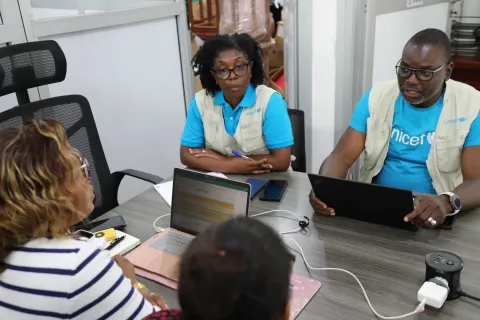
“We are in Dimako for a training workshop for community health workers on using digital tools for their community activities,” she said, her voice filled with enthusiasm.
For years, community health workers have been the backbone of primary healthcare in remote areas. They collect health data, assist families, and support local clinics. However, much of their work relied on handwritten reports and lengthy manual processes.
“Previously, everything was done physically. We had to find someone to enter the data, and many used their personal phones,” Ange explained.
Now, this is changing. Thanks to UNICEF's allocation of 7% set aside funds, each community health worker is receiving a tablet—an essential tool that will not only ease their workload but also enhance the accuracy and timeliness of health reporting.
During the workshop, participants were trained on community data collection tools, including the RMA (Rapport Mensuel d’Activités), and learned how to interpret indicators for better local health management.
“The facilitators took their time to explain each indicator,” Ange noted. “Even we, the heads of health areas, learned a lot and had our doubts clarified.”
For Ange, the training was not just a professional exercise; it was a moment of shared growth and renewed motivation.
“With this new knowledge and technology, we can better support our community. The proper use of these digital tools will benefit not only our community but the entire healthcare system in Cameroon.”

As she looked around the room filled with newly equipped health workers, Ange smiled with pride.
“We are very grateful,” she expressed. “It’s a privilege for our district to be selected. We thank the Ministry of Public Health, UNICEF, and all the facilitators. This training has truly enlightened us.”
As Mbetchang Ange and her peers return to their communities armed with new skills and digital tools, this initiative represents more than just a technological upgrade. It reflects UNICEF’s broader commitment to strengthening community health systems and primary healthcare. It also supports the “First 1,000 Days” strategy in Child-Friendly Municipalities, which aims to improve maternal and child health outcomes. By empowering frontline workers with digital solutions, this program enhances data quality, supports evidence-based decision-making, and contributes to achieving the Sustainable Development Goals (SDGs), especially those related to health, equity, and innovation.