Baria and her 6,300 peers deprived of emotional safety in Blangoua, in Cameroon’s Far North.
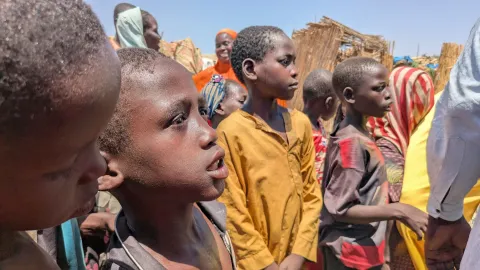
In Blangoua, displaced children wander without guidance after fleeing the gunfire of 5 February. Torn from their village and their daily lives, they left everything behind — even a part of their childhood.

- English
- Français
In Blangoua, in the Logone and Chari department, the day doesn’t really seem to move forward. It drags on, slow and almost still. It is the footsteps of children, their frail figures moving without any particular destination, as if the world had forgotten to tell them where to go.
Just a few weeks ago, these children were living in the village of Darak. They went to school, helped their parents with daily chores and played in the shade of the trees, and these games helped them forget the extreme heat of the day. They had routines, dreams and a sense of belonging.
Then, on the night of 5 February, gunfire shattered the silence. Fear seeped through the walls of the houses. They had to flee quickly, without thinking. In the darkness, families ran, not understanding, holding their parents’ hands; the children followed in their footsteps, leaving behind their homes, their schoolbooks, their clothes, their dreams, their toys and a part of their childhood. They took nothing with them, or almost nothing.
In Blangoua, there are now more than 18,000 displaced people. Among them are around 6,300 children who are now growing up far from everything that used to make up their world.

Baria is 10 years old and no longer thrives like other children his age. Sitting on the floor, he mixes soil with a little water to make a toy. “It’s a canoe,” he says. Perhaps it’s a memory, perhaps a way to forget the fear and trauma.
All around him, other children wander around the site. Some run between the makeshift shelters, whilst others sit silently, staring into space. With no school, there are no child-friendly spaces or psychosocial support to help them. There are no structured activities to help these children regain some semblance of a normal life.
“Many children are traumatised by the gunfire and the hasty escape. Others relive the escape through their nightmares. Without support, these traumas risk affecting their behaviour for the rest of their lives,” explains Blama Magra, a traditional leader at the site.
At night, Haoua, a mother of six, observes:
“They startle awake and cry in their sleep. Sometimes, none of us gets a wink of sleep until morning,” she says

In such circumstances, the most obvious needs are often food, water and shelter. But for children, emotional security and personalised support are of the utmost importance.
With every day that passes without any action being taken to protect them, these children remain at the mercy of distress and uncertainty, whilst being exposed to the risk of economic exploitation and dropping out of school.
To provide these children with appropriate child protection services that will help them rebuild their lives, laugh again, learn and find hope, the necessary support from UNICEF’s financial partners will enable individual case management for each child and their family, the establishment of child-friendly spaces, the reintegration of children into school, including the provision of school kits, and psychosocial, or even psychological, support.