Rewriting the Rules of Safer Classrooms in Cambodia
Positive Discipline and Child Protection initiatives are changing Cambodian schools, creating safer environments where children feel supported, confident, and free from fear.

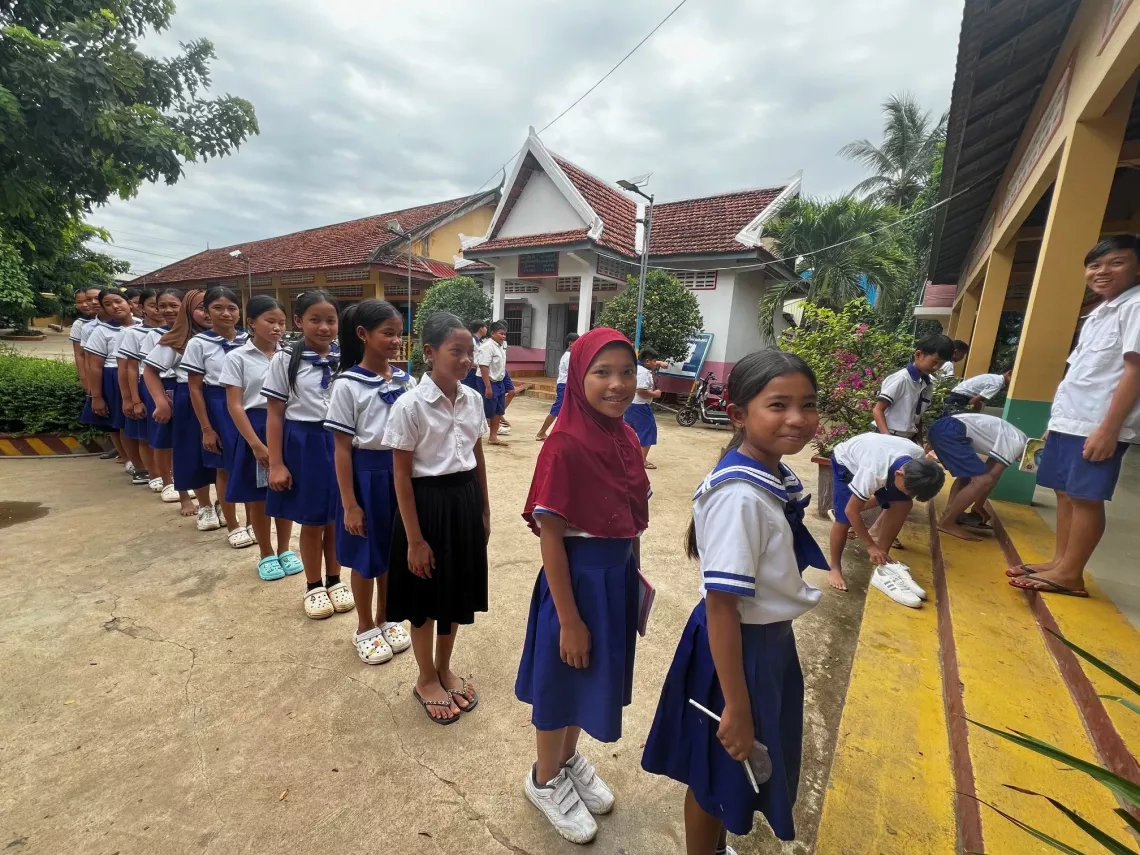
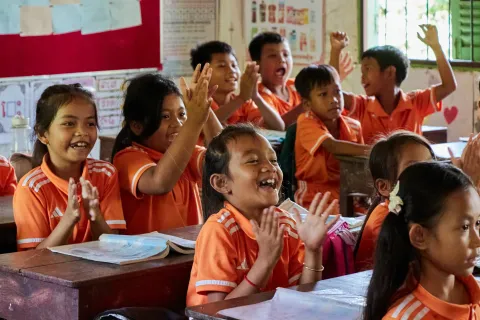
20 September 2024, Prey Veng, Cambodia — At 13 years old, Srey Moch has grown up in a school system shaped by the Positive Discipline Programme, which was introduced when she started primary school. In earlier years, fear and harsh reprimands were the norm for many students, but now, as a bright sixth grader at her primary school in Prey Veng, Srey Moch confidently raises her hand to ask questions. Gone are the days of silence and fear. Today, children like her are learning in an environment where they feel safe and supported.
Historically, Cambodian classrooms relied on strict discipline, often equating it with punishment, creating fear among students. In 2015, responding to this reality, UNICEF Cambodia, in support of the Ministry of Education, Youth and Sport, launched the Positive Discipline Programme and Child Protection initiatives to equip teachers with skills to manage classrooms without violence. Despite these efforts, the Cambodia Demographic and Health Survey 2021–22 found that 59 per cent of children aged 1–14 years still experienced psychological aggression, such as shouting or yelling, at home. Similarly, the Assessment of Positive Discipline in Schools Programme 2023 revealed that 28 per cent of students reported being shouted at or screamed at by teachers, while 32 per cent experienced or witnessed physical punishment, such as being hit with a stick or ruler. Boys continued to face higher levels of corporal, verbal, and psychological punishment, while girls more often reported non-violent discipline and greater satisfaction with their schooling experience.
The positive discipline programme has contributed to an important shift in mindsets and practices, training over 13,000 school directors and teachers by 2021, and helping 460,000 children. In 2023, the Assessment of the Positive Discipline in Schools Programme revealed that 69 per cent of teachers were using non-violent methods, with 91 per cent showing improved anger management. Meanwhile, the Royal Government of Cambodia has worked to solidify these changes through the National Action Plan to Prevent and Respond to Violence Against Children (2017-2021) and the Child Protection in Schools Policy Action Plan (2019-2023). Schools have been required to implement child protection policies and appoint child protection focal points. Building on this momentum, the government recently introduced the 2024-2028 Action Plan, deepening its commitment to creating safe environments for children, with stronger reporting and monitoring systems to prevent violence at school and at home.
Meanwhile, the Royal Government of Cambodia has worked to solidify these changes through the National Action Plan to Prevent and Respond to Violence Against Children (2017-2021) and the Child Protection in Schools Policy Action Plan (2019-2023). Schools have been required to implement child protection policies and appoint child protection focal points. Building on this momentum, the government recently introduced the 2024-2028 Action Plan, deepening its commitment to creating safe environments for children, with stronger reporting and monitoring systems to prevent violence at school and at home.
Supported by partners like Australian Government through the Australian NGO Cooperation Programme, the Swedish International Development Cooperation Agency (SIDA), the U.S. Agency for International Development (USAID), the European Union (EU), and Japan Committee for UNICEF, these initiatives have become central to Cambodia’s child protection and education strategy. As a result, classrooms once ruled by fear have transformed into spaces where students feel safe and eager to learn.
Embracing Positive Change: Transitioning from harmful social norms to child centered norms
Still, changing the culture of discipline in Cambodian schools has not been easy. For many teachers, corporal punishment was a deeply ingrained habit—how they themselves were taught. Meanwhile, parents were often in favour of the old ways, with 27 per cent of Cambodian adults believing that physical punishment was essential to raising children, according to the Cambodia Demographic and Health Survey 2022.
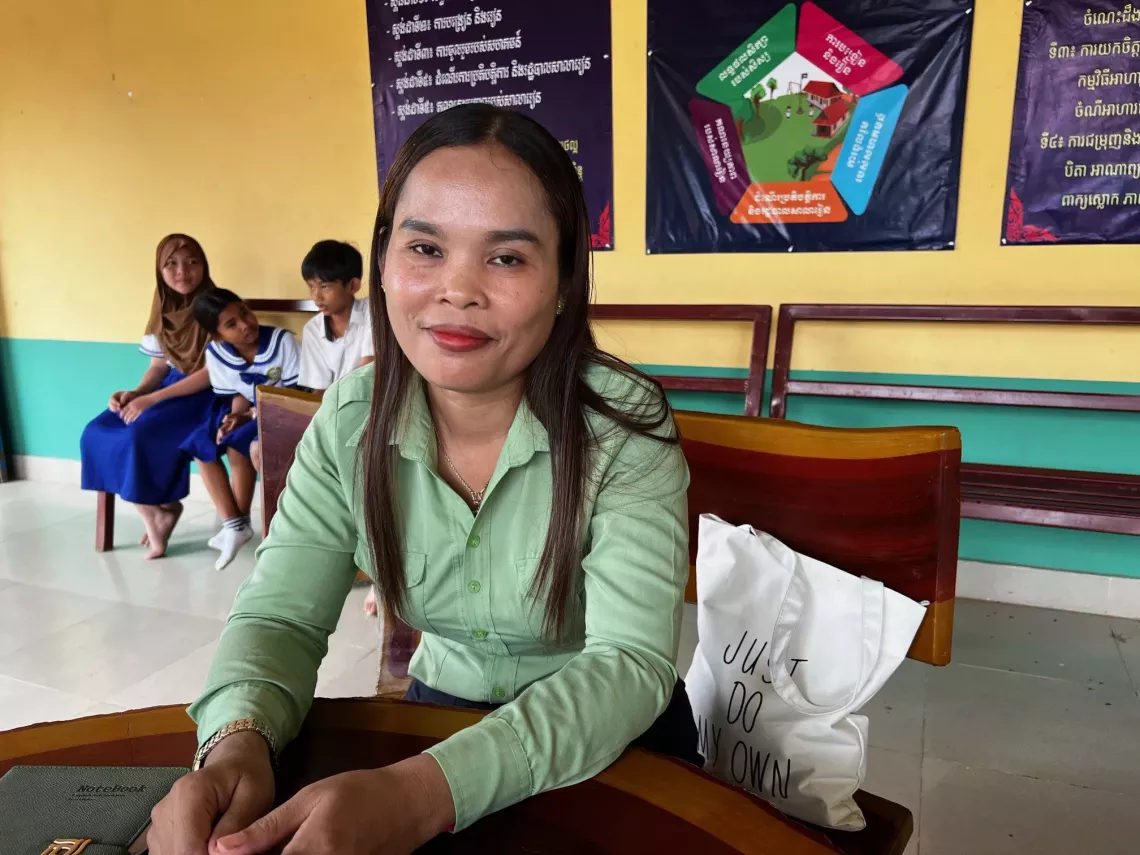
Teachers like Mrs. Thona Horn know this all too well. As the school’s child protection focal point, she reflects on her early years in the classroom with a mix of regret and revelation.
"I used to believe fear was the only way to maintain order and respect," she says. "I would raise my voice or use physical punishment, thinking it was necessary. But after learning about positive discipline, everything changed. Now, there’s trust and understanding. It’s incredible to see my students grow—not just academically, but as individuals."
At another school, Mrs. Muong, the librarian and child protection focal point, recalls being shamed by her teachers with harsh punishments. “I had to run laps around the school as punishment,” she says. “It was meant to shame me into better behaviour.” Today, she regrets having used similar methods with her own children.
Amplifying Students Voices and Empowering Them
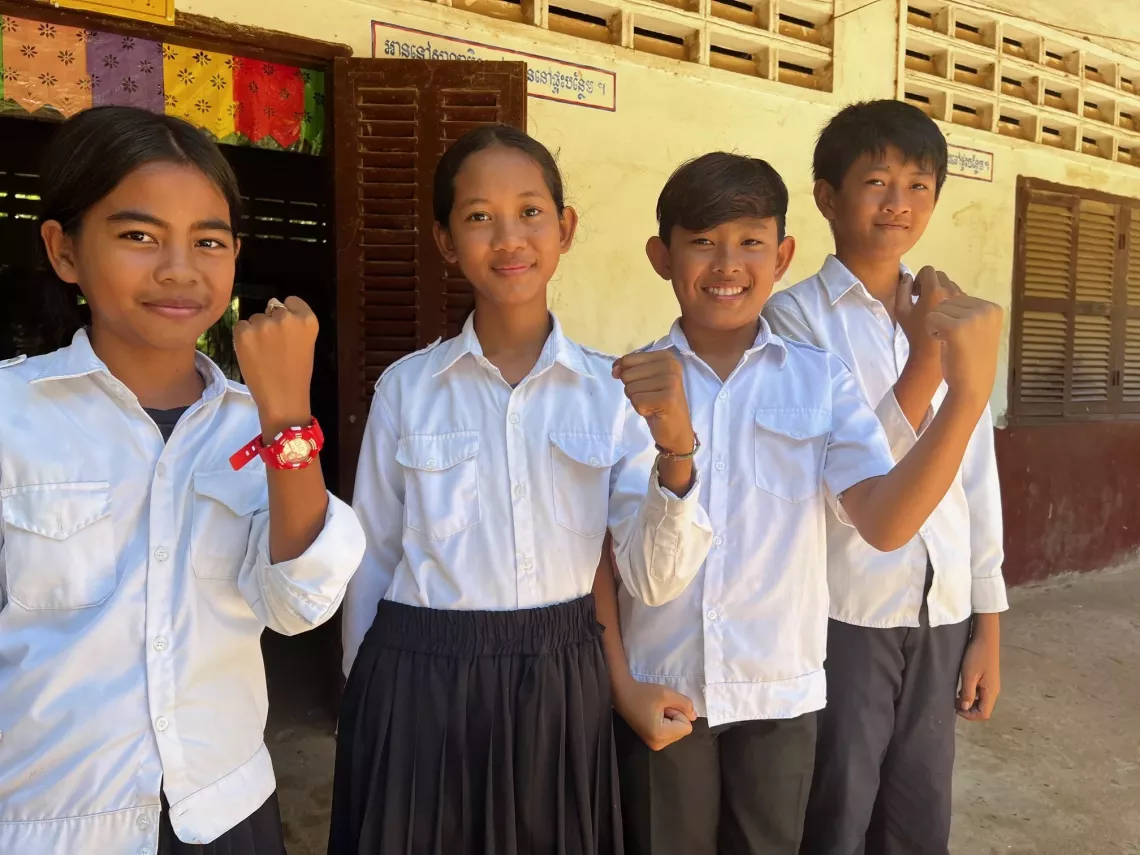
For students like Srey Moch, the Positive Discipline Programme has shaped their entire school experience. Now a sixth grader, Srey Moch proudly wears a red watch—a gift from her uncle for ranking first in her class and tenth in the province. Unlike previous generations, Srey Moch and her classmates have never faced harsh discipline or corporal punishment. Instead, they enjoy a classroom environment, where asking questions and seeking help is encouraged. "I raise my hand when I need help," says Srey Moch, who dreams of becoming a linguist when she grows up. "My teacher explains things in a way that helps me understand, and it makes me proud when I figure things out on my own.”
Her classmate, Thavath, dreams of becoming a math teacher. He, too, has benefited from a school where discipline focuses on guidance, not punishment. "When I misbehave or don’t do my homework, my teacher explains the consequences, and it helps me understand what I need to do better," he says. "I want to be a teacher one day; my own teacher inspires me."
At the school where Mrs. Muong teaches, 13-year-old Favith cherishes her school experience. Favith loves science, technology, engineering, and mathematics (STEM) subjects and hopes to become an engineer. "My teacher never yells at us," she says. "He’s always gentle, and that makes me want to learn more." Her best friend and classmate, Vichara, who hopes to become a first-grade teacher, adds, “Mr. Phano is like a second dad to me. I feel safe at school because of him.”
Reflecting on her positive discipline training in 2020, Mrs. Horn shares how she now manages her classroom: focusing on personal attitude, managing frustration by taking time to calm down, and avoiding harsh punishment. Her students now even take ownership of classroom maintenance without needing to be told.
The recent child protection guidelines introduced in Cambodian schools have also created a safety framework for everyone. Earlier this year, teachers, school directors, and community leaders across the country attended training sessions on how to identify victims of abuse and report cases properly. Now, students understand they can report violence—whether at home or at school—without fear. They’ve learned their voices matter, and their school experience is now centred on their right to safety and respect.
At both schools, teachers have fostered a safer, more supportive learning environment. "Since adopting these programmes, the atmosphere here has completely transformed," says Principal Ratha Khek. He proudly notes that the school now has a 100 per cent attendance rate, a significant improvement from the days when students avoided school out of fear.
Looking Ahead with a New Generation of Learners
As more schools adopt positive discipline and child protection guidelines, there is hope that this approach will spread across Cambodia, creating safer, more supportive learning environments. For Cambodian students, this shift represents more than a new teaching style—it’s a change in life opportunities. According to the Assessment of the Positive Discipline report, when children are in positive and supportive environments, they are more likely to stay in school, perform better academically, and develop key social skills such as empathy and teamwork.
In a country still healing from its violent past under the Khmer Rouge regime, the Positive Discipline Programme and Child Protection policies offer more than just safer classrooms—they provide hope for a brighter future. Students like Srey Moch are growing up in environments where they can learn confidently, free from fear, and are prepared to break generational cycles of violence.
“The Positive Discipline programme has given me a chance to feel safe at school and believe in myself,” says Srey Moch, who is excited to start 7th grade at a new school in November 2024.
With each generation, Cambodia moves closer to breaking the cycle of violence, ensuring that children grow up in classrooms filled with hope and opportunity, not fear.