Becoming better parents amid displacement
Displaced families face growing challenges in caring for their young children. With support from UNICEF, parents are learning how to become nurturing caregivers and better support early development.

- English
- Khmer
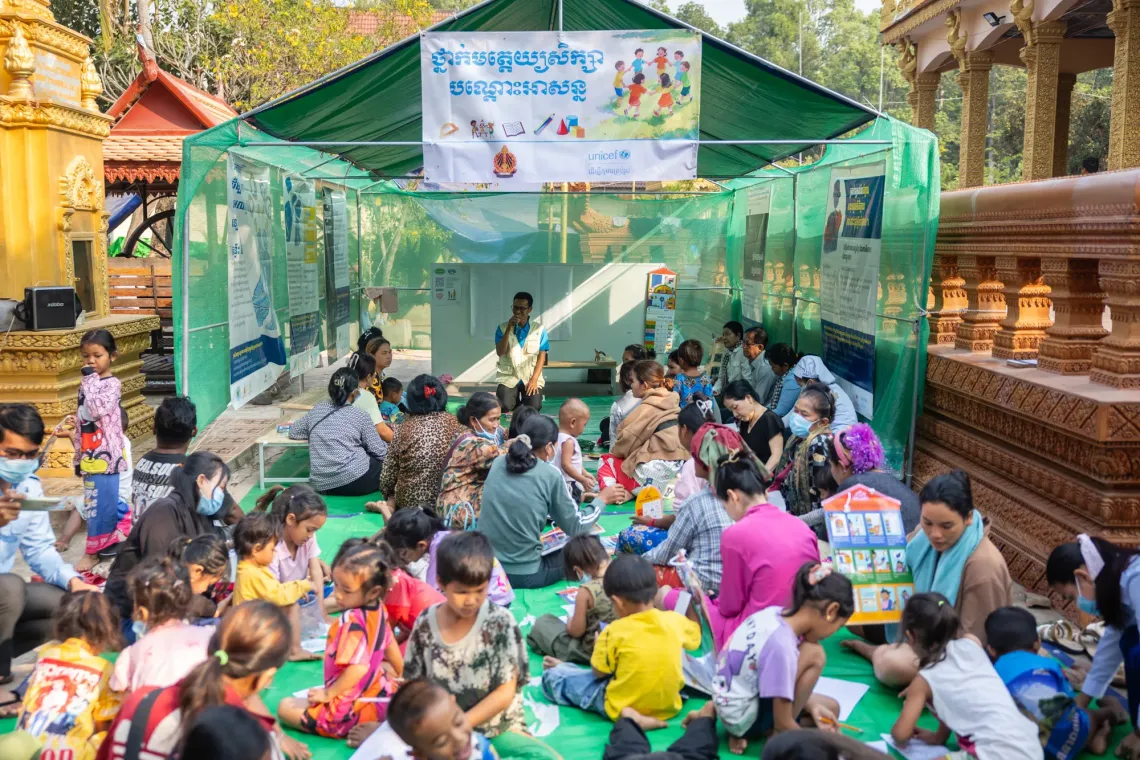
16 January 2026, Siem Reap – Inside a small blue tarpaulin tent at Sampov Loun Pagoda, about 50 parents are gathered for a parenting session. Some sit shoulder to shoulder on the tarpaulin laid across the ground. Others spill outside, settling on blue sheets spread just beyond the tent, listening from the edges.
Their children move in and out of the space. Some sit quietly, drawing with coloured pencils. Others tug at their mothers’ sleeves, asking for snacks or attention.
Among them is Thon Chan, 49, a mother of a five-year-old boy. She sits with the group while keeping an eye on her son nearby. Just weeks earlier, she was not here. She was at home in Pa’ong village, near O’Smach, along the Cambodia–Thailand border.
The pagoda, once a place of prayer and ceremony, now shelters families like Chan’s who fled their homes following the outbreak of conflict along the border in late July and again in December 2025. Many were forced to leave with little time to prepare.
Some, like Chan, returned home briefly, only to leave again. Her family remained on constant alert. “We were prepared since the evening before, so we were cautious. As soon as we heard the gunfire, we ran,” she says.
Her son remembers it. He told her the sound was loud. Now, at the displacement site, he asks a different question.
“Mom… when are we going home?”

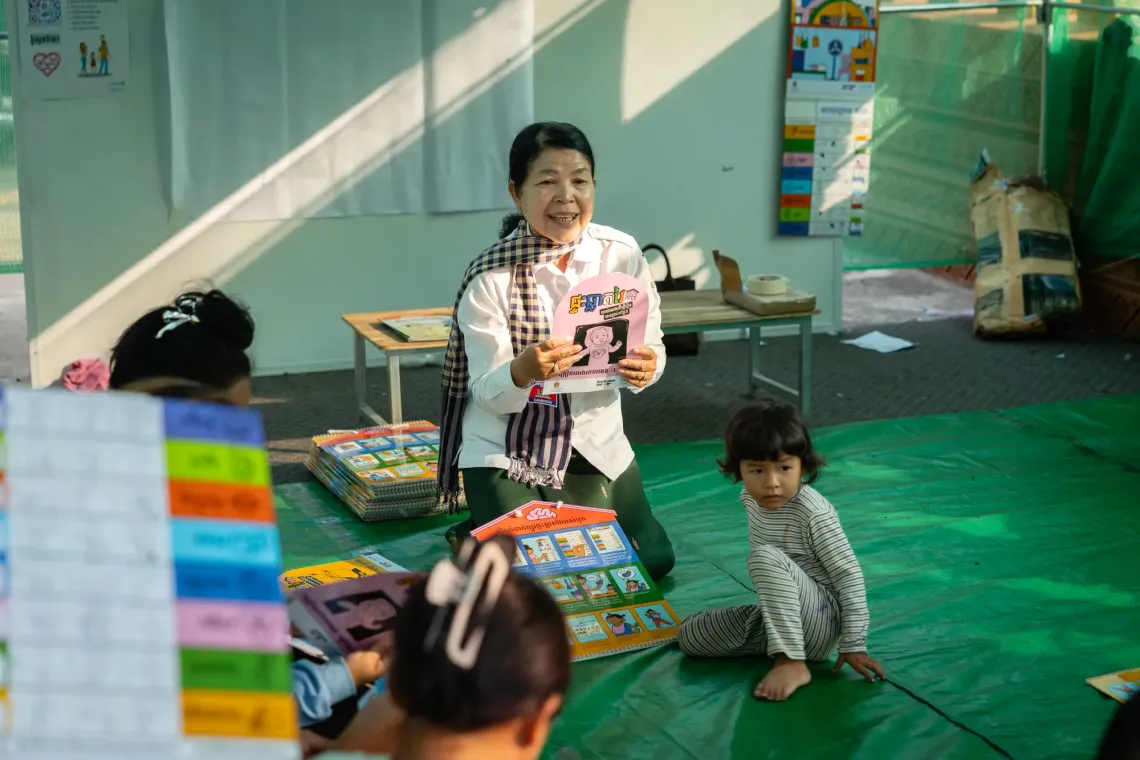
Inside the tent, a facilitator leads a session about nurturing care parenting. The topic is simple, yet urgent: how to care for young children.
The session is part of a broader response by the Ministry of Education, Youth and Sport, supported by UNICEF. It helps parents and caregivers understand how children grow, how they learn, and how everyday actions, small and repeated, shape their development.
The conflict forced hundreds of thousands of people to flee across seven provinces in Cambodia. At its peak, more than 600,000 people were displaced. Nearly one-third were children, and one in ten was under six. For young children, prolonged displacement disrupts routines and weakens the conditions need for early development.
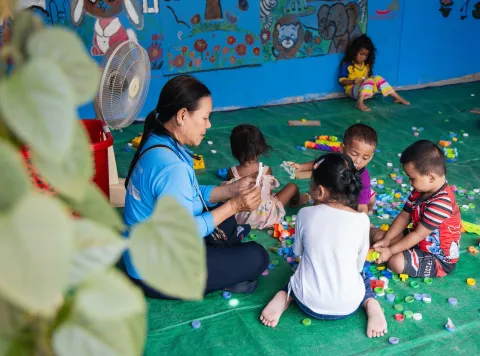
To enable early learning to continue, the Royal Government of Cambodia, with support from partners including UNICEF, established Early Childhood Education temporary learning spaces across displacement sites. At the height of the crisis, 129 such spaces were operating across seven provinces, offering children a safe place to learn and play.
Tents and simple structures now serve as classrooms. Teachers adjust their schedules, moving between formal schools nearby and sessions in temporary displacement sites like this one in Siem Reap.
UNICEF, with funding support UNICEF Germany and the Australian Government through the Australian NGO Cooperation Programme (ANCP), has supported these efforts by enabling the rapid setup of Early Childhood Development (ECD) temporary learning spaces through targeted support to provincial Departments of Education, Youth and Sport.
In addition, support from the China International Development Cooperation Agency (CIDCA) provided 417 Early Childhood Development kits, reaching approximately 12,000 children. Each kit includes essential learning and play materials designed to encourage interaction, movement, and learning, all important for early development.
Some parents, however, especially those with limited access to parenting information, do not send their children to these spaces. Many are not fully familiar with early childhood development, and some rely on mobile phones to keep children occupied, which reduces time for interaction and play. Displacement adds further pressure, including stress, fear, and uncertainty, making consistent caregiving more difficult.
Some parents also adjust their routines around aid distribution, staying close to the tents when support arrives.
“If they send their child to a public school, the child misses out on receiving donations and assistance,” says Thon Sina, Deputy Director of the Provincial Department of Education, Youth and Sport. “These donations often arrive two or three times a day, and when they distribute them, they do a head count.”
The parenting session responds to these challenges by offering practical guidance on how parents can support their children’s learning, hygiene, health, nutrition, and well-being and how to practice positive discipline, especially in difficult conditions.
For Chan, parenting carries its own pressures. When her five-year-old son, Meng Ang, misbehaves, she struggles to stay calm.
“When I’m angry, I hit him.” she says. After the session that morning, she reflects on what she learned. “I must change.”
She hopes to begin with small steps.
“I want to teach him. We aren’t literate, but we must teach him one letter at a time and to count fingers and toes so he knows the numbers up to ten.”
A few metres away, Touch Luot, 40, a farmer from Kok Khpos commune in Banteay Ampil district and is also temporarily sheltering at the site.
She already teaches her son simple things at home, including drawing and counting, though not always consistently. Work fills most of her day.
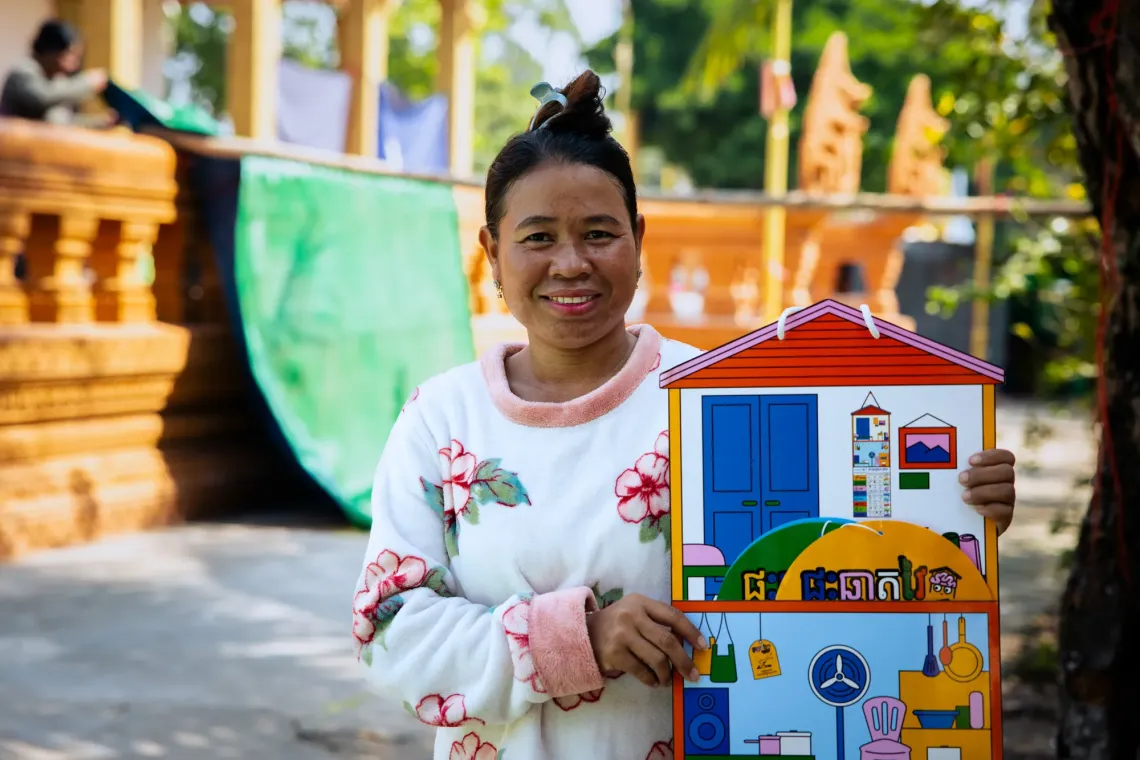
After the session, she speaks with more certainty. “I am more determined now. When I go back, I’ll lead the child in play and buy toys so we can play together. He likes playing.”
She hopes her children will continue their education as far as possible. “I want to raise my children to be smart and knowledgeable… I want them to finish [school].”
Across the displacement site, similar moments unfold. For many families, change begins in small ways. Actions repeated over time begin to shape how children grow and learn.