A social worker who never stops caring
During emergencies, children’s rights are most at risk. With support from UNICEF, social workers work day and night to protect returning child migrants and reunite them with their families.
- English
- Khmer
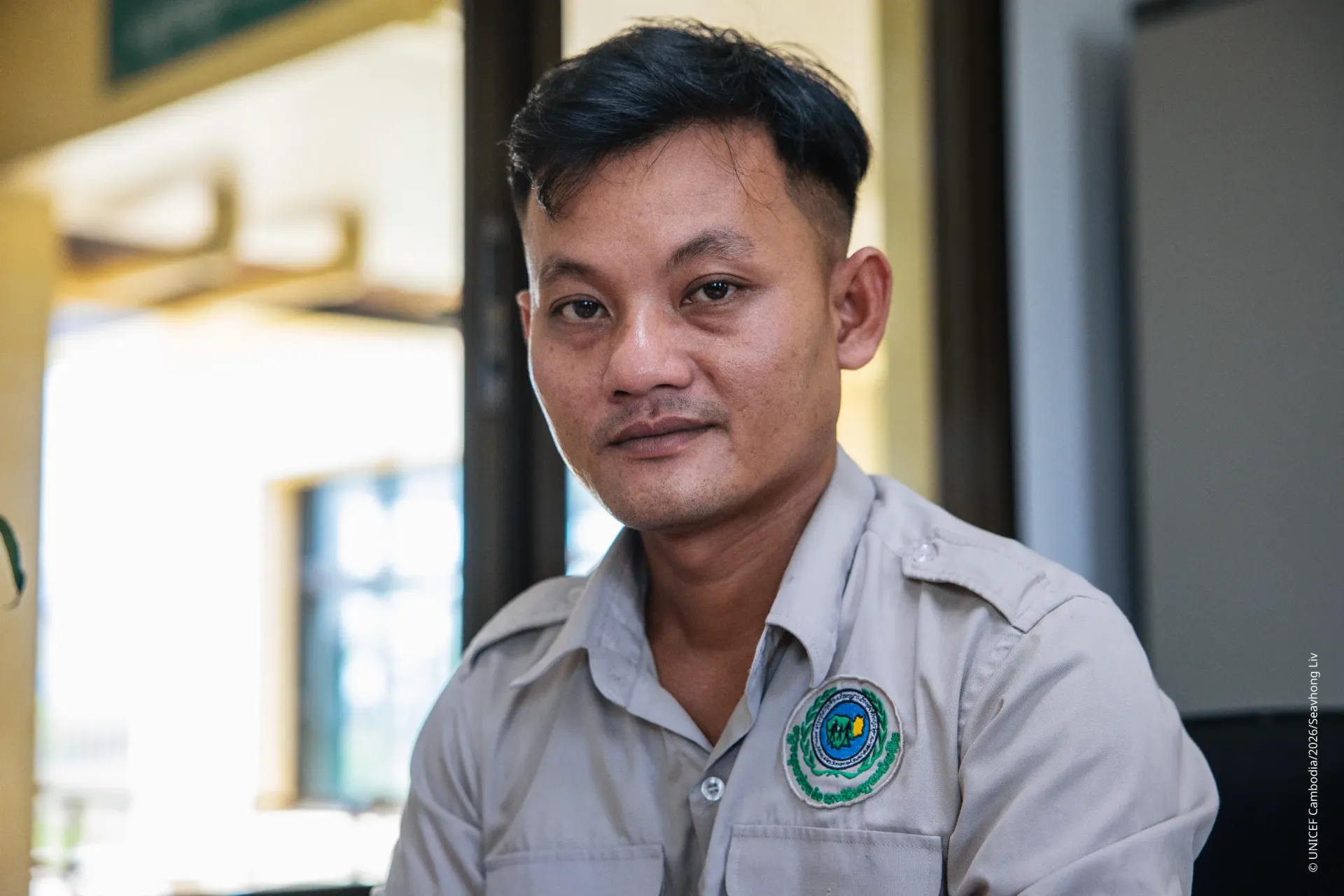
February 2026, Poipet City, Banteay Meanchey – When the bombing drew closer to Poipet in late 2025, Kim Thou was afraid.
“I was afraid of the bombs, but in times of crisis, children need more support from social workers,” he said.
For nearly nine years, Kim Thou has worked as a government social worker at the Poipet Transit and Rehabilitation Center, which is managed by the Ministry of Social Affairs, Veterans and Youth Rehabilitation (MoSVY). Based in the busy border town between Cambodia and Thailand, he supports children and migrant workers returning home, many of them vulnerable, undocumented, or separated from their families.
When conflict along the Cambodia–Thailand border escalated in late 2025, the number of returning migrants surged. Out of 900,000 returnees, 16,500 were children, who arrived tired, anxious and, in some cases, alone.1
At the height of the influx, Thou led his team to register 118 migrant children, including 56 girls. Of these, 26 children—13 girls—required direct case management support to assess risks, identify protection concerns, and reunite them with their families through the appropriate protection measures, including referral to obtain civil identity documents such as birth registration. Many evenings stretched late into the night as the team worked to identify the most vulnerable children and deliver timely support services.
During emergencies, trained social workers play an even more critical role in safeguarding children’s rights and well-being. Returning child migrants, especially those separated from their parents, face heightened risks of violence, abuse, and exploitation and may lack access to essential services like healthcare and education.
Behind Thou’s rapid response was thanks to months of preparation.
With support from UNICEF through the European Union–funded PROTECT Project (“Ensuring Decent Work and Reducing Vulnerabilities for Women and Children in the Context of Labour Migration in Southeast Asia”), Thou had participated in capacity-building activities on child protection case management for children in the context of migration, as well as training on the PRIMERO digital case management system. These trainings strengthened his ability to record migration-related cases, safeguard children on the move, and facilitate their safe reunification with their families.
The PROTECT Project aims to strengthen legal protections, access to services, and ensure the safe migration of women and children, reducing risks of abuse and trafficking.

The escalating conflict forced the Poipet Transit and Rehabilitation Center to evacuate. But even after leaving, Thou could not stop thinking about the children.
Despite the danger, he returned to Poipet to check on a 17-year-old boy and his adoptive family who had chosen not to evacuate, fearing they would lose their jobs. He brought essential supplies and provided social welfare support, helping ensure they had access to basic necessities and information about available services during the crisis.
Even while the centre remained closed, social workers continued their work, and they never stopped caring. They followed up with children by phone, coordinated referrals to safe locations, and supported returns to communities once conditions allowed.
Thanks to the dedication of social workers like Kim Thou, and the continued support of the European Union through UNICEF under the PROTECT Project, children affected by migration continue to receive timely support so they are protected from harm, can reconnect with their families, and move forward with greater hope and security.
1 National Committee for Counter Trafficking (NCCT)