Let’s talk about periods
In Siem Reap, school sessions on menstruation are getting both girls and boys learning and talking about periods, breaking taboos and empowering girls to take care of their health without shame

- English
- Khmer
12 March 2025, Siem Reap – Seventeen-year-old Srey Leak used to never talk about her period. It’s something to be kept secret, her parents had told her, because the blood can be used for black magic if it falls into the wrong hands.
“My parents told me that if other people know that I’m on my period and I don't dispose of the period blood properly, someone might use it to harm me,” she says. “After hearing that, when I first got my period, I was really afraid. I didn’t dare tell anyone.”
While attitudes are changing, period stigma and myths in Cambodia continue to impact how young girls manage their first periods. Some girls are still being taught that they will get pregnant if they touch a boy while menstruating, that going near people who are ill can make them sicker, or that eating sour fruits can stop the bleeding. In rural areas, shyness and a lack of access to information prevent girls from learning how to manage their period hygienically, risking both their health and self-esteem.

At Srey Leak’s school in Siem Reap, a new UNICEF-supported initiative to promote menstrual health and hygiene is helping her finally get over her fears. The school youth council has been breaking stigma by getting both boys and girls learning and openly talking about puberty, menstruation, and menstrual health and hygiene. They’ve also been demonstrating how to make period cycle bracelets and reusable cloth sanitary pads, explaining the benefits for both health and the environment.
“Before, I used to think that boys shouldn’t know about girls’ periods,” says Srey Leak. “But now, I can talk about it openly because I know it’s nothing to hide. It’s normal, and we can share it with people around us.”
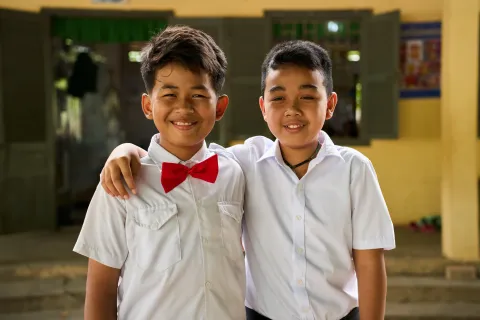
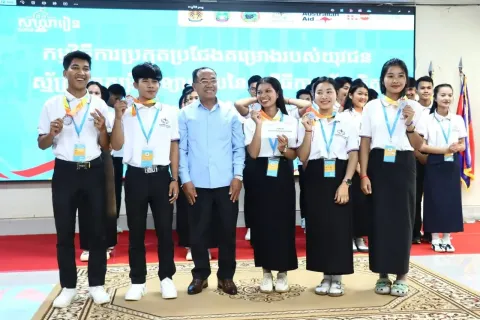
Grade 11 students, 16-year-olds Rey and 15-year-old Sean, were among the youth council members at their school who participated in the trainings run by the Ministry of Education, Youth and Sport’s School Health Department, with support from UNICEF and Green Lady Cambodia, an organisation that helps facilitate education on menstruation. With guidance from their teachers, they’ve been playing a crucial role in spreading awareness among the students, giving girls advice on how to best take care of themselves while telling boys that menstruation is something they should be learning and spreading awareness about too. Both boys and girls learn how to make the washable pads and period bracelets.
“When I train boys, they always ask, ‘I’m a boy, why do I have to know about this?’” says Rey. “I tell them that it’s important for men to understand what happens to girls when they have their period. Because they live in a family with a mother, a sister, even a wife.”
Sean says the sessions have helped younger girls prepare themselves for their first period.
“Because they are young and it’s their first time, we inform them about what a period is based on what we learn from the training so that they are prepared for it and not afraid,” he says. “I can see that they feel more confident and less shy.”
In Cambodia, 63 per cent of schools have no basic toilets that are separated by sex and usable (meaning available, functional and private), making it even harder for girls to hygienically and confidently manage their periods.1 For many poor women and girls, the cost of sanitary materials can also lead to unhygienic practices. Washable cloth pads provide an alternative to disposable sanitary products, helping girls and women save money and encouraging better hygiene, in addition to the environmental benefits.
UNICEF has so far supported trainings for 34 teachers (18 females) and 78 youth council members (55 girls) across five schools in Siem Reap, reaching 2,130 students, including 1,290 girls and four students with disability. To ensure that girls can feel safe and supported in all parts of their life, focal points from the commune council for women and children (CCWC) and village chiefs are also trained and encouraged to share what they learn within the community.
Sok Sipha, school director, says that it’s also important that they make sure to keep enough sanitary materials available within the school and that there are clean facilities available for girls to change in private.
“I want all schools to pay close attention to this important issue,” he says. “The school should be prepared with enough materials, because if girls have their period in the middle of class, it might affect their studies. They should have access to sanitary pads, clean bathrooms and trash bins for disposing the sanitary items.”


It’s not just the girls who are becoming less shy, the school says. Boys are embracing the message too.
“Periods should not be hidden. We need to spread awareness and educate both girls and boys that periods are normal, and that we shouldn't feel embarrassed talking about it,” says 16-year-old Bovan, a boy in Grade 10. “I can help spread awareness to other girls and my family members, especially my sister. So that when she has her period, I can understand that she’s feeling frustrated or not feeling well and tell her to drink warm water and eat nutritious food.”
Educating students on menstrual hygiene protects girls throughout their lives, says Rey. And when girls know how to take care of their health without shame, the country can thrive, too.
“I want to empower girls,” says Rey. “Since we live in a very remote area, this kind of information is still lacking. So this kind of training is an opportunity for us to educate them, so they know how to take care of their health and hygiene. Girls are the catalyst that drive and contribute to the development of the country. And girls are mothers. Mothers are the ones who can give birth to the next generation, the human resources of the country.”