Sina learns through play in Cambodian community pre-school
UNICEF is supporting early education nationwide, with funding from China
- English
- Khmer
It is early morning in Kratie Province of Cambodia, a rural area along the banks of the Mekong River. It’s dry season and skinny cows wander through dried-out yellow fields that shade into green paddy fields where they get closer to the river. Bales of hay are stacked in high lofts on stilts, golden where they catch the sunlight. A farmer drives a koyun – a small tractor engine pulling a wooden cart – past wooden houses on stilts, each of which also has a miniature spirit house with offerings to ancestors or local spirits.
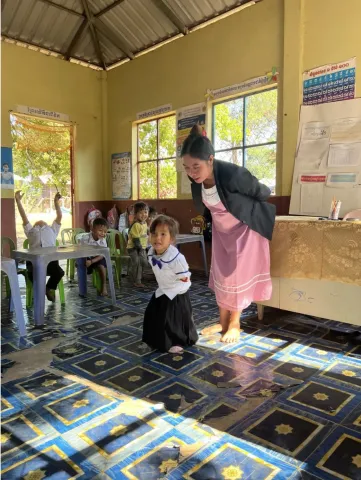
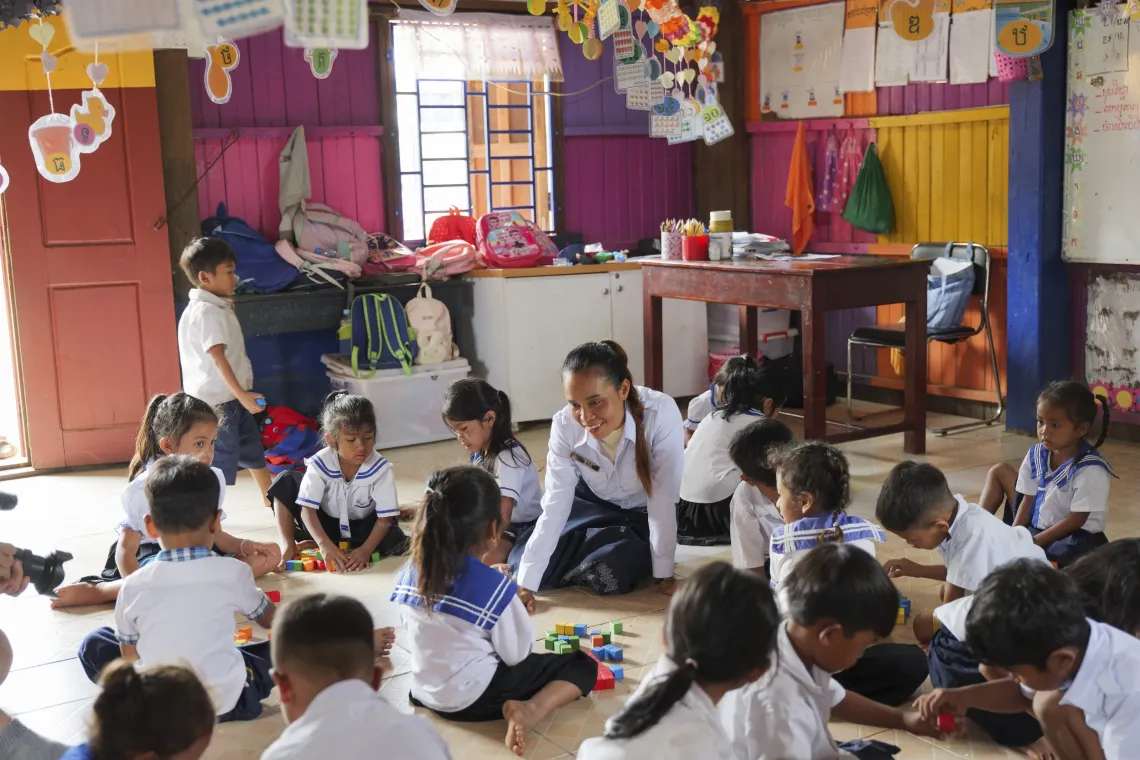
Mareum Community Pre-School is in the centre of the village. It consists of two classrooms and a playground brightly painted in cheerful shades of yellow, red and blue. Inside one of the classrooms, a group of five-year-olds are decorating pictures of flowerpots with small pieces of cut-up coloured paper. One of these children is Ny Sina.
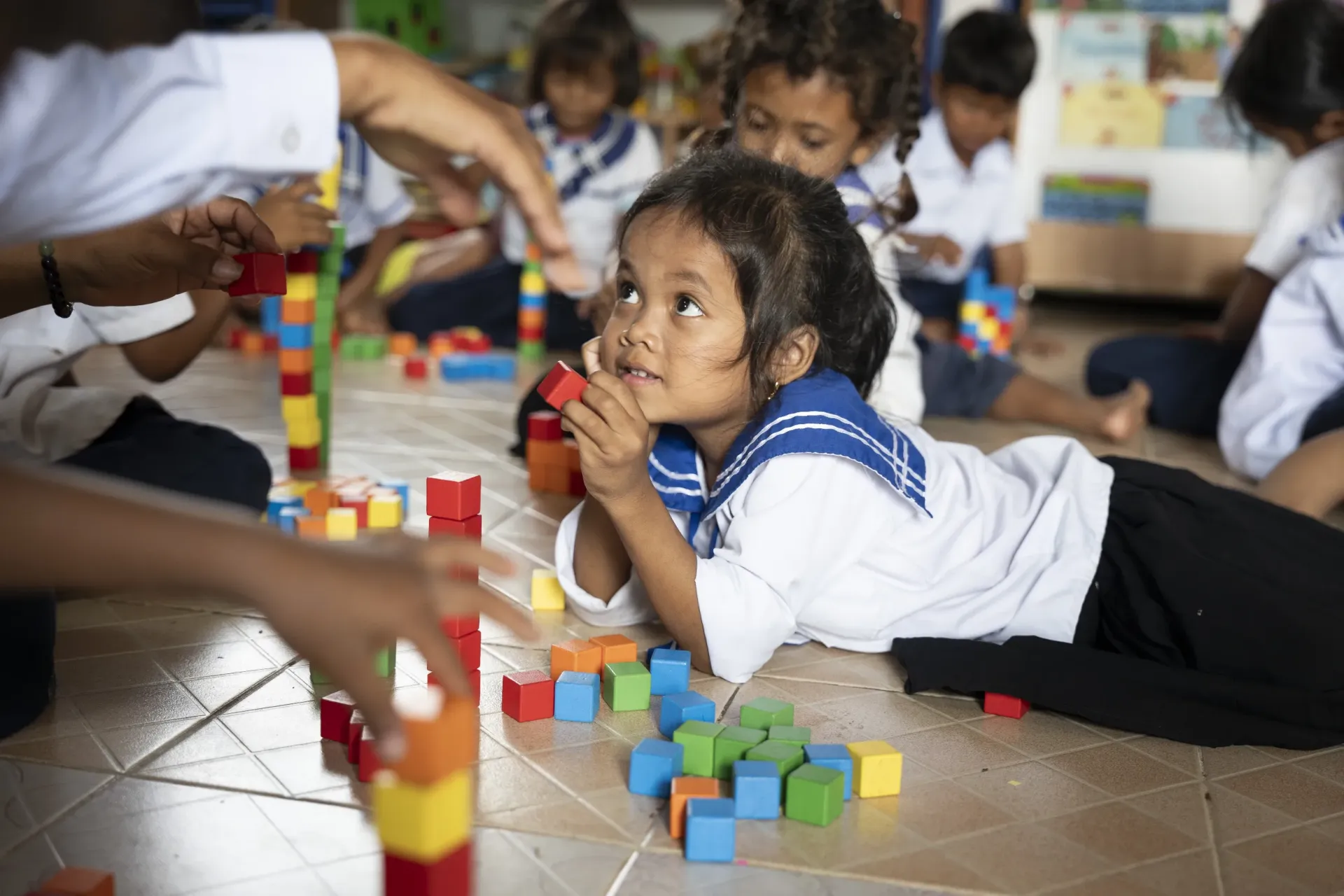
When they’ve finished, the teacher brings out a basket full of coloured wooden blocks. The children excitedly grab armfuls of blocks and carry them over to where they were sitting. Sina shares her blocks with the girl next to her. Together they sort them into different colours and start building towers.
Sina builds a tower of red blocks, counting in Khmer. When she gets to eight blocks, the tower topples and falls. “It’s OK, let’s try again,” her teacher Sum Dany says. “Let’s try with the blue blocks.”
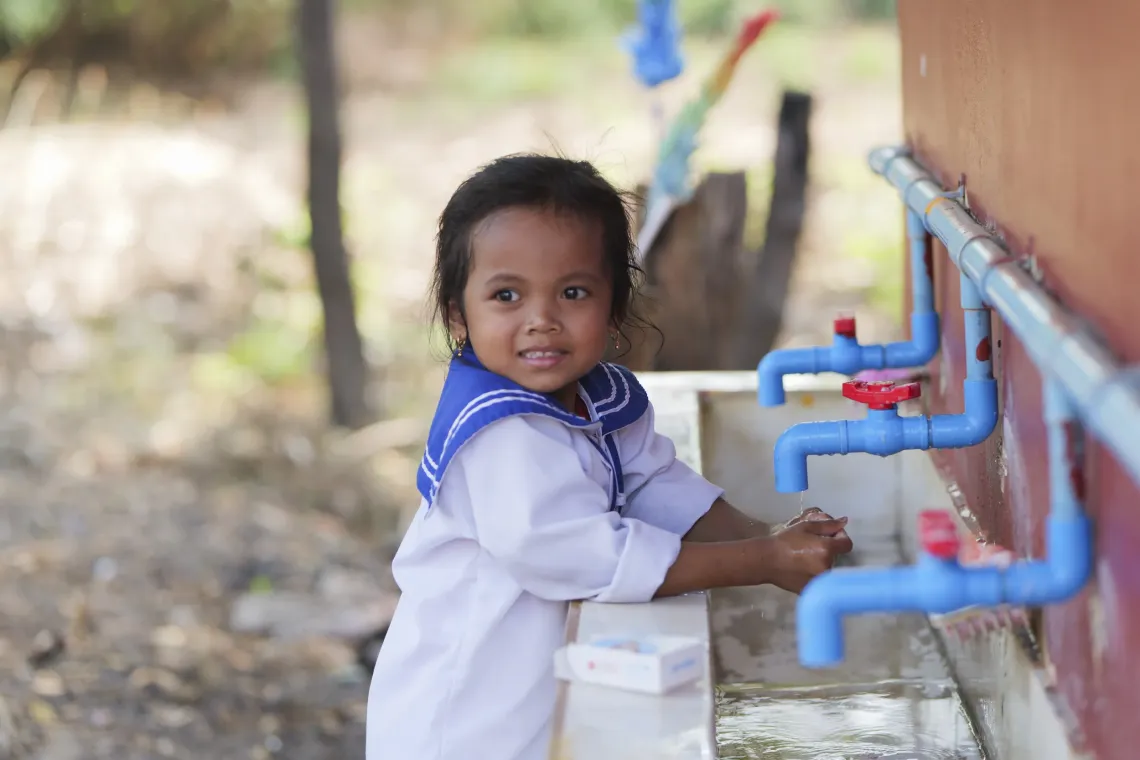
Once they’ve finished building towers, the children wash their hands with soap at an outdoor water tap, have a snack, then play football or on the swings in the playground. The children are clearly happy and energized, enjoying their time at school.
“My child Sina talks a lot and she is very lively,” says her mother Suen Sinet. “At first, when I took her to preschool, she cried a lot. The teacher asked me to come back to school and stay with her in the classroom. But it’s different now – I can just drop her off and go home to do my farming or housework.”
Early childhood education
In Cambodia, only around 43 percent of children aged three to five years old are enrolled in preschool. In rural areas, many are missing out on quality early learning. Others go to community pre-schools, which are set up and managed by local communes in remote areas where government pre-schools are not available.
Previously, government pre-schools in towns and cities were well equipped, but community pre-schools like the one in Mareum were not provided with learning or handwashing supplies. Often teachers would have to buy these themselves, using their own money. Even then, it often hard for them to find good quality materials locally.
With support from China, UNICEF is providing learning, teaching water and handwashing materials to more than 3,200 community pre-schools throughout Cambodia. Funding was provided by the China International Development Cooperation Agency (CIDCA). This has allowed UNICEF to expand the programme to cover all community pre-schools nationwide in Cambodia.
“The Government of China and UNICEF have carried out successful projects together in Cambodia, to improve education, health, nutrition, and water, sanitation and hygiene services for children in the most vulnerable communities,” says Chinese Ambassador to Cambodia, Wang Wenbin. “This marks a new level in our partnership.”
“I would like to thank the Government of China for supplying learning materials to community preschools throughout Cambodia, helping children receive better education,” says Sina Sam, Education Specialist at UNICEF Cambodia. “This support has helped us expand early childhood education across the country.”
Community pre-school
Play is an essential component of high-quality pre-school education. It helps children learn how to navigate the world. Through play, children acquire language and learning skills, emotional regulation, and problem-solving skills. Early play-based learning also creates a solid foundation for all future learning.
The supplies provided to Mareum Community Pre-School included play-based learning materials such as coloured blocks, coloured paper, pencils and pens, as well as teaching materials such as a whiteboard and textbooks. There were also a water filter and bars of soap to help provide safe water and hand hygiene, which is important for children’s health.
“Before, we had very few teaching and learning materials,” Sina’s teacher Som Dany says. “Without materials, it was very difficult and the children were not interested in coming to school. Managing the class was difficult and chaotic.”
After Mareum received the UNICEF materials, Som Dany immediately noticed a change in the children in her class. The play materials stimulated their creativity and imagination, while helping them learn skills like counting and naming colours. She also noticed a difference in the children’s parents, who became more willing to send them to school, increasing attendance.
“When the children saw these new things, they became excited and even competed to play with them,” she continues. “They love the wooden blocks because they can build different shapes and sort them by colour. They can make them into different things like houses or robots. With soap available, they can wash their hands and maintain good hygiene.”
“I am not very good with words, but I am truly very happy.”
Home learning
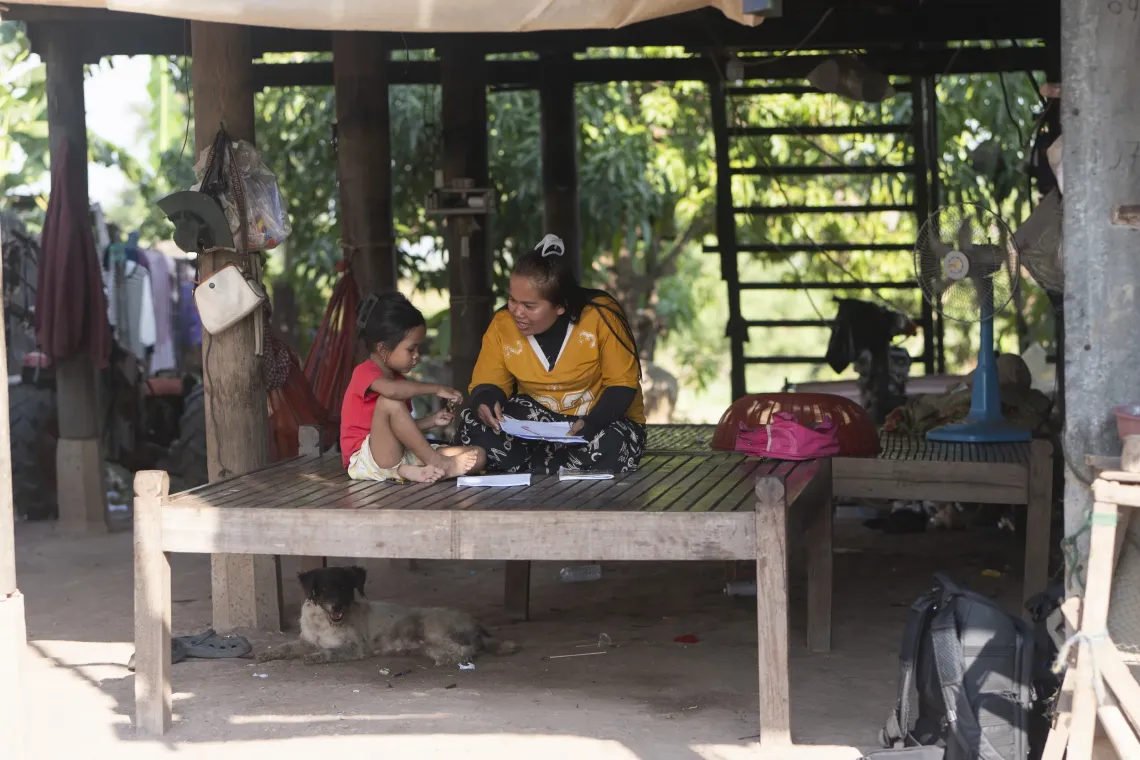
As school finishes, Sina’s mother arrives by motorbike to pick her up. Sina runs over to her and climbs on the back of the bike. They drive down the earth road through the village to the family home, opposite a rice field. Like others in the village, Sina’s home is a wooden house raised on stilts. During the hot afternoon, people and animals take shelter in the shady area under the house. Here, there are hammocks strung between the stilts, a wooden decking area for family activities, and large urns holding water for washing and cleaning.
Tired from school, Sina sleeps in a stripey red hammock strung between wooden beams. After her nap, she shows her mother her artwork from school, spreading her pictures out on the wooden deck. “What did you do at school today?” Suen Sinet asks. “I did colouring and decorated this jar. Is it pretty?” Sina replies. “Yes, it’s very pretty,” her mother says.
Afterwards, they practice writing Khmer letters together and then Sina sings a song: “There’s an owl with big eyes, hooting from a tree. It hears the call of a Scops owl and joins in, hooting merrily,” she recites.
When they’ve finished playing, Suen Sinet reflects on the changes in Sina. As she talks about her daughter, her eyes light up and her face breaks into a wide smile.
“After Sina went to school and saw many new toys and other learning materials, she began to enjoy going,” she says. “When she comes home, she tells me: ‘Mom, I can write my letters now!’ I want my Sina to complete her studies and become a teacher. She can get a good job and not struggle like me, working in the fields.”