Cambodian youth advocates call for greener future at COP29
Youth delegates at this year’s COP29 in Azerbaijan balance out losses and gains from the globe’s primary conference on climate change. Despite setbacks, their hopes are high for youth climate action
- English
- Khmer
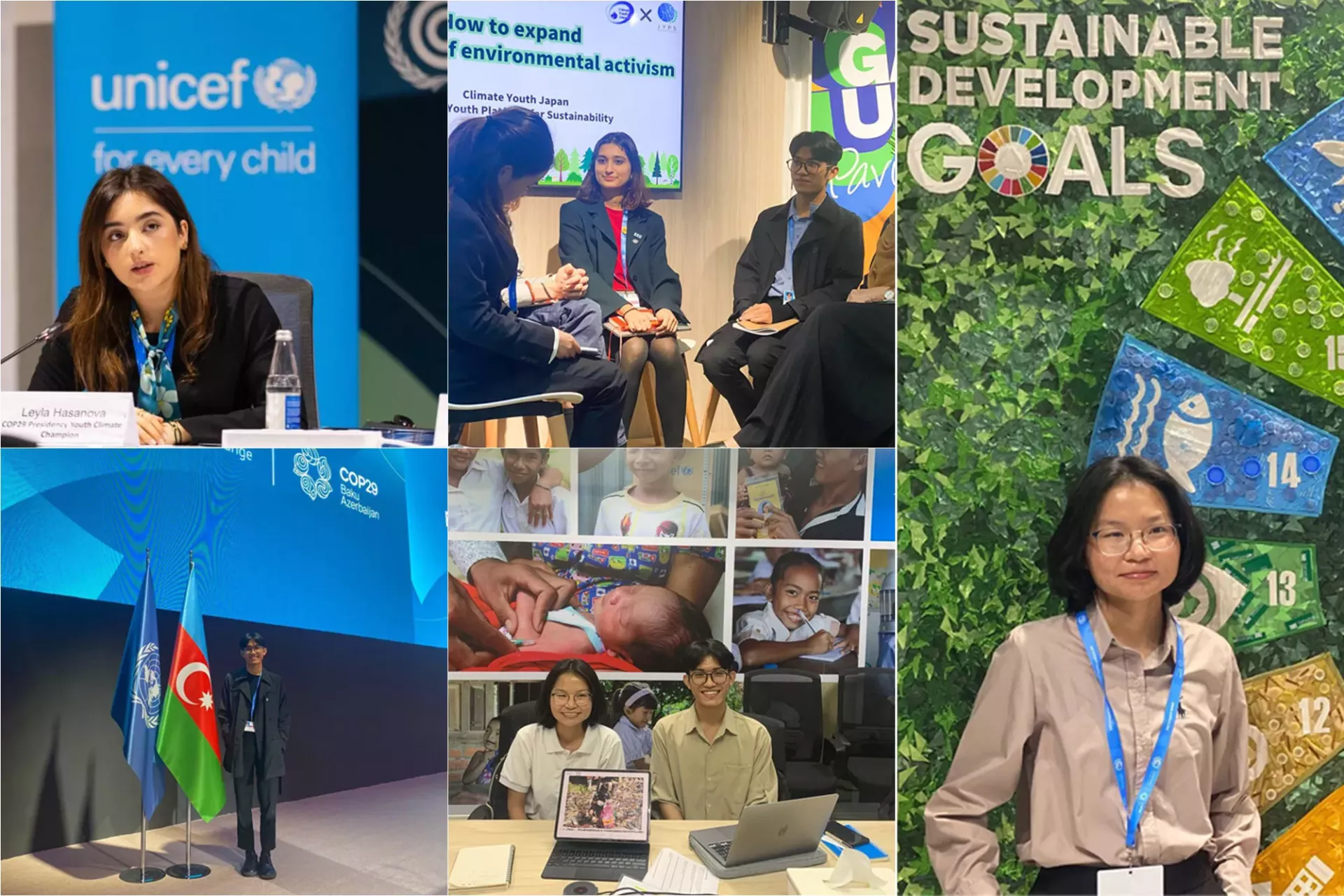
28 November 2024, Phnom Penh – The excitement of COP29 in Baku, Azerbaijan remains strong for the Cambodian youth delegates, even weeks after the event. Representing Cambodia at COP29’s Youth-Led Climate Forum, Phavan Va and Silida Sithan engaged in constructive, forward-looking discussions with youth participants from all over the world. UNICEF Cambodia, as a part of its youth climate action initiative, selected and supported these two promising climate and environment advocates to attend the UN’s annual global conference on climate change.
For Silida, the COP29 youth-led sessions were “inclusive, informative and engaging”.
“It was a fantastic open platform for young climate advocates to introduce their ongoing projects, and I was truly inspired by the passion of young people to make this world a better place,” he said. “We are very much obliged to UNICEF for the support to make this all happen. Taking fresh perspectives from fellow youth delegates was an eye-opening experience for me.”
This year, the COP29 Youth-led Climate Forum featured dialogue sessions over five days, with children and youth invited to share policy priorities directly with decision-makers on critical topics such as the Nationally Determined Contributions (NDCs), loss and damage, sustainable agriculture and water resource management, health and education, and climate finance.
Silida and Phavan were selected to attend the conference by the Youth Council for Climate Action (YCCA), which UNICEF has been supporting since early 2024 as part of initiatives to empower Cambodian youth to lead climate action in their communities. Earlier this year UNICEF Cambodia hosted both the Local Conference of Youth (LCOY), a platform for young people to consolidate their climate demands into a national youth statement to be presented at COP, and the Cambodia Climate Change Summit 2024 (CCCS24).
“Momentum for youth-led climate advocacy in Cambodia was fully gained with this year’s Local Conference of Youth (LCOY),” says Phavan, praising the dedicated efforts of Cambodian youth to make the event back in August a success.
“We were proud to present ‘The Cambodia Youth Statement on Climate Change 2024’, which was adopted at LCOY and officially endorsed by the Ministry of Environment. Our youth action key points were integrated into the Global Youth Statement at COP29, along with other fantastic suggestions from fellow participants.”
The Global Youth Statement is a collective call for action from children and young people for world leaders to step up to the climate challenges facing the world. This year, youth climate advocates presented their climate policy demands and proposals, calling on policymakers to accelerate concrete actions on loss and damage, gender-responsiveness, inclusiveness for the marginalized, and financial transparency.
Above all, this year’s COP29 discussions went deep into climate finance. “I was impressed by how all speakers pushed for a dramatic increase in climate financing for child-sensitive programmes,” said Phavan of a session on closing the finance gap and investing in climate action for children, which was led by UNICEF Deputy Executive Director for Partnerships, Kitty van der Heijden.
This year, attendees set a new target to replace the previous US$100 billion goal, known as the New Collective Quantified Goal for Climate Finance (NCQG), which increases commitment for climate adaptation and loss and damage in developing countries to US$300 billion.
“Kitty underscored that, for now, only 2.4 per cent of the multilateral climate budget goes towards protecting children exposed to climate threats. So the NCQG is a breakthrough agreement that will be a lifeline for millions of children suffering under climate crisis.”
Despite the excitement, both young delegates had to think about what could have been improved at the COP29 youth discussions.
“I somehow had the feeling that youth-led sessions were upstaged by others,” said Phavan. “If you think of TV programmes – the prime-time shows were for the high-level speakers, and youth sessions were pushed back to midnight hours. We were not ‘mainstreamed’ for substantive discussions.”
Silida is also concerned that the ambitious goals for climate finance might become squandered opportunities.
“I know the delegations struggled through conflict of views to reach the US$300 billion agreement for climate finance,” he said. “However, it is another thing to live up to the promises. We know that these commitments have gone unfulfilled in the past, which adds concern to the wealthy nations’ negligence.”
Despite the lingering doubts on the outcomes of COP29, these young climate advocates hope to continue to build momentum on the work they’ve done so far. They plan to take home what they learned in Azerbaijan and use their voice to deliver their findings and directly implement what is viable and effective in Cambodia.
Cambodia ranks 46th out of 163 countries in the global Children’s Climate Risk Index (CCRI), and this report highlights the severe impact of climate change on young people and its risk to their health, education, and safety. Nearly 2.3 million children—43 per cent of the child population—face extreme heat stress, while 2.2 million are at risk of riverine flooding, especially in rural areas near Tonle Sap Lake and the Mekong River.
Phavan is currently a Communication Lead at the GOMI Recycle, a private firm that specializes in recycling plastic into furniture. Silida is a member of the YCCA and advocating climate change education nationwide. Silida is confident that Cambodia is ahead of other countries in waste management, but only small steps have been taken in urban areas with limited resources.
“There is a wide urban-rural disparity in recycling systems and many other environmental initiatives,” he said. “At COP29, other youth participants introduced the projects they are running with local partners and how they successfully engaged vulnerable groups during community activities. They highlighted the importance of awareness raising about climate impacts, and how we should empower people to build their resilience. I realized that with climate and environmental action, no one should be left behind.”
To walk the talk, Silida will travel to Kampot province in mid-December and reach out to youth groups to offer learning sessions on climate change. Phavan is also excited to share her insights and observations from COP29 youth discussions.
“We are already looking forward to next year’s LCOY,” she said, hopes high. “COP29 youth discussions have avenues for both inspiration and improvement. There may have been disappointments, but things cannot change overnight. Rather, conveying our visions to the policymakers in a compelling manner is just the start, and we should be proud of our achievements so far. Steady and consistent efforts will pay off in the long run.”
Watch video for information on ‘Reflections of the Cambodia Youth Delegations to COP29’