Crossing the river: safer births for mothers and babies
On a remote Mekong island, unstable connection to electricity meant midwives often relied on headlamps during deliveries. Today, solar power is making labour safer for both mothers and babies

- English
- Khmer
23 April 2025, Kratie – On sunny Koh Pdao, a serene fishing island of the Mekong River, mothers are resilient.
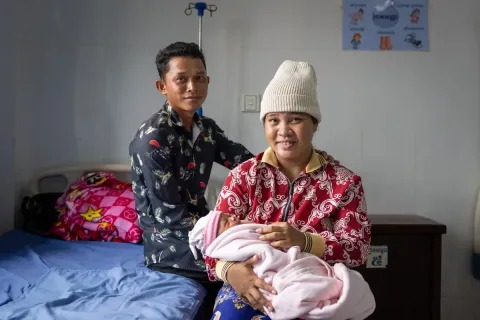
Thirty-five-year-old Chea Sokha, who’s preparing to welcome her third child, laughs as she remembers how she delivered her first two unexpectantly at home.
“It was really fast and easy,” she says, even comparing giving birth to going to the bathroom. Fourteen years ago, she was young and fearless. “I had prepared everything to go to the district hospital. I borrowed money and a boat, but then the contractions started and just 30 minutes later the baby was born.”
In Khmer, crossing the river means to give birth, a common metaphor for the risks of labour in previous years, especially when health services were far, hard to reach, or poorly equipped. A decade ago, some pregnant women on Koh Pdao would risk travelling an hour by boat during labour if they wanted to give birth at a health facility. Some would make it to the mainland – crossing choppy water through rain, thunderstorms or pitch-black darkness – while others would give birth right in the middle of the river. Some would stay home, relying instead on traditional birth attendants.

Even after a health centre finally opened on the island, giving residents a safer option to access medical care, unstable connection to electricity at night meant many women would have to give birth in the dark, without the relief of a fan in the tropical heat.
“Before, when there was no electricity at night, I would need to use a headlamp to deliver the baby, ” explains Pan Socheat, a midwife at Kampong Cham Health Centre, where one small solar panel was not enough to power the facility through the night. “There was no fan in the delivery room, so it was very hot and uncomfortable.”
Without light, common post birth procedures like perineal repairs were also made much more difficult and taxing. “I need to focus to see the area that I need to stitch up,” says Socheat.
While rural life on the mighty Mekong teaches its communities to be tough, the dangers of delivery are ever present for the doctors and midwives who, despite their best efforts, cannot give patients the care they deserve. With deliveries often lasting hours, the lack of electricity to power basic equipment like fans or lights makes the delivery process more uncomfortable and challenging for both pregnant women and healthcare workers. And without electricity to power essential medical equipment, routine procedures such as the delivery of non-complicated births can also become risky and even life-threatening.


In Cambodia, 154 out of 100,000 women die due to complications during pregnancy or childbirth, a number which has remained high over the past two decades despite dramatic improvements in neonatal and under-five mortality.1
With support from UNICEF, deliveries on Koh Pdao are now much safer for mothers and babies. The health centre is now powered entirely by solar, helping staff deliver the best possible quality of care 24 hours a day, without interruption. With adequate light, midwives like Socheat can perform their job in a safer and more comfortable environment.
“Now, with the light, I can see clearly,” says Socheat. “I feel more confident delivering the babies, and I don’t have to be stressed about the heat. I feel more relaxed, so I can provide better care.”

In tropical countries like Cambodia, solarising health facilities is a sustainable, cost-effective and environmentally friendly solution to help health workers provide better quality healthcare services in remote areas. Health centres that are not connected to the electricity grid usually rely on small solar panels that can only power limited functions or generators that use diesel, which produces harmful emissions that can negatively impact the health of community and the surrounding environment.
On Koh Pdao, solar power can now support all functions of the health centre that require electricity, including basic amenities like lights and medical lamps, ceiling fans, and essential medical equipment like oxygen concentrators and sterilizers, which are normally used to disinfect equipment during deliveries. The solar system also powers the refrigeration of vaccines and other life-saving medicines like oxytocin, which is used for the treatment of postpartum hemorrhage, a kind of severe bleeding after birth and one of the leading causes of maternal deaths in Cambodia and globally.
“Ever since the health centre was powered by the solar system, we’ve been able to provide services to more people,” says the director of Kampong Cham Health Centre, Dr Va Katiya. “The solar can be used 24/7. When the people in the community receive our services, they are happy.”
By helping staff to provide more reliable and quality care, solar also helps build trust between patients and health workers, encouraging the community to seek health services near their house and whenever they need to. By reducing the travel time for mothers and children to seek critical healthcare, including deliveries and routine vaccinations, fewer mothers and babies will die due to preventable causes.

“Now, I don’t have to travel far,” says Sokha, the soon-to-be mother-of-three.
“The health centre is nearby, so it’s easy. There’s light, there’s a place to stay, there’s everything.”
The solar electrification of health facilities is also part of UNICEF’s efforts to protect children and communities and to mitigate the impacts of climate change. It’s estimated that solarisation helps reduce carbon emissions by 25 per cent. With funding from UNICEF and the Government of Australia through the Australian Department of Foreign Affairs and Trade (DFAT), 30 health centres across 8 of Cambodia’s hardest-to-reach provinces have been connected to solar power.
As the gentle sun sets over the Mekong, water buffaloes bathe in the cooling river water, and the golden silhouettes of unhurried long-tailed boats lazily pass by alongside Koh Pdao.
As orange turns to blue and then black, much of the island turns dark, and only a few lights are dotted along the horizon in the distance. But a few steps from the steep riverbank, the bright, trusting lights of Kampong Cham Health Centre are unmissable.
“I want the next generation, when they give birth, to go to the health centre,” says Sokha. “Because it’s safe.”