A single register to decrease the workload of community health workers.
To better harmonize community health interventions, a simplified community data collection tool is being implemented in the Mutaho health district.

- English
- Français
One morning, as light rain was falling, we arrived at the Mutaho health district in Gitega province. The community health focal point welcomed us. After briefly presenting the pilot project activities under the national community health strategy, of which this district is part, he suggested that we visit the Mutoyi health center (CDS), which is benefiting from this project.
This health center is one of the facilities in Gitega province piloting the new national community health strategy (SNSC 2025–2029). It covers approximately 33,107 inhabitants, or about 8,372 households. Under this strategy, the Ministry of Public Health has developed a simplified register (Single Register) for the monthly collection of community data by community health workers (CHWs), replacing the nine registers previously used. The objective is to lighten the workload of CHWs.
“For my home visits, I had to carry 13 registers to process cases. Sometimes I would come across a case and not have the right register to record the information,” says Nestor, a CHW.
Previously, CHWs monitored more than 700 or even 1,000 households. Given this number, some households were never visited, even for several consecutive months. Home visits were conducted selectively, focusing on households with patients who required close monitoring or had specific awareness needs. In response to this constraint, the Ministry of Public Health implemented a new policy allocating only 100 households to each CHW.


Spès, a community health worker in Bugendana, says she is very satisfied with this new policy: “Before, I had to rush to see as many families as possible. I often recorded information without verifying it due to time constraints. Now, I can visit all 100 of my households each month and inquire about their concerns. I visit at least 3 households per day, spending 45 minutes to 1 hour at each. This gives me the time needed to carry out my awareness, prevention, and curative activities when necessary.”
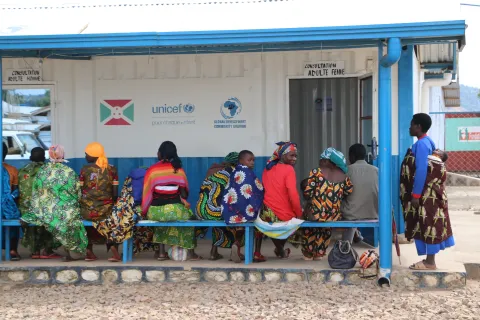
To help community health workers strengthen their skills, the Mutoyi Health Center, like other facilities involved in this project, has been provided with a television set to show short awareness videos. These videos help patients waiting for consultations receive essential health messages. “These videos help workers reinforce key messages and familiarize themselves with awareness-raising techniques to use during home visits,” explained the head nurse at the Mutoyi health center. Patients attending consultations also learn essential good family practices by watching these videos. This also helps them better understand the role and importance of CHWs.
The use of a simplified, single-register system has enabled more accurate identification and monitoring of households, contributing to improved health coverage.


All the CHWs we met said that the workload is reasonable and manageable given the tasks and households they are responsible for. “Thanks to the Single Register, we are no longer overwhelmed. We can now manage our work and provide quality care to patients. Using the single register really helps us generate more reliable official statistics,” said a community health worker during a home visit in Mutaho.
The population of Mutaho is satisfied with this initiative. Claire, a mother we met during a home visit by a community health worker, expressed her satisfaction: “Before, I could go weeks or even months without seeing a community health worker at my home. Now, they come more often, and my whole family can follow their advice.”

Thanks to this simplified and unique Register, the data is better standardized, and the information system is better populated. The collected data helps manage the stock of essential supplies more effectively and prevent or manage disease-related emergencies. "The unique register has allowed us to improve our emergency management. Since it is updated daily, when an epidemic breaks out, we are quickly informed and can react swiftly, before the situation worsens," asserts Sébastien Nsengumuremyi, the head nurse at the Mutoyi health center.
This initiative, supported by UNICEF through funding from the Pandemic Fund, has greatly strengthened the health system and ensured effective planning of life-saving activities and interventions. It helps to manage health personnel and make decisions based on accurate data.
The communities from nearby localities in the Mutaho health district hope this project will be extended nationwide, as it would greatly help implement the "One Health" approach.