In Musenyi, young Congolese refugees face hope and educational challenges.
The determination of a young Congolese refugee to continue her studies : the case of Nasra, an example of perseverance.

- English
- Français
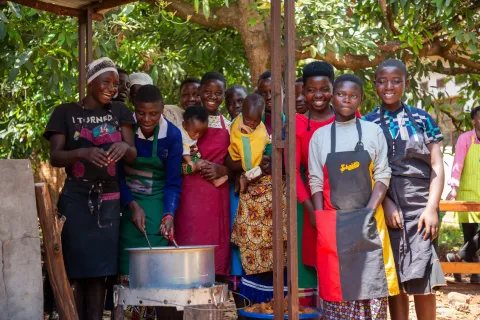
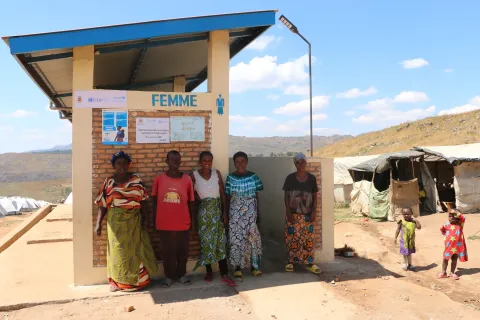
After more than an hour on a dusty road, we finally arrived at the Musenyi refugee site. A crowd of children, curious to see the visitors, rushed toward our vehicle. An agent from the NGO Jesuit Refugee Service (JRS) warmly welcomed us and, after a brief overview of the activities underway, led us to a group of over a dozen girls and boys waiting for us.
This group was made up of young Congolese refugees, aged 13 to 19, who had been invited to take part in a discussion with the UNICEF team. All of them live on this site. "These young girls and boys are at the secondary level (post-fundamental). We have gathered them here to discuss their integration into Burundian schools. The aim is to understand the difficulties they encounter and identify their specific needs together," explains a JRS worker, who introduced the meeting in the form of a focus group.
One by one, the young people shared their views and personal experiences. Most of them said that language is their greatest challenge. "This is my first time in Burundi. I only know a few words in Kirundi, but I have to speak this language to communicate with my classmates at school," says Joseph, a 17-year-old teenager.
In the Democratic Republic of Congo (DRC), some of these young people were studying technical fields that are not available in Burundi. They therefore have to make difficult choices in order to avoid dropping out of school completely.

Nasra, a 14-year-old girl, and the second of a family of three children, left her country, the DRC, with her mother, her sister, and her brother. After crossing through the former province of Cibitoke, the family settled in the Musenyi site.
"Before leaving, I was studying at a paramedical school. But upon arriving in Musenyi, I discovered that this field of study was not available here," she tells us. Nasra did not want to interrupt her studies. That is why she asked her mother to find her another school. Thanks to the help of the JRS, an implementing partner of UNICEF, her mother found a school in Giharo, 9 km from the site.
"I was delighted to find a school in Burundi. I agreed to change my field to avoid interrupting my studies. Now I am studying social sciences," explains Nasra with enthusiasm. However, the reality of daily life is far from easy. Although she didn’t have a school uniform and was used to wearing a veil, she agreed to wear a black skirt and white T-shirt to meet the dress code requirements of her new school and blend in with her classmates in Giharo. She gets up at 4:00 a.m., leaves home at 5:30 a.m., and arrives by 6:30 a.m. for mandatory morning study.
"I quickly got used to it. At first, a classmate would take me to school on his bike. That's how I started making friends," she said, remembering her early days at her new school in Giharo. Today, even without transportation, she doesn't hesitate to walk for an hour to get to school.
Thanks to remediation classes organized by the school and the support of her classmates in sharing notes, she managed to catch up and move on to the next grade. Her success demonstrates her determination and courage.

Nasra's journey inspires other young people like Dieudonné, another teenager from the Musenyi site. Before fleeing, Dieudonné was in his third year in the electricity section. He also wants to continue his studies, but in his field, electricity. "I don't like being idle. Sometimes, I help the people on the site by doing small electrical installations. Recently, I even installed the electrical circuit for a hair salon here," says Dieudonné, happy to be able to serve the Musenyi community.
In Musenyi, despite the numerous challenges – language barriers, adaptation to the school system, and lack of resources – the hope for a better future through education remains strong. The perseverance and solidarity of these young refugees are a true model of resilience.
For children at the fundamental level, UNICEF, in collaboration with JRS and using its own funds, has just supported the Ministry of National Education and Scientific Research, through the emergency unit, to organize training sessions for 149 teachers from schools under the Communal Department of Education, including 10 Congolese refugee teachers from the Musenyi site, in order to jointly prepare for the school reintegration of young children, both girls and boys, who wish to return to school following the Burundian curriculum. The aim of this training is to prepare these teachers to use effective methods for providing remedial classes, taking into account the realities and needs expressed by these refugee children.
A future to build, one step at a time.
The testimonies of Nasra, Joseph, Dieudonné, and the other young refugees we met in Musenyi show the determination of a generation of young people ready to rebuild their future, despite the obstacles. Education, even in the most difficult conditions, remains a source of hope for them. For these young people, school is not only an escape, but also a means of integration into a host country, with the strong belief that every effort counts.