A home and hope for unaccompanied Refugee Children
UNICEF cares for unaccompanied children who have fled alone from armed conflict in the Democratic Republic of Congo, placing them with host families to protect them and provide them with an environment conducive to their development.

- English
- Français
“When I was asked to look after a child on my own, I didn't hesitate for a second. I'm a mother myself, so I naturally put myself in the shoes of his parents, who must be consumed with worry. I do everything I can to make him feel at home. I bring him up as if he were my own child,” says Adèle Isenga Jeannette, a mother of three. She is now the guardian of a 9-year-old boy, an unaccompanied refugee she has welcomed into her family. This type of situation, which is becoming increasingly common, is of great concern to UNICEF. In collaboration with its implementing partner, Social Action for Development (SAD), UNICEF has established a specific programme to care for these particularly vulnerable children.
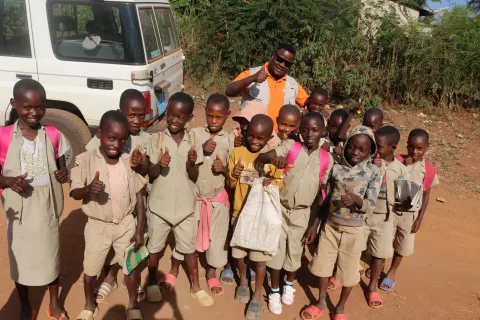
Under the tents of the Musenyi refugee site, more than 200 km from the Congolese border, the cries of children resound. Cries of childhood, of play — but also, sometimes, of suppressed pain. Here, hundreds of children have fled alone, separated from their families in the chaos of the war ravaging eastern Democratic Republic of Congo.
There are between 450 and 500 of them, according to figures from SAD on the ground. These are “unaccompanied” or “separated” children, technical words that conceal heartbreaking realities: crossing a border in a hurry, swimming across the Rusizi River, the anguish of not knowing where mum or dad is.

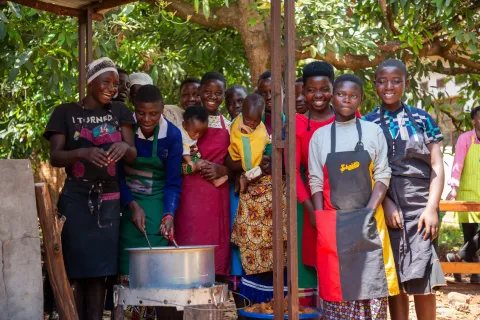
In the face of this human tragedy, a solidarity initiative was launched. At SAD's request, Congolese families, who are themselves refugees, volunteered to take in these children. It’s a structured programme: candidate families receive training on children’s rights, welfare, and protection before they can open not only their homes, but above all their hearts, to these young refugees.
Among the children is Malipo Uliba, aged 12, from Katogota in South Kivu. His eyes are deep, his voice steady. “When I was fleeing, I swam across the Rusizi. It was night time. I was with other children. When I got to Rugombo, I was spotted by SAD agents. They placed me with a family who took me in like a son. I go to school, and I eat every day. I've got what I need at the moment.”
Malipo’s story is just one of many. Each child has their version of the chaos, their own story of exile, sometimes whispered, sometimes still trapped behind a child’s silence.
On the ground, SAD's work doesn’t stop at placement. Fidèle Bindisha, the organisation’s humanitarian coordinator, insists on regular monitoring: “At the Musenyi site, we have identified several dozen host families. Our teams make weekly visits to ensure that the children are well cared for and that they have no unmet needs or safety concerns. Child protection is our priority.”
War tears people apart, but humanity gently stitches the broken threads back together. In this crisis in eastern Congo, acts of compassion are writing another story, the story of families who have little but share everything; the story of children who, despite the horror, are finding their bearings. Even in the midst of war, there is still room for dignity, tenderness, and, above all, hope.