Early childhood development at the heart of an integrated intervention in Kayanza
Thanks to a multi-sectoral intervention project supported by UNICEF Switzerland, the community of Kayanza is mobilising to improve nutrition, health, protection and hygiene for young children.

- English
- Français
Despite the dry season, Muruta Hill is at its most beautiful. Though rain is scarce, the slopes are covered with golden wheat fields and lush green tea plantations, neatly aligned along the hillsides. The vibrant contrast brings the landscape to life.
Yet behind this natural beauty, communities in Muruta and elsewhere in the Kayanza health district face significant challenges. Young children struggle with poor health, malnutrition, inadequate hygiene and sanitation, and lack of protection from violence, abuse, and exploitation, threatening their development from the earliest years.
It is in this context that the project funded by UNICEF Switzerland is taking place: “Improving child development outcomes through the implementation of an integrated package of early childhood development (ECD) interventions in the Kayanza district of Burundi”, implemented in collaboration with the NGOs Help a Child (HAC), Help Channel Burundi (HC) and Social Action for Development (SAD). The project aims to reduce infant morbidity and mortality by targeting the first 1,000 days of life through a comprehensive package of multisectoral ECD interventions. On the ground, the positive effects of this integrated approach are already visible.
Combating malnutrition from the first months of life

In the Kayanza Health District, the project has reached 11,591 children aged 6–23 months with micronutrient powder, known in Kirundi as Ingaburo ibereye. These single-dose sachets contain 1 gram of 15 essential micronutrients to be sprinkled on complementary foods prepared at home. In Muruta, this approach to home fortification, integrated with other nutrition interventions, has already improved the daily lives of families such as Caritas’s, whose daughter, now 18 months old, was able to overcome malnutrition thanks to this support.
“At one point, my daughter was hardly eating anything. She was getting weaker and visibly losing weight,” says Caritas. Thanks to screening by community health workers, her daughter was referred to a nutritional learning and rehabilitation centre, where she received care for eight months. After recovering and returning home, she received micronutrient powders from a community health worker, who also taught the family how to prepare balanced meals. “Now, with every solid or semi-solid meal, I add the powders to her food. She hasn’t had to return to the rehabilitation centre since,” she says proudly.
Gertrude Miburo, another mother in Muruta Hill, has noticed positive changes across the community. “Thanks to the training and the micronutrient powder distribution, parents now know how to prepare better meals for their children. This has reduced the number of children admitted to the nutritional centres. We used to receive more than 20 cases every month—now it’s down to eight. That’s real progress,” she says.
Edward, the head of Muruta’s community health workers, confirms the trend: “The difference is clear. Parents are better informed, better equipped, and more confident. If we keep up the momentum, we can eradicate child malnutrition in our community.”
Communities formed to better prevent and treat disease


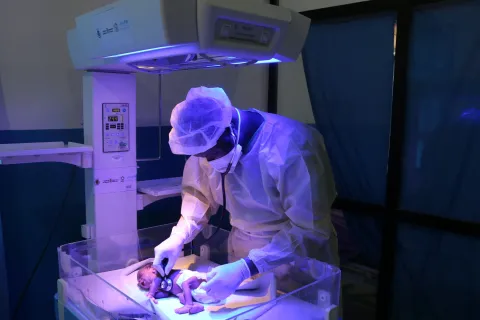
Encouraging gains in nutrition are also being supported by essential health interventions, particularly those focused on prevention and care for mothers and children.
Calinie, a mother of three and chair of a women’s group on Muruta Hill, explains how training on attentive care, HIV treatment, and Prevention of Mother-to-Child Transmission (PMTCT) has changed her mindset. “Before, I didn’t know that a woman living with HIV could give birth to a healthy child, or that early stimulation and learning were so crucial for young children. Now I know it’s possible, with proper monitoring and adherence to medication. I also know that children who receive quality care grow well and reach their full potential.”
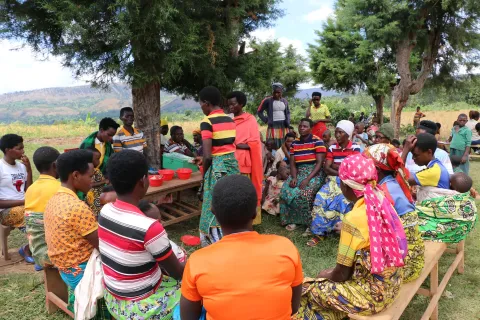
Empowered by this new knowledge, Calinie and her peers are raising awareness in the community, encouraging parents to take care of their young children and get tested for HIV. Domine, a community health worker, recalls one case: “I accompanied a pregnant woman who was HIV-positive so she could get proper care. Her baby was born healthy and safely,” she says with pride.
In total, 359 community members have strengthened their knowledge in attentive care, HIV testing, and PMTCT, and have raised awareness among 1,244 others in the process.
Communities are equipped to protect every child from violence, abuse and exploitation

Because the early years are so critical for children’s physical, emotional, and social development, the project also supports child protection. It has strengthened local capacity to prevent, detect, and respond to violence, neglect, and exploitation affecting young children.
Sébastien, deputy chief of Muruta Hill and member of the local child protection committee, shares: “The training we received on how to refer and support victims of violence now helps us act quickly in difficult family situations. We can prevent serious harm to young children.” He cites a case where a father had separated his children from their mother, including a baby who was still breastfeeding. Thanks to mediation led by trained community members, the couple reconciled for the sake of their children.
Families like those of Bienvenu and Marie Goretti are applying this knowledge to support others. “We recently helped a family whose daughter had left home because of abuse. After our awareness session on children’s rights, the parents changed their behaviour, and their daughter returned home to a safer environment,” says Marie Goretti. By acting early and involving all stakeholders, Muruta is building a more protective environment for young children.
Better infrastructure for better hygiene


Beyond health and protection, the project has also improved access to water, hygiene, and sanitation with visible changes at both the health facility and household levels.
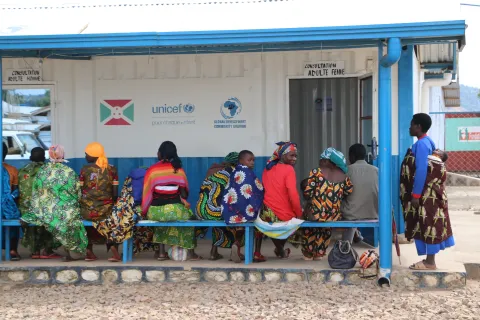
At the Karunyinya Health Centre, for example, the project renovated toilets, washbasins, septic tanks and soakaways, and installed a washing tub and a 2,500-litre rainwater tank. Vianney, a staff member, says this has eliminated dangerous practices such as transporting waste from delivery rooms through patient areas.
Twelve health centers in Kayanza have benefited from similar work, improving WASH services for over 2,180 people, primarily in pediatric and maternity units.
The change is also visible in homes. Of the 34,726 households that received awareness sessions, 16,389 have built latrines with handwashing facilities, and now regularly wash their hands not only after using the toilet, but also at other critical times.
Aussi and Sarah are among them. They’re finalising construction of their family’s latrine. “Before, I didn’t know we had to add a lid, a door, and a handwashing point,” says Aussi. He now understands how this helps stop the spread of disease through flies or animals like rats, ensuring a cleaner home environment.
Muruta’s experience proves that empowered communities can lead sustainable change. By focusing on early childhood development and addressing health, nutrition, protection, and hygiene in an integrated way, they are improving the lives of thousands of young children and reshaping local priorities for the better.