Busuma: Safe sanitation facilities restore dignity and protection
With funding from the Central Emergency Response Fund, UNICEF and its partners AIDE and COPED are improving access to safer and more inclusive sanitation and hygiene services at the Busuma refugee site.

- English
- Français
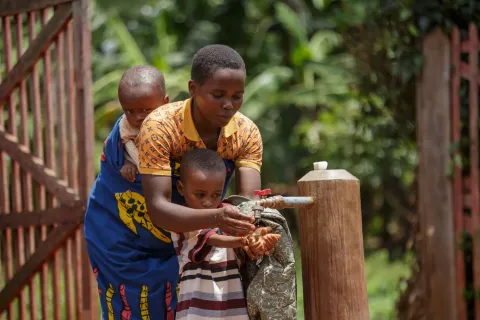
For families forced to flee their homes, humanitarian assistance is not limited to food and shelter. Access to safe water, sanitation and hygiene services is equally essential to health, protection and dignity.
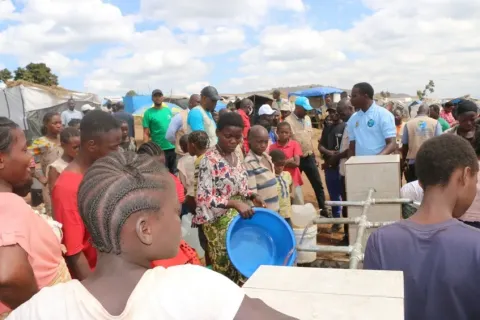
At the Busuma refugee site in Ruyigi Province, the arrival of large numbers of refugees from the Democratic Republic of the Congo has placed considerable pressure on the available infrastructure and surrounding natural resources. Significant gaps remain, particularly in access to sufficient numbers of latrines and bathing facilities.
During the initial phase of the emergency, residents relied on temporary latrines made of wooden planks and plastic sheeting. Although these facilities provided an immediate solution, they offered limited durability, accessibility and protection, particularly for children, women and girls, and people with disabilities.
A neighborhood leader at the site welcomed the construction of the new sanitation facilities.
“With the limited number of latrines, some people had no option but to practice open defecation in the surrounding area. This increased the risk of disease because the environment around us was becoming unsanitary,” he explains.


Insufficient access to sanitation facilities can increase the risk of diarrhoeal diseases, including cholera, particularly when faecal matter contaminates water sources. During the rainy season, heavy rainfall and runoff can worsen erosion and deepen gullies within the site, increasing the risk that contaminated material will reach water sources used for drinking and cooking.
Safe sanitation is also a protection issue. Facilities that are distant, poorly lit or not separated by sex can make women and girls feel unsafe and expose them to heightened protection risks, particularly at night.
“We were afraid to go out at night because the toilets were too far away and there was no lighting,” says a girl living at the site.
To improve safety, sanitation blocks separated for women and men have been built in different neighborhoods of Busuma. The facilities are equipped with lighting so that residents can use them more safely at night.
To support the proper use and maintenance of the new infrastructure, hygiene committees have also been established in different neighborhoods. Each committee brings together neighborhood leaders and women and men from the community. Members help organize cleaning, distribute maintenance supplies, and promote good hygiene practices.


Residents interviewed at the site say the new facilities have improved their daily lives and allowed them to meet their sanitation needs more safely and with dignity.
“Before, I had to queue every morning. Waiting in a large crowd for other people to finish using the communal toilets was very difficult. Sometimes, people would even argue over a bucket of water,” says a member of one of the hygiene committees.
Accessibility has also been integrated into the design of the facilities. Each sanitation block includes an accessible latrine cubicle or cubicles for people with disabilities. These are equipped with an access ramp, grab bars and a raised toilet seat, enabling people with limited mobility to use the facilities more independently.
“Before, I struggled to squat when using the toilet. Now, I can use it without anyone’s help,” says Rachid, a resident of the Busuma site who has limited mobility.
With funding from the Central Emergency Response Fund (CERF), UNICEF, working with its implementing partners AIDE and COPED, supported the construction of 23 sanitation blocks in Zones A, B and C. Each block comprises four latrine cubicles and two bathing cubicles. Thirty temporary latrine blocks were also installed during the initial phase of the emergency response.
In addition, 3,000 households received hygiene supplies, including buckets, jerrycans, soap, brooms and other essential items.
The new infrastructure has improved access to sanitation and hygiene services for many residents, but significant gaps remain. Additional funding is urgently needed to build more sanitation blocks and move closer to humanitarian standards for the number, accessibility, separation and safe location of facilities.
For families living in Busuma, these investments are essential not only to reducing public health risks, but also to ensuring that women, men and children, including people with disabilities, can meet their basic sanitation needs safely and with dignity.