Active community-based case finding: A key lever in the fight against Mpox
In the Gitega and Isare health districts, community health workers with support from UNICEF, the Ministry of Public Health & AIDS Control, and funding from the Pandemic Fund have made notable progress in the fight against Mpox through active case finding

- English
- Français
In July, Rubamvyi Hill, located about 30 km from the provincial capital of Gitega, is calm and beautiful. It’s the dry season: rain is rare, but there is still a slight chill in the air. We follow red dirt roads hardened by the sun. A narrow path, lined with banana trees and terraced fields, leads us to a modest home perched on the Kabango hillside. This is where Gérard and Alice live with their family. Their 14-year-old son, Ismaël, was recently treated for Mpox and fully recovered. Their welcome is warm and simple. In their eyes, we can still see the relief of having come through the ordeal.
With emotion, Gérard recalls the moment when their son began developing lesions on his face: “We thought it was an allergy, so he continued going to school. But since we had been informed about the symptoms of Mpox by community health workers, we decided to take him to the Rubamvyi Health Centre anyway. He was then referred to the Gitega treatment centre, where he tested positive for Mpox and received treatment,” he explains. For Alice, Ismaël’s mother, the hardest part was not the diagnosis itself, but the fear stirred by rumours circulating about the disease. “Some said it was incurable, others spoke of total isolation or even rejection by the community.” Despite everything, their instinct to protect their child prevailed, and they courageously headed to the Gitega centre with hope.
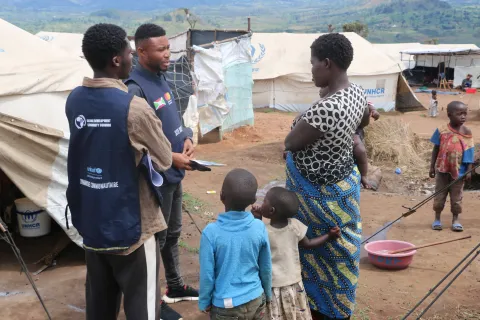
Following the detection of Ismaël’s case, Bénigne Francine, a community health worker in the Kabango sub-hill, intensified her awareness sessions and follow-up visits to those in contact with the case. “With the help of hygiene specialists, we disinfected the home and distributed hygiene kits. We then monitored the surrounding area for 21 days to ensure there were no new cases,” she explains.


After meeting Gérard and Alice’s family, we continued to the Rwoga sub-hill, where we spoke with Gertrude. Now in her sixties, Gertrude may not have recognized the symptoms of Mpox without the awareness sessions conducted by Sabine, the community health worker in her area. “When I saw the symptoms appear, I immediately remembered what Sabine had told us. I spoke to her about it, and she advised me to go to the health centre quickly,” Gertrude recalls.
She was swiftly referred to Gitega Hospital, where she received appropriate care. Today, she is a firm believer in the importance of local information and awareness.
Faced with a surge in Mpox cases and the risk of widespread transmission, UNICEF, in collaboration with the Ministry of Public Health and AIDS Control—through COUSP—launched a targeted active case-finding strategy in the health districts of Gitega and Isare. These two districts were prioritized due to the high number of confirmed cases. The goal of the initiative, which ran from 19 March to 19 April 2025, was to strengthen early detection, interrupt transmission chains, refer patients to care facilities, and raise public awareness about the symptoms, transmission, and prevention of the disease. This community-based approach was rigorously implemented by community health workers, under the supervision of district focal points.
Blaise, the community health focal point at the Rubamvyi Health Centre, shared the results observed in his area: “Among the eight sub-hills I supervised, I can say that active case finding played a decisive role in reducing Mpox cases. Sharing clear information within communities allowed for the quick identification and referral of suspected cases, which helped prevent the disease from spreading further,” he said.
In the Gitega health district, the active case-finding initiative covered 16 hills across eight health areas: Ceru, Mubuga, Mukanda, Muremera, Mushasha, Rutoki, Songa, and Rubamvyi. During this period, over 52,000 people were educated about Mpox, eight positive cases were identified, 11 households were disinfected, and 184 contacts were monitored.
“Active case finding has delivered remarkable results,” said Dr. Jean Damascène Bayubahe, Chief Medical Officer of Gitega District. According to him, the initiative helped break the silence and dispel fear surrounding Mpox. “Before active case finding, many people were reluctant to report their symptoms due to persistent rumours—some even believed it was a sexually transmitted infection, which contributed to stigma,” he added.
His counterpart in Isare District, Dr. Jimmy, shared a similar perspective: “Without this active search strategy, many cases would have gone unnoticed. Some patients were hiding, and they would have continued to spread the disease in the community,” he said. In his view, the approach was essential to controlling the local epidemiological situation. In this district, the intervention focused on three priority areas in Mutimbuzi commune: Gatumba, Rubirizi, and Rukaramu. A total of 36 cases were detected in Gatumba, 18 in Rubirizi, and 4 in Rukaramu.
In both Gitega and Isare, the testimonies collected confirm that combining active case finding with local awareness efforts has been critical in reducing new Mpox cases. This strategy has been widely welcomed by frontline health workers, who believe it could serve as a model for addressing other epidemic-prone diseases.