Using the Nexus Approach to educate and empower communities
The UNFPA-UNICEF Joint Programme on Eliminating Female Genital Mutilation is working to enhance the implementation of the Humanitarian Development Nexus Approach within the context of Female Genital Mutilation.

Over the last year, the Joint Programme has worked with select country offices to strengthen their technical capacity to implement the Nexus Approach effectively. Through this work, the Joint Programme has gained some insights into the tangible impact of the Nexus Approach. Alongside the innovative and practical ways country offices have been implementing the Nexus Approach, the real-life experience set out below captures the human dimension of the Approach.
In Burkina Faso, the Joint Programme expanded its partnerships with humanitarian NGOs, grass-roots organisations, community facilitators and health workers to reach out to families and community leaders in the crisis-affected regions and settlements of internally displaced persons (IDP). This process of localisation of services improves access to vulnerable children and families in crisis-affected regions, by using existing local structures, co-creating solutions to meet social unmet needs, and enhancing community leadership, social accountability, and inclusiveness. The Joint Programme used these community-based platforms that enabled the adaptation of the FGM/child marriage interventions in the humanitarian context and ensured the continuity of service delivery and community engagement.
As more country offices begin their journey towards implementing the Nexus Approach, they can draw inspiration from real-life experiences that have transformative effects on individuals and communities. This story of the 10-year-old Mouniratou, living in an IDP settlement, provides a powerful example of the practical implications and significance of the Nexus Approach.
HUMAN INTEREST STORY
May 2024
“When I think about it, it still hurts.”
In Burkina Faso, several women and girls are still at risk of female genital mutilation (FGM). Thanks to the actions of UNICEF, UNFPA and its partners, the population is becoming more aware of the dangers of this practice and many survivors and girls at risk of FGM are identified and taken care of in both a development and humanitarian context.

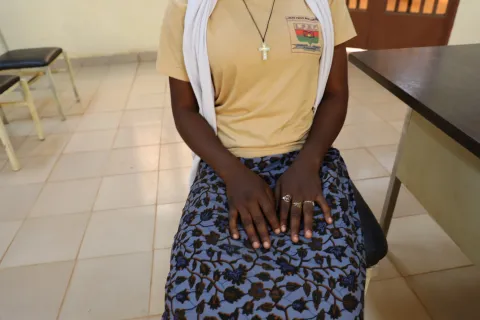
Mouniratou is 10 years old. She lives in Kaya, in North Central Burkina Faso, with her parents and siblings as internally displaced people (IDP). When she was younger, she survived genital mutilation.
Sadia, her mother explained, “When Mouniratou was 11 months old, I got pregnant again. It was difficult for me to take care of my pregnancy and my baby daughter. That's why one of my sisters-in-law offered to take care of her. Mouniratou stayed with her for 3 years. After my daughter came back, I saw that something was wrong while I was washing her.” For a moment Sadia went silent, and then continued to tell with a worried and anxious voice that her eldest daughter had undergone the same practice when she went on vacation to her aunt. However, this time it was more serious. Mouniratou was really hurt. She suffers when it is too hot or too cold. And the little girl’s pain is not only physical. She often has flashbacks. “I often see images of that moment in my head. When I think about it, it still hurts. I tried to entrust it to my friends. They made fun of me saying I was deformed,” explains Mouniratou.

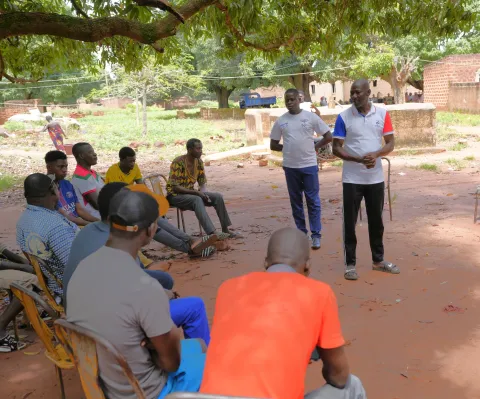
A year ago, community workers of the Association for Community Development and the Promotion of Human Rights of the Child (ADC/PDE), which is a local partner of UNICEF and UNFPA, were on an awareness-raising campaign in the IDP camp where Sadia’s family lives. They used images to explain the dangers of FGM. “Our image boxes show the after-effects of mutilations. The images may be shocking. We use these to awaken the target population and make them conscious. Our audience consists mainly of women. During discussions, we work to build their confidence. Afterwards, they manage to confide in us” says Babribilé Tendano, community animator for ADC/PDE.
The campaign caused Sadia to reflect. She had already suspected it, but now realised the severity of the harm that was done to her daughters. Initially, she was scared to ask for help, but after a month of scrutinising, she mustered the courage and confidence to ask for help. She approached the ADC/PDE facilitator, who explained the options available to her and assisted in facilitating a consultation with a doctor and access to psychosocial support services.

Through the collaborative efforts of UNICEF, UNFPA, ADC/PDE, and others Mouniratou and her family were supported, and she was given a bicycle so that she could get to school easily. She is now at the top of her class. When she is older, Mouniratou would like to become a nurse so she can fight effectively against FGM. As for her mother, since she understood the dangers surrounding practicing excision, she has become a fervent spokesperson in the fight against FGM.

Just like Babribilé Tendano, 135 community support technicians and 1048 community leaders assume the role of mentors who work on a daily basis to prevent, identify, refer and care for FGM survivors, particularly in high-risk areas. In 2023 there were 493 villages and 100 IDP reception sites that publicly declared the abandonment of the practice of excision, child marriage and violence against children, thanks to the support of the FGM Joint Programme and the partnership between UNICEF, UNFPA, NGOs and associations.
This story captures the value of the Nexus Approach and the importance of working with affected communities and enhancing community knowledge and awareness around FGM. It encompasses the importance of persistent efforts, in all spaces, including IDP camps to ensure that communities are aware of the harms and risks of FGM. It further illustrates the power of knowledge that can lead to positive outcomes for others.