New Classrooms to Rebuild Honorine’s Dream
Thanks to the Japanese Committee for UNICEF, a new three classroom building constructed by UNICEF is helping normalize Weguian Primary School

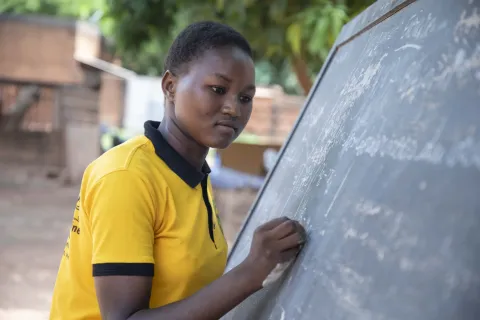
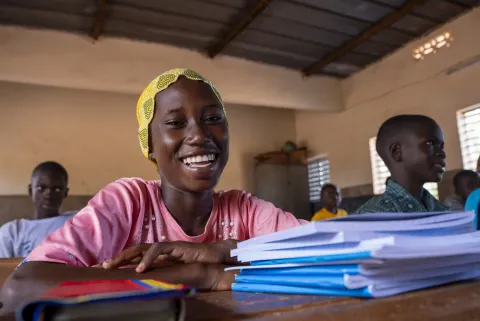
Honorine, 11 years old, is a CE1 pupil at the Boussouma public primary school. She now sits in a spacious, airy classroom where she can follow lessons in peace. A few months ago, this routine was very different.
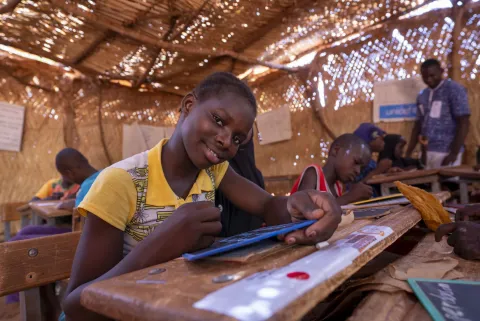
Three years ago, when Honorine began her first school year at the public primary school of Weguian in Boussouma, in the Koulsé region, there was only one building with three classrooms. Because of the insufficient number of classrooms, the school operated under a biennial enrollment system.
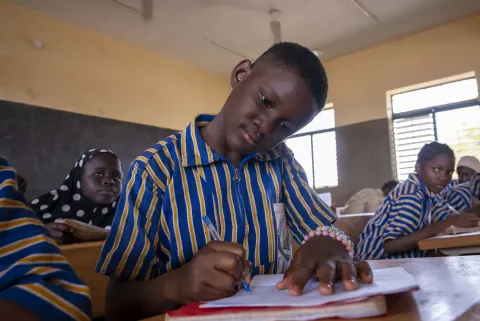
"There were so many of us in class that three, sometimes even four, had to share a single desk. The heat made it difficult to follow the lessons. Today, I can write without being cramped and listen to the teacher without being disturbed," Honorine confides enthusiastically.

Created in 2000 under a straw‑hut shelter with an initial enrollment of 60 pupils, the Weguian public primary school evolved after three years into a three‑classroom building thanks to the Boussouma municipal council. The security crisis, which disrupted access to education for many children due to population displacements, led the school in 2023 to erect three additional straw‑hut shelters beside the main building to host internally displaced pupils.
"Under the straw huts, interruptions were frequent. The wind lifted dust, the intense heat made children less attentive, and the rains sometimes brought classes to an end. Now, we can teach in a stable environment, which improves concentration and student performance," explains Boureima Sawadogo, the school’s headmaster.

Today, Honorine feels immense joy at finding herself in a dignified setting where she can learn with peace of mind, thanks to the construction of a brand‑new three‑classroom building by UNICEF with financial support from the Japanese Committee for UNICEF. Built to replace the former straw‑hut school and to ease overcrowded classrooms, this new infrastructure finally offers pupils a safe, comfortable learning environment conducive to their success.

For the teachers, the change has been remarkable. "Interruptions caused by bad weather are now a thing of the past. All the conditions are in place for better continuity of learning. The pupils are more attentive, more motivated, and attend school with greater regularity," testifies Marguérite Zalé, a senior teacher at the school.

At the end of 2025, with financial support from the Japanese Committee for UNICEF, UNICEF undertook the construction of an integrated building with three classrooms and a director’s office, along with two blocks of gender‑segregated latrines for girls and boys, and one block of latrines for teachers. The aim was to ensure continuity of education and provide children with a protective learning environment.

Today, the Weguian public primary school has been standardized. It now has a total enrollment of 398 pupils — 216 girls and 182 boys. Among them are 115 internally displaced students, all of whom now benefit from improved learning conditions.

Honorine’s story is that of thousands of children whose resilience commands admiration. Thanks to this new school, they no longer simply attend classes — they regain the dignity of learning in conditions that respect their fundamental right to quality education. For Honorine, the new building is much more than a school; it is a mold for shaping the future. “I want to work hard to become a teacher. That way, I too can help children learn,” she says with a shy smile.