Solar Power Facilitates Access to Water for Displaced Women and Children in The Sahel
In Dori, eight solar-powered simplified drinking water supply systems installed by UNICEF has reduced the hassle of finding water.

- Français
- English
23-year old Dapoa Namountougou, lives in Petit Paris, on the outskirts of the Sahel regional capital of Dori with her four children. Armed violence that erupted in her village of Kargounol, pushed her into displacement with her family. Now, she lives on an internally displaced persons’s site with other people in the same situation. Living on this site is not very easy as finding water is a nightmare.
“For the three years that I’ve spent here, we go almost three kilometers away on a cart to fetch water and we could spend the whole day there just to have enough water to prepare and drink. It was very tough for us,” says Dapoa.

In Burkina Faso, more than 2 million people are displaced, more than 58 percent of whom are children. In recent years, the commune of Dori has welcomed more than 177,000 displaced people. ONEA, the state water company which supplies the city of Dori, does no longer have the capacity to cover the needs of the populations due partly to persistent security issues and climate change.
“Well before this crisis, we felt a drop in water tables at water points and boreholes. Water from the boreholes is drying up. We felt the effect of climate change well before the crisis,” says Paul Kabore, Regional Director of Water in Dori.

Like Dapoa, Djeneba Dicko must go fetch water. Displaced from Sebba, the 15-year-old adolescent girl helps her elderly mother who suffering from back pain. She had to walk miles to give her family some water, until UNICEF provided a solution.
“We would go to other water points and spend hours, even days, just to get some to prepare and drink. But two months ago, UNICEF offered us a water point here in Petit Paris. Today, we have water to prepare, drink and do laundry, wash dishes and much more,” explains Djeneba.

In Dori, thanks to funding from the French Development Agency (AFD), UNICEF was able to build eight solar simplified drinking water supply systems (AEPS) with 32 standpipes, reducing the burden of fetching water for host and displaced households. The solar-powered water supply systems that were meant to cover the needs of some 24,000 people, now serve more than 40,000 host and displaced people.

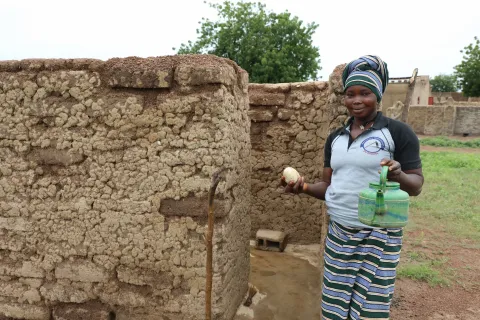
To relieve Dori populations deeply affected by climate change and a severe lack of water, UNICEF built 10 high-volume boreholes and 12 human-powered pumps. In total, 900 latrines were also built to reduce the risk of open defecation to make the environment of displaced people and host populations healthier.

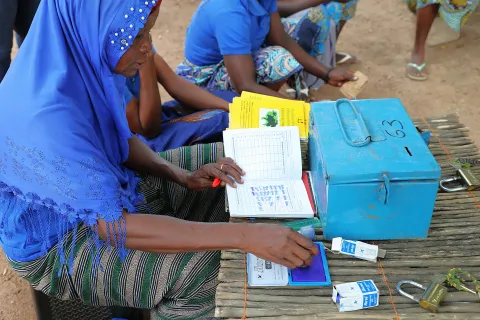
Displaced women organized themselves to maintain water supply facilities and make them more sustainable. On the Petit Paris site, it is Nafissa Sanou who got displaced from Sebba due to insecurity, who is the manager of AEPS.
“Initially, the water point did not exist. Its realization a few months ago was a great relief to us. The water point is right next to my home, so I take care of cleaning the terrace and I remind people who come to fetch water that they must follow the hygiene rules at the water point,” says Nafissa.