The safe school Initiative in Wendou
School in danger

- Français
- English
“One morning I was at school and armed men arrived on motorcycles. They said that if they found the teacher at school, they would kill him. They burned houses, schools and even notebooks. They killed a lot of people. Since these attacks I can no longer sleep at night.”
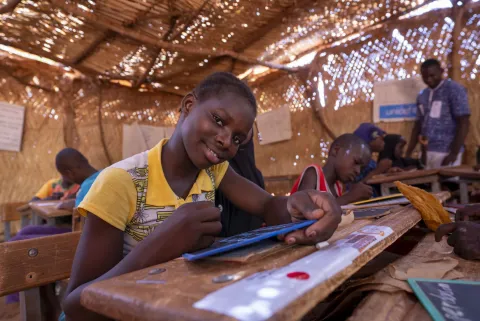
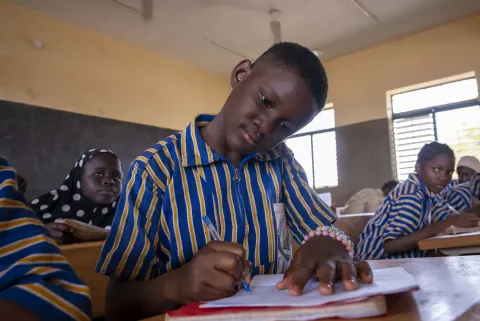
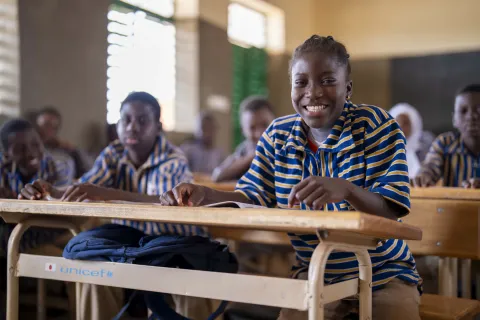
Three years after leaving his village in the Arbinda department in the Sahel, Ibrahim remains traumatized by that day. He is one of 60 per cent of children among the 1.2 million internally displaced persons in Burkina Faso. At 13 years old, this frail little boy with the face of an angel is in fifth grade at a school in Wendou. With his classmates, they are doing math exercises this morning. Their faces are smiling, the atmosphere is quite relaxed.
Suddenly Hamidou, his teacher, blows his whistle.The students turn off the lights, close the windows and doors, then take shelter under tables. All this in a fraction of a second. For five minutes the class is plunged into a deafening silence. A second whistle blow signals that the situation is under control and that classes can resume. This real demonstration of group cohesion is in fact an exercise in emergency sheltering in the event of a school attack.
Since 2015 and the rise of insecurity in Burkina Faso, schools have become privileged targets of non-state armed groups. The figures are alarming: more than 2,000 schools are closed, depriving more than 300,000 students of education according to the Ministry of National Education.
This simulation is therefore carried out twice a week. “At the beginning it was quite difficult for the pupils, but now they understand the aim of this exercise”, explains Hamidou Maïga, CM2 teacher at the Wendou school.
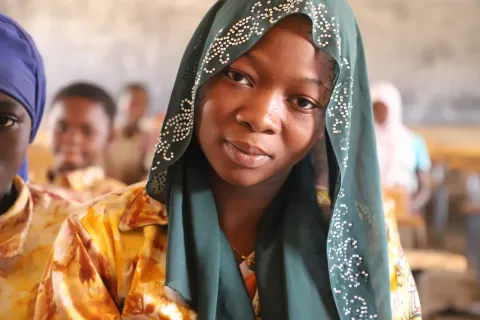
One of the students, Aminata, aged 15, who also left her village with her family to take refuge in Dori explained, “This exercise is to protect us from danger. Everyone in the class understands it”.
The attacks on schools have created a sense of fear that has resulted in many children being withdrawn from their schools, as well as long-lasting psychosocial repercussions on the students. Teachers at the Wendou school have been trained to deal with cases of students with mild post-traumatic stress disorder.
But for severe cases, teachers report them to advocates and partners like UNICEF for further support. “We see children coming in with severe trauma. They have nightmares and are unable to sleep for months. Some still have sequelae and jump when they hear the sound of a motorcycle. These children are followed by specialists who do a remarkable job saving many”, explains Hamidou Maïga, CM2 teacher at the Wendou school.
UNICEF express its sincere appreciation to the King Salman Humanitarian Aid and Relief Centre for their generous financial contribution in support of children in Burkina Faso.
Thanks to this fund, the Safe Schools project has addressed the education and protection needs of 11,600 children (6,000 girls) affected by armed conflict in the Centre-Nord region. The project also guaranteed access to education for 10,000 children (5,200 girls) aged 3 to 17 years old living in conflict-affected communities and strengthened protective environment for 2,000 children (1,000 girls) in conflict-affected communities.