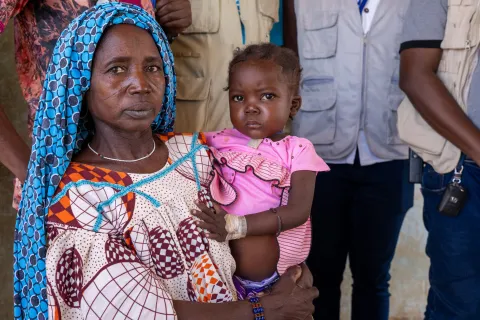
Making Quality Nutrition Interventions Accessible for Children in Conflict-Affected Areas
who is suffering from severe acute malnutrition (SAM)
- Français
- English
Situated in the Sector 6 health district of Kaya[1], the UNICEF-supported “IDPs’ Hospital,” named due to the large number of internally displaced persons (IDPs) who come to seek care, is under pressure to treat the ever-increasing number of severely malnourished children who continue to arrive in the city of Kaya. During her fourth visit to the IDPs’ Hospital, Aminata, a young Burkinabe mother of three, breastfeeds her 9-month-old daughter, Zenabo, as she anxiously awaits her turn to speak to someone about her daughter’s nutritional status.
Aminata is originally from Foube, a municipality located 60 km from Kaya. Foube has been subjected to repeated attacks by non-state armed groups (NSAGs) and two months ago, during a particularly vicious attack, Aminata and her entire family were forced to run for their lives. Unfortunately, when fleeing, Aminata was separated from her husband, and she has had no word from him since. Aminata and her three children were able to make it to Kaya, where they are taking refuge with her cousin.
Aminata’s story is commonplace throughout the country. In 2021, Burkina Faso became the epicenter of violence in the Central Sahel, a position formerly held by Mali. Non-state armed groups are pushing further into the country, attacking whole villages, schools and health facilities. Entire families have had to flee for their homes, leaving behind their livelihoods and food sources. In 2021, the percentage of internally displaced persons (IDPs) increased by 47 percent, from 1.07 million in January to 1.6 million by December, solidifying the crisis in Burkina Faso as one of the fastest-growing displacement crises in the world. As of May 2022, NSAGs now control at least a third of the country, and the number of IDPs stands at 1.8 million, with children under the age of 18 accounting for nearly 61 percent. Displaced families are finding it harder to meet their basic needs, particularly in terms of nutrition, and children are bearing the brunt of the crisis.
Today is Aminata’s fourth visit to the IDPs’ hospital for her daughter, Zenabo, who is suffering from severe acute malnutrition (SAM). According to Aminata, “Zenabo’s health has improved a lot today. Four weeks ago she was in a deplorable condition. Thanks to the medical care she received, she is better and I thank God. We are still continuing the treatment.”
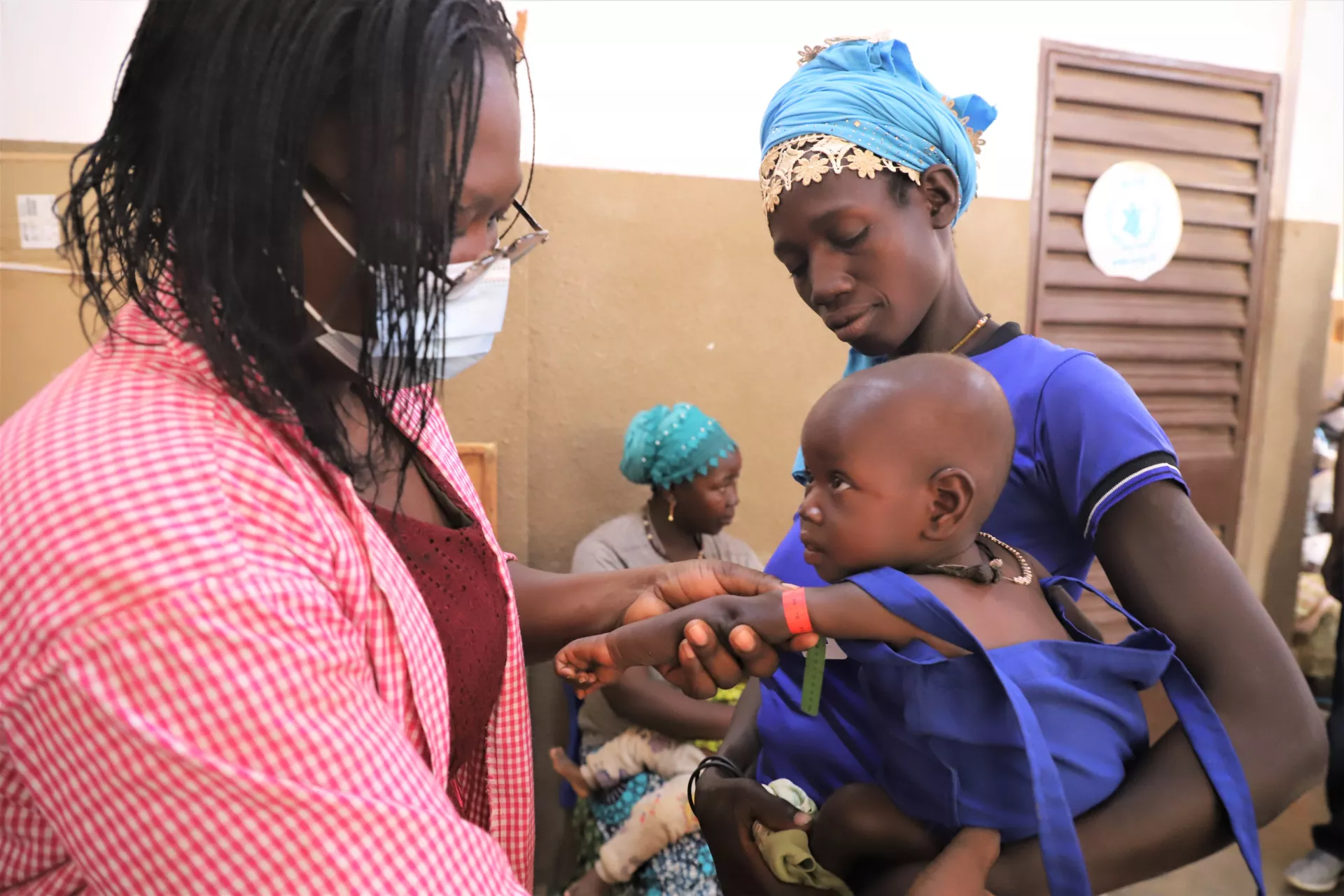
Mrs. Sandrine Kaboré is the midwife who has been assisting Zenabo in her recovery. Sandrine is one of many health staff who have been reassigned to the IDPs’ Hospital to help the health facility manage the massive influx of IDPs over the past year. During Zenabo’s consultation, Sandrine begins as usual, by measuring the child’s height, weight and checking for oedema, or the presence of swollen face, feet or limbs resulting from SAM. Sandrine then uses a mid-upper arm circumference (MUAC) measuring tape to take arm measurements. Unfortunately, something is wrong. Zenabou is measuring in the red, when she should be in the green. “It’s not normal. It should be green since she is being treated with plumpy nut and seems to like it,” explains Sandrine. Plumpy nut, or ready-to-use therapeutic food (RUTF), is a nutrient-rich food that is used to treat severely acutely malnourished children.
At first Sandrine thinks that Zenabo must have diarrhea which is impeding her ability to maintain a proper nutrition level. Unfortunately, due to severe water scarcity in Burkina Faso, water-borne diseases such as diarrhea and cholera have a high incidence rate throughout the country. The most vulnerable families are forced to prioritize survival through drinking water over using water to implement proper hygiene practices. Handwashing, bathing and using water to clean surfaces has become a luxury for far too many families. Children are more susceptible to coming into contact with diarrheal-causing pathogens when subjected to unhygienic environments. Whereas an adult can more easily overcome diarrhea, children quickly experience profound dehydration and are unable to maintain adequate levels of nutrients in the body. Today, diarrhea remains a top killer of children under the age of five.
Despite Sandrine’s suspicions, during the consultation Aminata explains that she has been using the RUTF for all of her children. She simply does not have enough money to ensure that all three of her children have enough to eat. Zenabou’s single ration therefore has become a family ration and her nutrition situation has worsened, going from moderate to severe.
Sandrine severely reprimands Aminata, as Zenabou will die if she does not adequately follow the RUTF treatment course. She then instructs Aminata to combine enriched porridge with roasted peanuts, baobab fruit powder, sugar and salt. “You should also pay attention to hygiene, especially on the equipment you use to prepare the food for the baby. The same goes also for the hygiene of your environment,” she says. “I must see an improvement in your baby at the next visit,” adds the nurse. As long as Aminata takes heed to Sandrine’s advice, she should see Zenabou’s status improve.
The continuous influx of IDPs, mainly women and children, from the localities of Foubé and Barsalogho in the Centre-Nord region, puts great pressure on this health facility in Kaya. In February 2022 alone, 62 cases of malnourished children, including 23 severe cases were recorded during screening. "We distribute four to five cartons of Ready-to-Use-Therapeutic Food (RUTF) per day, whereas in the recent past we were at two or three cartons," declares Marceline Sawadogo, a UNICEF-supported community-based health worker who is based at the health center.
It is not only in Kaya, but across the country, that the cases of SAM are increasing. By December 2022, nearly 700,000 children throughout Burkina Faso are projected to suffer from SAM, a 19 percent increase from 2021. In response to the increase in malnutrition rates, UNICEF has scaled up treatment activities across the country, including in some of the hardest to reach areas and those burdened by conflict. UNICEF and partners are training health workers on the integrated management of acute malnutrition, which is the use of simplified methods for monitoring undernutrition in homes and clinics, ensuring that children suffering from wasting can be identified and treated early. UNICEF-supported staff are supervising and monitoring activities at the district, health center and community levels, as well as collecting data on malnutrition incidence through a weekly monitoring system.
UNICEF is also supporting the implementation of the Infant and Young Child Feeding (IYCF) approach, which focuses on optimal feeding practices for children under the age of two. In particular, UNICEF is using the IYCF approach to encourage exclusive breastfeeding in IDP sites. Baby-friendly spaces have been set up for lactating women who are exposed to stress and may forget to breastfeed their children. In addition, UNICEF has established support groups within which mothers can learn about the importance of IYCF, including exclusive breastfeeding, even when experiencing displacement, throughout IDP sites in Tougouri, Barsalogho, Kongoussi, and Kaya.
However, as the conflict escalates, UNICEF must continue to scale up interventions. “We need urgent support to cover the nutritional needs of children who are always in hard-to-reach areas such as Foubé, Kelbo, Ankuna," insists Rodrigue Tiombiano, Nutrition Officer at UNICEF's field office in the Centre-Nord region. In 2022, UNICEF requires $32 million to scale up lifesaving nutrition interventions for children throughout Burkina Faso.